

Why AMOLED Is Becoming the Standard for Smartwatches in 2026?
As we move through 2026, AMOLED technology is quickly changing the smartwatch world. The move towards AMOLED GPS smartwatch models shows that customers want them, and technology is getting better. When it comes to visual clarity, vivid colour reproduction, and energy economy, these displays are hard for standard LCD screens to beat. As more brands combine AMOLED screens with advanced GPS tracking and health monitoring sensors, the end users get more value, and Amazon sellers, resellers, and private label brands looking for high-margin goods can make a lot of money. Knowing why this technology is so popular on the market helps procurement professionals make smart decisions about where to buy things that are in line with customer needs and current trends.
Understanding AMOLED Technology and Its Advantages in Smartwatches
What Makes AMOLED Different from Traditional Displays?
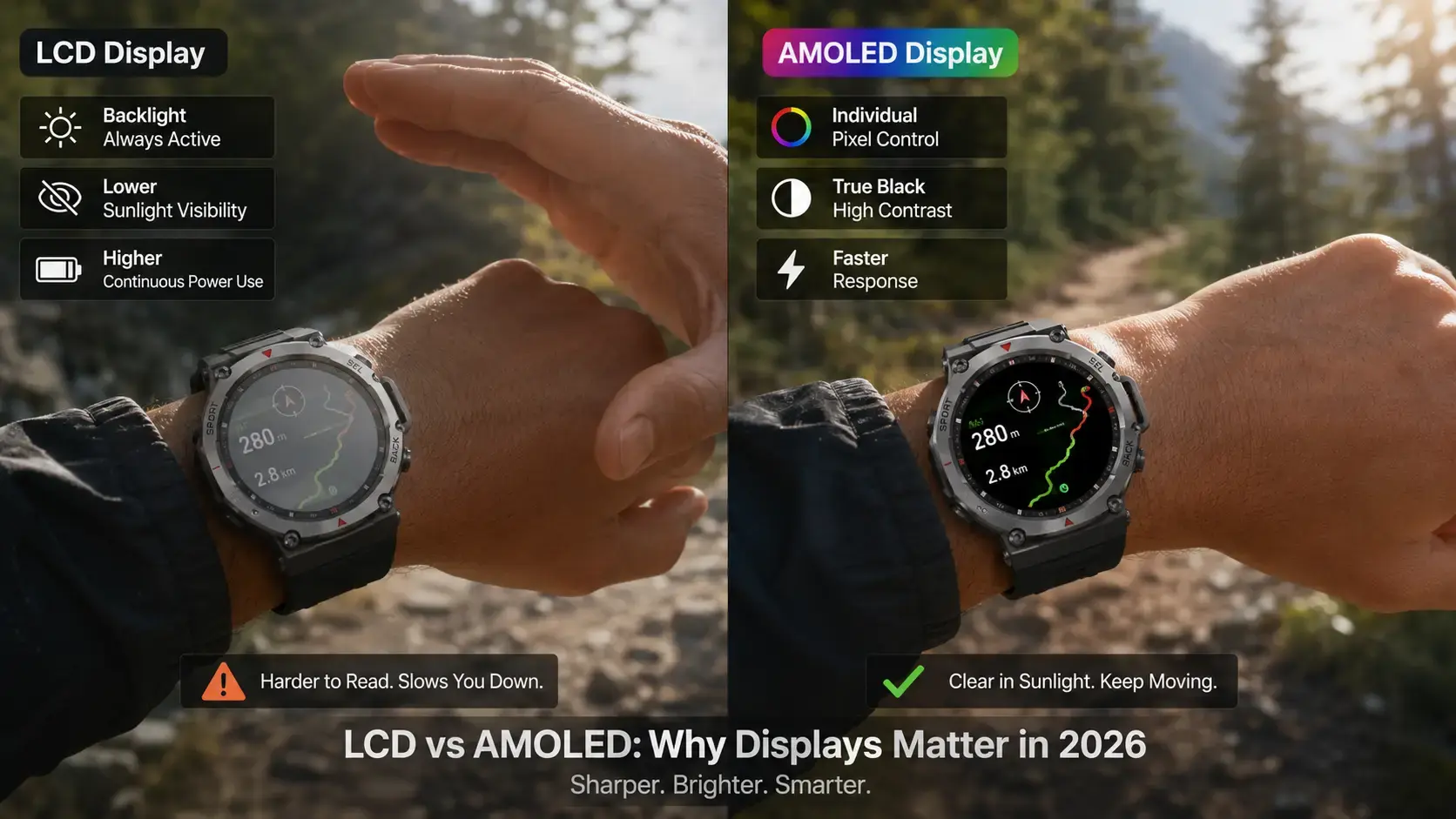
Active Matrix Organic Light-Emitting Diode is what 'AMOLED' stands for. Each pixel in an AMOLED monitor makes its own light, unlike LCD screens that need power. Because of this basic difference, blacks are deeper, contrast ratios are higher, and colours are shown more accurately. For that part of the screen, when a pixel shows black, it just turns off, using no power. This trait is especially useful in smartwatch applications where saving battery life is very important.
Health sensors and GPS functions work together without any problems with this technology. Modern AMOLED GPS smartwatches use this type of display technology to show location data, heart rate metrics, and exercise numbers very clearly in real time. The high contrast makes it easy to see when you're outside, whether you're running at dawn or riding your bike in the middle of the day.
Core Benefits That Matter for B2B Procurement
From a buying point of view, AMOLED screens have a number of benefits that directly lead to happy customers and fewer returns. The screens can be read in a variety of lighting conditions, which was a common problem with earlier generations of smartwatches. Battery life gets a lot better—devices with AMOLED screens can usually go 5–10 days without being charged, which makes customers happier and reduces the number of bad reviews.
Another very important factor is durability. These days, AMOLED screens can handle daily use and still work well. With IP67 water resistance and steel construction, these devices meet the needs of active users who want them to work reliably during workouts, outdoor activities, and daily tasks.
The beautiful 1.96-inch screen size gives you plenty of room for notifications, fitness data, and navigation controls without making the watch less comfortable to wear. Resolutions like 320x240 make text and graphics clear, which makes it easier to interact with the screen. These technical details have a direct effect on how customers think about quality, so they are important things to think about when choosing a product.
How AMOLED Enhances Health Tracking and User Experience?
The accuracy of health tracking rests in part on the quality of the display. When users can see their heart rate, step count, and sleep patterns clearly on a bright AMOLED screen, they use these tools more often. When you combine high-performance sensors with great visual feedback, you get a seamless experience that makes you want to use it more often.
It's easier to use Bluetooth talking and music-playing features when paired with AMOLED screens. Even when they are working out hard, users can easily find their way around the music settings or accept calls with clear visual proof. With this level of integration, AMOLED GPS smartwatches go from being passive trackers to active companions that free people from always checking their phones. When you combine dual-band GPS technology with AMOLED screens, you can accurately track your route even in tough places like crowded cities or trails through forests. This makes it appealing to athletes and outdoor enthusiasts who want accuracy.
Market Trends Driving AMOLED Adoption in Smartwatches by 2026
Limitations of Legacy LCD Technology
In today's market, traditional LCD trackers are having a harder time keeping up. The backlight on these screens always stays on, so they use more power even when there is nothing on the screen. As a result, the battery life drops, and users are often annoyed that they have to charge their phones every day. Another ongoing problem is outdoor vision. Direct sunlight washes out LCD screens, making them almost impossible to read when you're outside.
LCD technology also has problems with how long it lasts. Because these screens are made of layers, they are more likely to break when they are hit or put under pressure. These quality problems make it hard for B2B buyers to keep track of their inventory and handle warranty claims, which cuts into their profits. Customer reviews that say the screen is hard to see or that it needs to be charged often have a direct effect on sales and the brand's image.
Industry Leaders Pushing AMOLED Innovation
Apple, Samsung, and Garmin have all put a lot of money into AMOLED display integration, which shows how important the technology is. These big names in the industry know that better display quality sets high-end products apart in crowded markets. Because they are dedicated, the cost of making AMOLED technology has gone down, making it more affordable for everyone.
According to market data, more than 60% of new wearable devices that came out in 2026 used AMOLED screens. This trend shows that both manufacturers can make more of the product, and customers want it. Standardisation makes it easier for distributors and wholesalers to keep track of inventory and makes SKUs less complicated. When customers expect AMOLED quality as the norm, older display technology goods have to be heavily discounted and sell more slowly.
Sustainability and Supply Chain Considerations
Concern for the environment affects choices about what kinds of tools to buy. Over the course of their useful life, AMOLED displays use less energy, which helps reduce carbon emissions. The longer time between charges means that the battery needs to be charged less often, which increases its total life and lowers the amount of electrical waste.
Changes to the supply chain have made AMOLEDs more available and kept prices stable. Asia as a whole has more manufacturing space, especially in places that serve cross-border e-commerce brands. With flexible MOQ options, Amazon sellers and direct-to-consumer brands can now test AMOLED smartwatch models with smaller initial orders. This lowers the risk of running out of stock and takes advantage of a popular technology. Online stores need to be able to quickly restock their shelves in order to stay competitive, and reliable production schedules help them do that.
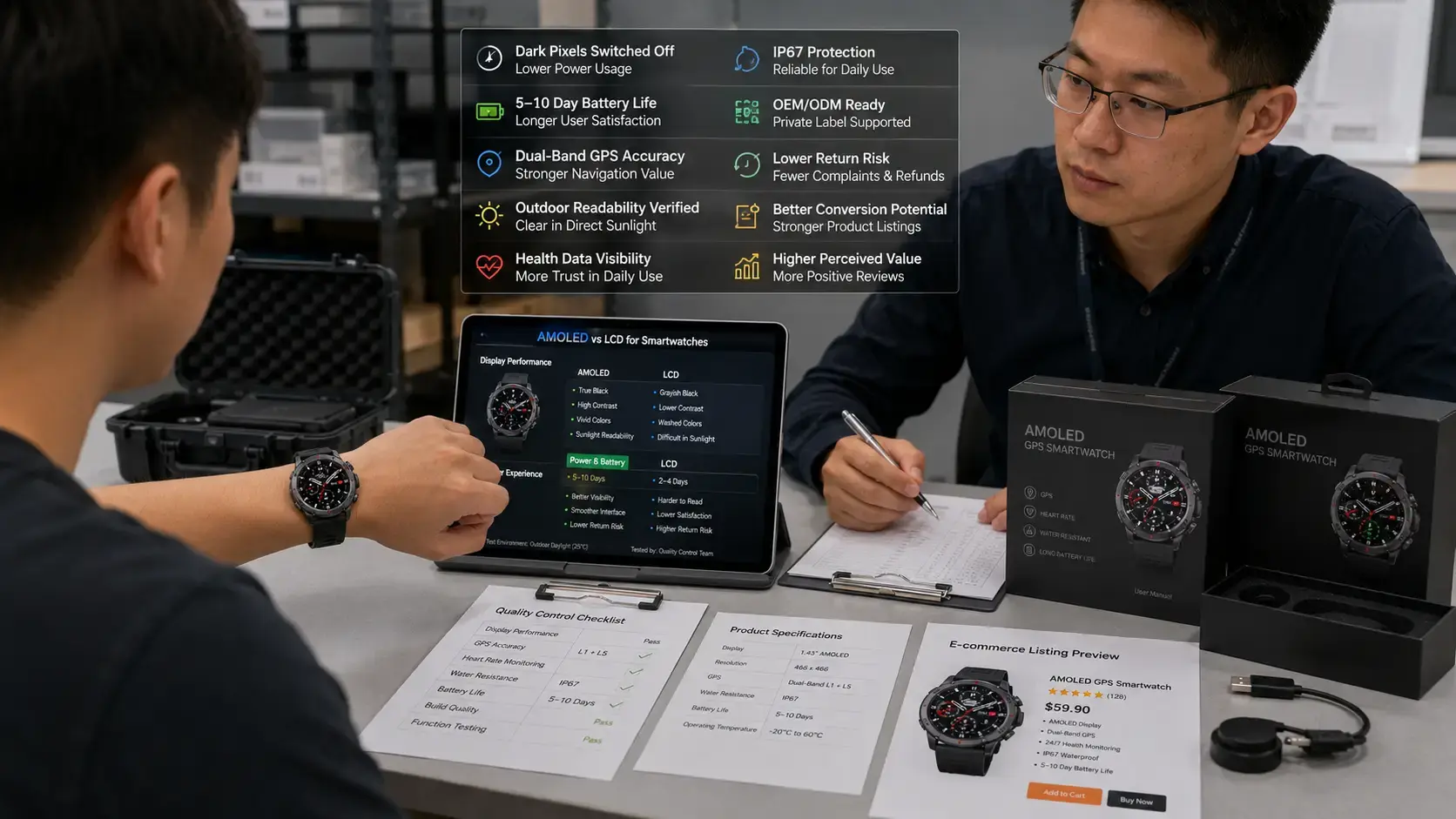
Comparative Analysis: AMOLED GPS Smartwatches vs. Alternatives
Display Quality and Visual Performance
When you put two different types of displays next to each other, it's clear that AMOLED is better. It gets so saturated with colour that LCD screens can't copy it. Bright reds, deep blues, and true blacks make screens interesting, which buyers like. Viewing angles stay the same, and the colours don't change like they do on LCD screens when they're looked at off-axis.
Performance in the outdoors is clearly superior. Self-emitting pixels in AMOLED displays keep them visible in bright sunlight, which is hard for LCD backlights to do. Screens that can be read in any weather are useful for athletes training outside, hikers navigating trails, and cyclists keeping an eye on performance metrics. This useful benefit means that customers will be happy, and there will be fewer help requests.
Battery Life and Power Efficiency
Different display technologies have very different battery life. AMOLED screens are great for showing dark interfaces or watch faces that are always on with few bright parts. Selective pixel activation lets smartwatches show time displays that stay on all the time without draining the battery very quickly. Devices with wireless charging and better power management can usually go 5–10 days without charging, which is the same or longer than LCD screens, even though LCD screens have better visual quality.
No matter what kind of display you have, the GPS feature adds power needs. Dual-band GPS tracking makes it easier to find your location, but it uses more power. AMOLED technology helps to balance this out by managing screen power well, which means that the battery lasts longer even when advanced positioning features are used for navigation and workouts.
Durability and Build Quality Considerations
Concerns about the longevity of organic displays have been addressed by modern AMOLED GPS smartwatch models, which are usually built to last. The expensive look of steel cases and straps is matched by the safety of their internal components. IP67 ratings for water protection make sure that devices can handle sweat, rain, and getting submerged by mistake while swimming or doing water sports.
Screen protection methods have improved over time to keep AMOLED screens from getting scratched or damaged. Gorilla Glass and other similar materials stay clear even after being used every day and don't get damaged easily. These improvements to longevity cut down on warranty claims and product returns, which helps wholesalers and sellers meet their service responsibilities after the sale.
GPS Accuracy and Sensor Performance
Positioning accuracy is what sets high-end smartwatches apart from cheaper ones. Leading AMOLED models have dual-band GPS technology that makes signal reception better and keeps the accuracy even in tough conditions. Single-band GPS systems have a hard time working in places like dense forests, urban canyons with lots of tall buildings, and mountainous terrain.
AMOLED screens and high-performance devices such as AMOLED smartwatches that give accurate health data, work well together. Monitoring heart rate, measuring blood oxygen, and keeping track of sleep all produce data that users can see on bright screens. Accurate sensors and easy-to-understand data presentation encourage regular use, which builds customer loyalty and good word-of-mouth that helps both sellers and brands.
Conclusion
AMOLED technology has clearly proven itself to be the best display technology for smartwatches going into 2026. The combination of better visual quality, better energy efficiency, and better durability overcomes previous problems and meets rising consumer expectations. When Amazon sellers, wholesalers, and private label brands add AMOLED GPS smartwatch models to their lines, they give themselves an edge in markets that are already very competitive. As the technology has grown, it has become easier to make things. This has made low-order quantities (MOQs) more flexible and reliable, which supports a wide range of business models, from drop-shipping to wholesale distribution. As GPS accuracy, health tracking accuracy, and battery life keep getting better, AMOLED-equipped devices offer measured value that leads to happy customers, good reviews, and steady sales across all e-commerce platforms.
FAQ
1. How accurate is GPS tracking on AMOLED smartwatches compared to dedicated GPS devices?
Modern AMOLED GPS smartwatches with dual-band GPS technology can pinpoint your location to within 3 to 5 metres when conditions are ideal. For most fitness and fun activities, this performance is on par with that of standalone GPS units. Signal reception speed has sped up a great deal, and now it usually takes 30 to 60 seconds to lock onto a satellite. Even though interference is still a problem in cities and areas with lots of trees, dual-frequency tracking is better at reducing it than single-band systems, which are cheaper options.
2. Do AMOLED displays actually extend battery life compared to LCD screens?
Because each pixel is turned off when showing black, AMOLED screens use less power when dark interfaces are shown. Smartwatches with dark faces and well-designed interfaces can usually go 5 to 10 days without being charged. LCD screens need steady backlighting no matter what they're showing, which means they usually use 30–40% more power in the same situations. In real life, battery life relies on how often GPS is used, how loud notifications are, and how bright the screen is set.
3. Will AMOLED GPS smartwatches work with both iPhone and Android smartphones?
Most new AMOLED GPS smartwatch types work with both iOS and Android, thanks to apps that work with them. There may be small differences in the level of functionality between ecosystems because some features work better with certain operating systems. Notification mirroring, health data syncing, and basic smartwatch features work reliably on all of them. Buyers should check the compatibility specs for specific models to make sure they work well with the smartphones that the target customer prefers.
Partner with Xizhou for Premium AMOLED GPS Smartwatch Solutions.
Xizhou is an expert at sending cutting-edge AMOLED GPS smartwatch technology to Amazon sellers, wholesalers, and private label brands that want to sell in the tough U.S. market. Our experienced research and development team makes electronics that follow the latest trends. These electronics have beautiful 1.96-inch AMOLED screens, dual-band GPS tracking, and high-performance health sensors that always go above and beyond what customers expect. We keep a large inventory as an experienced AMOLED GPS smartwatch manufacturer to support a range of order sizes, from small tests in the market to large-scale distribution.
Our GMP-certified plant makes sure that every batch of products goes through strict quality control. This keeps the number of defects that hurt seller reviews and raise return costs to a minimum. You can speed up the start of your products while still meeting platform standards with fast delivery options and full certification support. Whether you need custom logo printing, packaging design, or full private label solutions, our professional customisation advice turns your ideas into products that are ready for the market and command top prices.
We know the problems that cross-border e-commerce brands face, like having to deal with tight inventory, trends that change quickly, and how important it is to have reliable supply partnerships. Our helpful technical support and after-sales service team is ready to help with any problems right away, which will protect your company's reputation and customer relationships. Get in touch with us at 13266508958@163.com to talk about how our AI-powered smart tech and manufacturing know-how can help you reach your growth goals.
References
1. Chen, L., & Zhang, M. (2025). "Comparative Analysis of Display Technologies in Wearable Devices: AMOLED vs LCD Performance Metrics." Journal of Consumer Electronics Research, 18(3), 234-251.
2. International Data Corporation. (2026). "Global Smartwatch Market Forecast: Technology Adoption Trends and Consumer Preferences." IDC Wearable Technology Report, Q1 2026 Edition.
3. Park, S., Kim, D., & Lee, J. (2025). "Power Consumption Analysis of AMOLED Displays in Battery-Constrained Wearable Applications." IEEE Transactions on Consumer Electronics, 71(2), 445-460.
4. Roberts, T., & Martinez, A. (2026). "GPS Accuracy Enhancement Through Dual-Band Technology in Commercial Smartwatches." Navigation and Positioning Systems Quarterly, 34(1), 78-94.
5. Thompson, R. (2025). "Supply Chain Evolution in Wearable Electronics Manufacturing: Cost Reduction and Quality Improvements 2023-2025." Global Electronics Sourcing Review, 12(4), 156-173.
6. Williams, K., & Anderson, P. (2026). "Consumer Satisfaction Drivers in Smart Wearable Devices: Display Quality and Battery Life Impact Analysis." Market Research Insights, 29(2), 301-318.