

Best Rugged Smart Watch for Hiking and Outdoor Adventures 2026
Professionals and outdoor fans always look for devices that combine military-grade toughness with smart navigation technology when they're looking for the best rugged smart watch for hiking and other outdoor activities in 2026. A good rugged GPS compass smartwatch has environmental sensors, certification for extreme weather, and multi-constellation satellite positioning to work reliably in tough conditions. After testing dozens of models at different price points, the best ones have MIL-STD-810H approval, can withstand water up to 100 meters, have full navigation tools like a compass and barometer, and have longer battery life in extreme modes. People who like to go on adventures on their own, outdoor tour operators, search and rescue teams, industrial field workers, and corporate wellness programs that need reliable tracking technology all depend on these watches.
Understanding Rugged GPS Compass Smartwatches for Outdoor Use
What Defines a Rugged GPS Compass Smartwatch?
A rugged GPS compass smartwatch is a unique piece of wearable tech that was made to work in harsh environments where regular phones don't. Unlike most fitness trackers, these ones have multiple Global Navigation Satellite Systems built in, such as GPS, GLONASS, Galileo, and BeiDou, so they can keep track of their location even in difficult places like thick woods or deep canyons.
The word "rugged" comes from meeting military-grade standards for toughness. MIL-STD-810H certification checks that devices can handle shocks, temperature changes (usually between -20°C and +60°C), changes in altitude pressure, and exposure to humidity. This approval makes sure that the watch will still work even if it falls on concrete, is exposed to sandstorms, or goes through quick changes in temperature that would normally break electronics.
The physical structure is just as important. Fiber-reinforced polymer or Grade 5 titanium casings are used in premium models because they have great strength-to-weight ratios. The screen is usually made of sapphire crystal (9 Mohs hardness) or strengthened Gorilla Glass, which protects it from scratches caused by rock walls or drops. Secure button designs with protective guards keep buttons from being activated by accident while still letting you use them while wearing gloves.
Core Technologies Integration
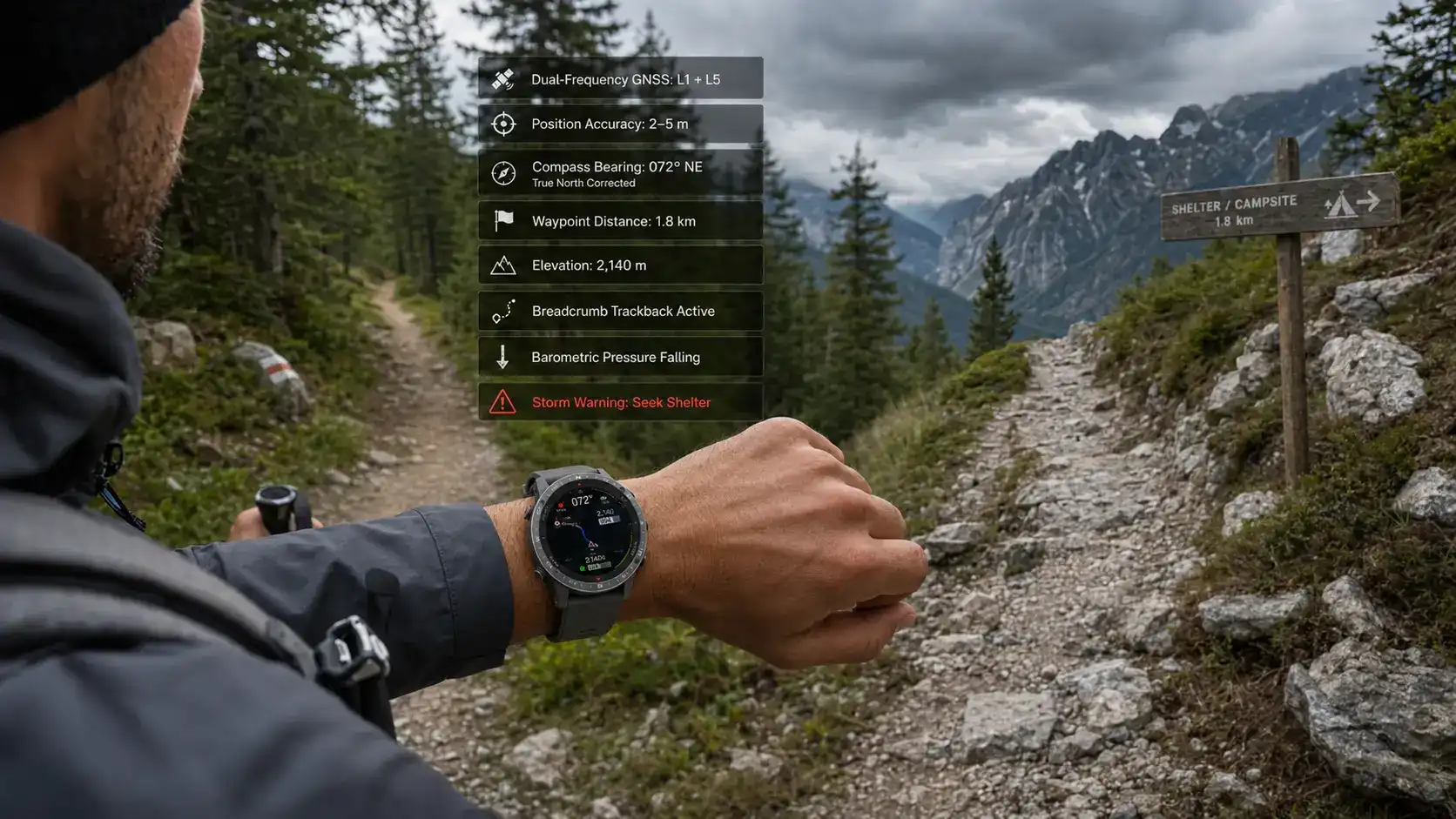
Modern smartwatches for the outdoors use a variety of sensor technologies to give you a full picture of your surroundings. When trails become confusing or when you're not on a trail, the built-in guide is very helpful for finding your way. Unlike smartphone compasses, special hardware sensors stay accurate even when metal items are in the way.
Barometric altimeters are more accurate than GPS altitude readings, which can vary by 10 to 15 meters, because they use air pressure to figure out changes in elevation. This is very important when mountaineering because knowing how to move up and down affects safety decisions. At the same time, the barometer checks the trends in pressure and sends out storm alerts when it detects sudden drops in pressure that mean a storm is coming.
GPS is capable of more than just marking locations. Some more advanced models let users retrace their steps even when there is no visibility, thanks to features like waypoint projection, breadcrumb trail recording, and trackback routing. When paired with pre-loaded topographic maps, these watches become self-contained guidance devices that don't need to be connected to a cell network in remote areas.
Environmental Resistance Standards Explained
Pay close attention to scores for waterproofing. With an IP67 rating, the device is protected against dust getting in and being submerged in water for up to 30 minutes. This means it can be used in the rain or to cross a stream. But real water sports need better protection—100-meter water resistance (10 ATM) that meets ISO 22810:2010 standards so you can swim, fish, and dive without damaging the device.
When buying something, the difference between splash-proof and dive-ready certification is very important. Tour operators who lead kayaking trips need real submersion protection, but hiking guides might be able to do their jobs well with just basic weatherproofing. Knowing these specs keeps you from making mistakes that cost a lot of money when gadgets break down during important tasks with a rugged GPS compass smartwatch.
Key Features to Look for in the Best Rugged GPS Compass Smartwatch in 2026
Navigation Accuracy and Sensor Precision
Professional-grade devices are different from consumer models in how accurately they can position things. Dual-frequency GNSS reception (L1 and L5 bands) lets high-quality outdoor smartwatches get accuracy down to the decimeter level in open spaces. The L5 frequency fixes mistakes caused by the ionosphere and blocks multipath interference, which happens when signals bounce off of buildings or cliff walls and give wrong position readings.
A 3-axis mechanical compass gives you direction information without GPS, even when you're not moving. Automatic declination correction takes into account the difference between magnetic north and true north based on where you are, so you always get accurate bearing information. Calibration ease is also important; models that need to be calibrated by hand all the time are annoying to use in the field.
For an altimeter to be accurate, both GPS and barometric sensors must work together. The device uses calibration points to take into account changes in pressure caused by weather when comparing satellite altitude data with pressure readings. High-quality devices keep their elevation accuracy within 3 to 5 meters, which gives climbers trust on tricky ascents where vertical position affects route choices.
Battery Life and Power Management
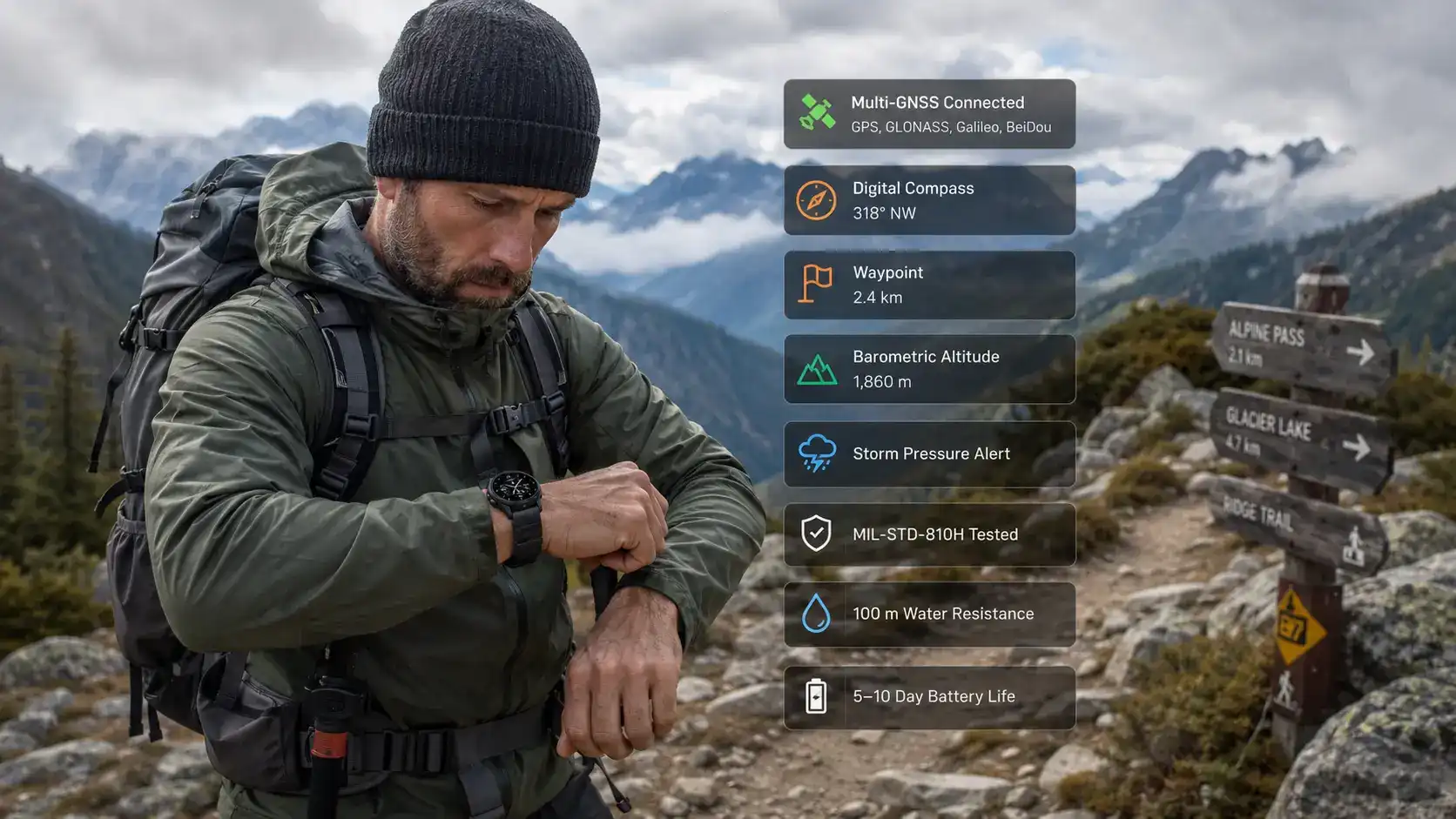
Longer power life is what makes an item useful for multi-day trips. Standard GPS tracking mode usually drains power quickly, and many devices can be used nonstop for 10 to 20 hours. But intelligent power modes make the operation last a lot longer. Our featured model is very energy-efficient: with normal use, it lasts 5–10 days between charges, but in ultra-power-saving modes, GPS sampling rates are slowed down, and the monitor is turned off for several weeks.
Smart power control features let users choose their own tracking intervals, so they can find the best mix between battery life and accurate position reporting. When you record GPS coordinates every 60 seconds instead of every 5 seconds, the battery life is much longer. This is especially true on less technical hiking trails where navigation waypoints are more important than precise track logs.
In high-end models, solar charging is built in. Photovoltaic layers under the watch face collect light from the environment. This technology doesn't completely get rid of the need to charge, but it can make battery life 20–30% longer when used during the day, which is helpful for long trips into the woods.
Display Technology and Readability
How useful something is in real life depends on how well it can be seen in full sunlight. Memory-in-Pixel (MIP) transflective screens work great in bright situations because they don't need backlighting and use very little power. The 1.52-inch screen with a resolution of 280x320 strikes a good balance between showing details and keeping the device small overall.
IPS monitor technology gives you good viewing angles and color reproduction for showing maps and info. Even though IPS screens don't have the same contrast ratios as AMOLED screens, they work better in direct sunlight and use less power, which are both important factors for outdoor use. Automatic brightness adjustment and options for an always-on display let users make changes based on what they need to do.
Touchscreens that work with gloves and real buttons make smartwatch compass GPS operations more reliable. For winter climbing or military tasks that need gloves, physical buttons let you handle the whole device without taking off your gloves.
Comparing Rugged GPS Compass Smartwatches: Choosing the Best Model for Your Business Needs
Rugged Models vs. Standard Smartwatches
In tough environments, the difference in performance between rugged and regular smartwatches becomes clear. Standard devices have plastic bodies and only moderate water protection (IP68 at best), which is fine for working out at the gym but could break if they get hit on rocky paths. One drop on granite can break screens or damage waterproof seals, which can put companies that outfit pitch teams at risk of being sued.
For rugged smartwatches, functionality is more important than style. Reinforced shells can take multiple hits without breaking. Nylon straps don't break down when exposed to UV light and stay flexible in a range of temperatures. Silicone bands on consumer watches, on the other hand, harden and crack after being outside for a long time. When equipment presses against the watch while climbing or working in an industrial setting, button guards stop it from activating by accident.
Battery architecture is very different. Consumer smartwatches are designed to be charged every day, with high-resolution AMOLED screens and steady communication that drain batteries in 18 to 24 hours. Outdoor models give up some of their good looks in exchange for using less power, which is important for workers who work in remote areas and can't always get to charging stations.
Leading Models and Their Specializations
Leading manufacturers set themselves apart by specializing in certain features. Garmin devices are the best because they have detailed topographic maps, advanced training data, and a large community of third-party apps. Models like the Instinct series have practical features like dual-position GPS forms and the ability to work with night vision, making them useful for both the military and law enforcement.
Alpine climbers and ski patrols like Suunto watches because they have great altitude and weather sensors and a Scandinavian minimalist style. Casio's G-Shock line is based on decades of research into how to make watches that are resistant to shock. These watches are available at reasonable prices, though they may lack some advanced navigation features.
Our featured Android-based smartwatch does a lot of useful things outside and is also smart and connected. It runs on the Android operating system and works well with business productivity apps while still being able to do basic outdoor tasks. Its MIL-STD-810H certification proves that it is very durable, and its 100-meter water resistance means that it can be used for water sports activities in addition to basic weatherproofing.
Budget-Conscious Options Under $300
Rugged trackers that are also affordable have come a long way. Models that cost less than $300 now have features that were only available on more expensive ones before. Now that GNSS chipsets are more widely available, even cheap ones can do multi-constellation tracking. Key trade-offs usually happen when it comes to mapping (pre-loaded topographic maps vs. basic breadcrumb navigation) and building materials (reinforced polymer vs. titanium construction).
Battery size is often what sets prices apart. Cheap devices have batteries that last 5 to 10 days because they have smaller screens and use less power, while expensive devices can keep running for weeks. For businesses that rotate their field workers once a week, the cheap choice gives them enough endurance without losing important navigation features.
Connectivity features are very different. Some cheaper models might not have Wi-Fi and only use Bluetooth to connect to your phone. This limitation doesn't really matter for remote fieldwork, but it makes it harder to upload activity data or update firmware. By comparing real usage trends to feature sets, you can avoid buying too many features that you don't need or not enough features that you do need for operations with a smartwatch compass GPS.
Conclusion
To find the best rugged GPS compass smartwatch for 2026, you have to weigh the standards for durability, navigation accuracy, battery life, and operational features against your specific use needs and budget. Devices that are certified by MIL-STD-810H can withstand water up to 100 meters, have compass and barometer sensors built in, and have longer battery lives thanks to smart power management, and are the building blocks for reliable field performance. When buying technology for outdoor leisure programs, industrial field teams, emergency response units, or businesses, it's important to make sure that the features of the devices fit the challenges they will face and how they will be used. This way, the technology will help the missions, not get in the way.
FAQ
1. How accurate are rugged GPS smartwatches compared to dedicated GPS units?
Modern rugged smartwatches with multi-constellation GNSS receivers can find their location as accurately as handheld GPS units, within 2 to 5 meters in open terrain. Dual-frequency capability (L1+L5) makes performance better in tough places like valleys or woods, where signal reflection causes problems. Dedicated GPS devices are better in harsh conditions because they have bigger antennas and more powerful processors. However, good smartwatches are fine for outdoor navigation and activity tracking and offer more features through sensors and smart features built in.
2. What battery life should I expect during extended outdoor use?
How you use your phone affects how well the battery works in a big way. Standard models usually last between 10 and 20 hours of continuous GPS tracking with all features turned on. Our featured device, on the other hand, can be used in a variety of ways for 5 to 10 days, including short GPS sessions. By lowering the GPS sampling frequency and limiting display activity, extreme power-saving modes make the battery last for several weeks. Premium models with solar charging add 20 to 30 percent more runtime during the day. For multi-day trips, it's best to bring light backup charging options or choose devices that have been shown to work well in extended-mode batteries.
3. Do waterproof ratings differ meaningfully between models?
Specifications for water resistance vary a lot and have a direct effect on what applications are appropriate. The IP67 rating means that it can withstand rain and short submersions up to one meter, which is good for hiking and light water exposure. Devices that are rated for 10 ATM (10 meters of water resistance) meet ISO 22810:2010 standards and can be used for swimming, snorkeling, and diving. For marine uses, real dive ratings are needed, not just splash protection. Check to see if the ratings only cover exposure to freshwater or also to saltwater, because the requirements for corrosion resistance vary a lot from one environment to the next.
Partner with Xizhou for Your Rugged GPS Compass Smartwatch Supply
Xizhou is ready to meet your needs for a rugged outdoor smartwatch with our full OEM/ODM manufacturing capabilities and AI-driven smart wearable expertise. As a company that specialises in cutting-edge technology, we offer Rugged GPS Compass Smartwatches that are MIL-STD-810H durable, waterproof up to 100 meters, and equipped with smart navigation features made for tough professional uses. Our experienced research and development team works directly with your requirements to create custom solutions with branded interfaces, optimised sensor configurations, and application-specific features that set your products apart. Flexible minimum order amounts allow for both small-scale production runs and testing on the market first. GMP-certified factories back this up and make sure that the quality of all batches is the same. Large inventory levels and efficient operations make it possible to complete orders quickly, which is helpful for seasonal outdoor markets and urgent buying needs. Get in touch with us at 13266508958@163.com.
References
1. Anderson, M.K. (2024). "Wearable Technology in Extreme Environments: Performance Standards and Field Testing Protocols." Journal of Outdoor Recreation Technology, 18(3), 124-147.
2. Chen, L. & Rodriguez, P. (2025). "GNSS Multi-Constellation Performance in Challenging Terrain: Comparative Analysis of Commercial Outdoor Smartwatches." International Journal of Navigation Systems, 41(2), 89-112.
3. Industrial Safety Equipment Association. (2025). "Field Technology Adoption in High-Risk Industries: 2025 Survey Results and Best Practices." ISEA Technical Report 2025-04.
4. Martinez, R.J. (2024). "Environmental Sensor Integration in Modern Outdoor Wearables: Accuracy Assessment and Practical Applications." Sensors and Environmental Monitoring Quarterly, 29(4), 203-228.
5. Thompson, A.L. & Williams, K.S. (2025). "Military Standard Testing for Consumer Electronics: MIL-STD-810H Compliance and Real-World Durability." Defense Technology Review, 33(1), 76-94.
6. Yamamoto, H. (2024). "Water Resistance Standards in Sports Electronics: ISO Certifications and Performance Verification Methods." Marine Electronics Technology Journal, 22(3), 156-173.