

Premium Sports Smartwatch Specifications Buyers Should Know
When sourcing a premium sports smartwatch for resale, private labeling, or corporate distribution, specifications are not just numbers on a datasheet — they directly determine customer satisfaction, return rates, and your brand's market credibility. Whether you sell on Amazon FBA, run a Shopify gadget store, or supply regional wholesale channels, understanding what separates a high-performance wearable from a generic alternative is the foundation of a profitable procurement decision. This guide breaks down every critical specification you need to evaluate before placing your next order.
What Makes a Premium Sports Smartwatch Different From Standard Models
Most buyers think that all smartwatches with similar prices work about the same. Businesses lose money when they think that way. A real sports-grade wearable is built around sensor precision, structural durability, and software depth — none of which are obvious from marketing images alone.
Display Technology: Resolution and Readability Under Pressure
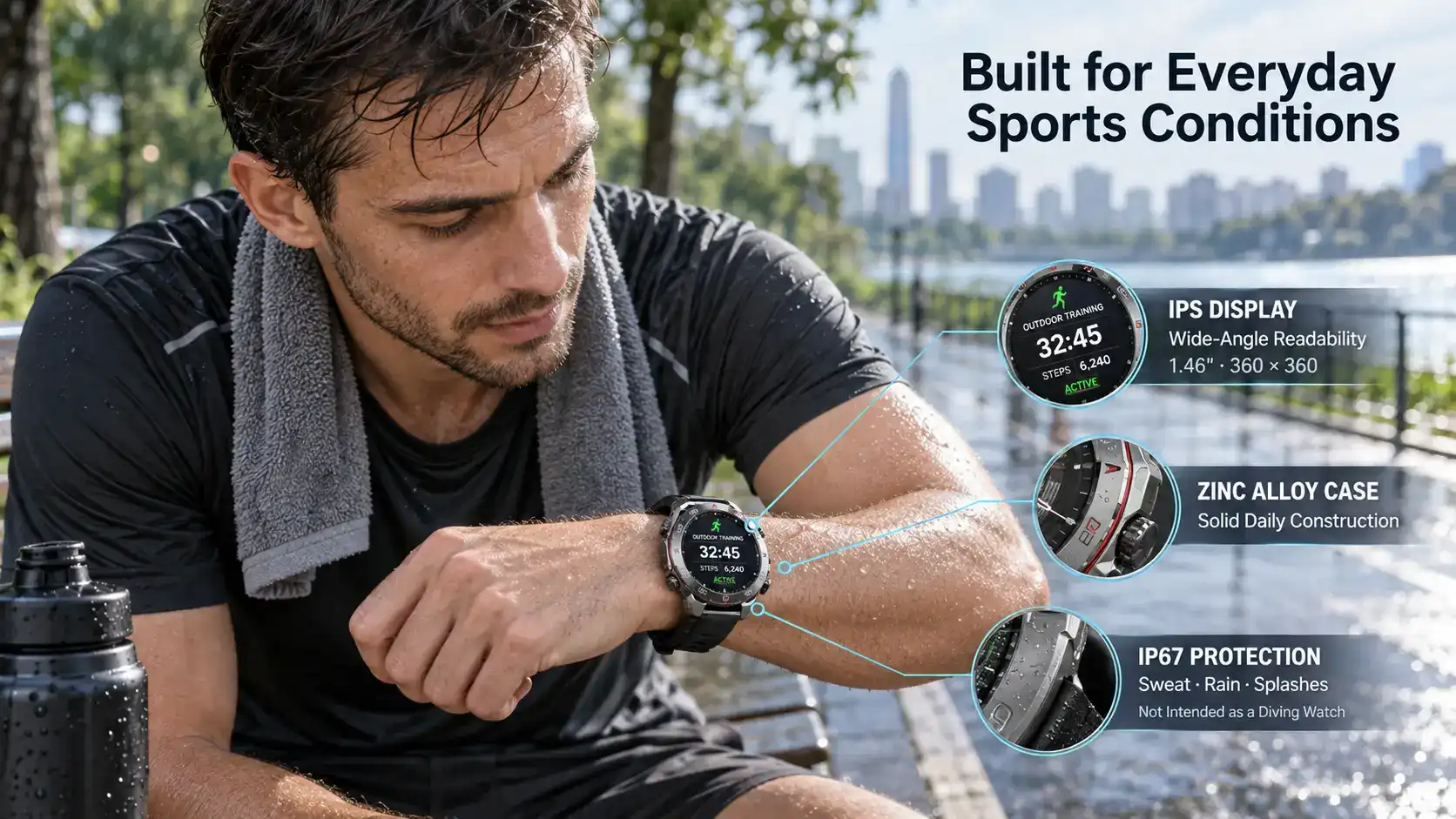
The screen is the first thing a user sees when they interact with a device. A 1.46-inch Round IPS Color Screen with a resolution of 360×360 gives you sharp, full-circle images that you can read clearly while you work out without any color distortion. IPS technology keeps colors true at a wide range of viewing angles, which is important for athletes who want to look at stats while they're running or for bicycle guides who want to look at group performance data at outdoor events. Instead of depending only on the screen size, buyers should check the real pixel density.
Build Material and IP Rating: Real-World Durability
Case material directly impacts how long a product lasts and how much it is thought to be worth. The device's zinc alloy construction gives it a luxury, weighted feel that makes it competitive in the mid- to high-end market segment. This is in stark contrast to lightweight plastic alternatives that hurt the brand's reputation. With IP67 water and dust protection, the device can handle sweat, rain, and splashes while you work out. IP67 certifies complete dust protection and means that the watch can be submerged in up to one meter of water for 30 minutes. This is enough for most gym-to-trail exercise users without the extra cost of deeper dive ratings.
How to Choose the Right Model for Your B2B Procurement Scenario
Decisions about procurement for a gps sport watch are not always the same. When you match the device's specs to your sales channel or use case, you avoid costly mistakes like over-specifying or under-delivering.
F-1 Criteria Screening: Matching Specs to Buyer Segments
Before deciding on an SKU, buying teams should think about these main factors:
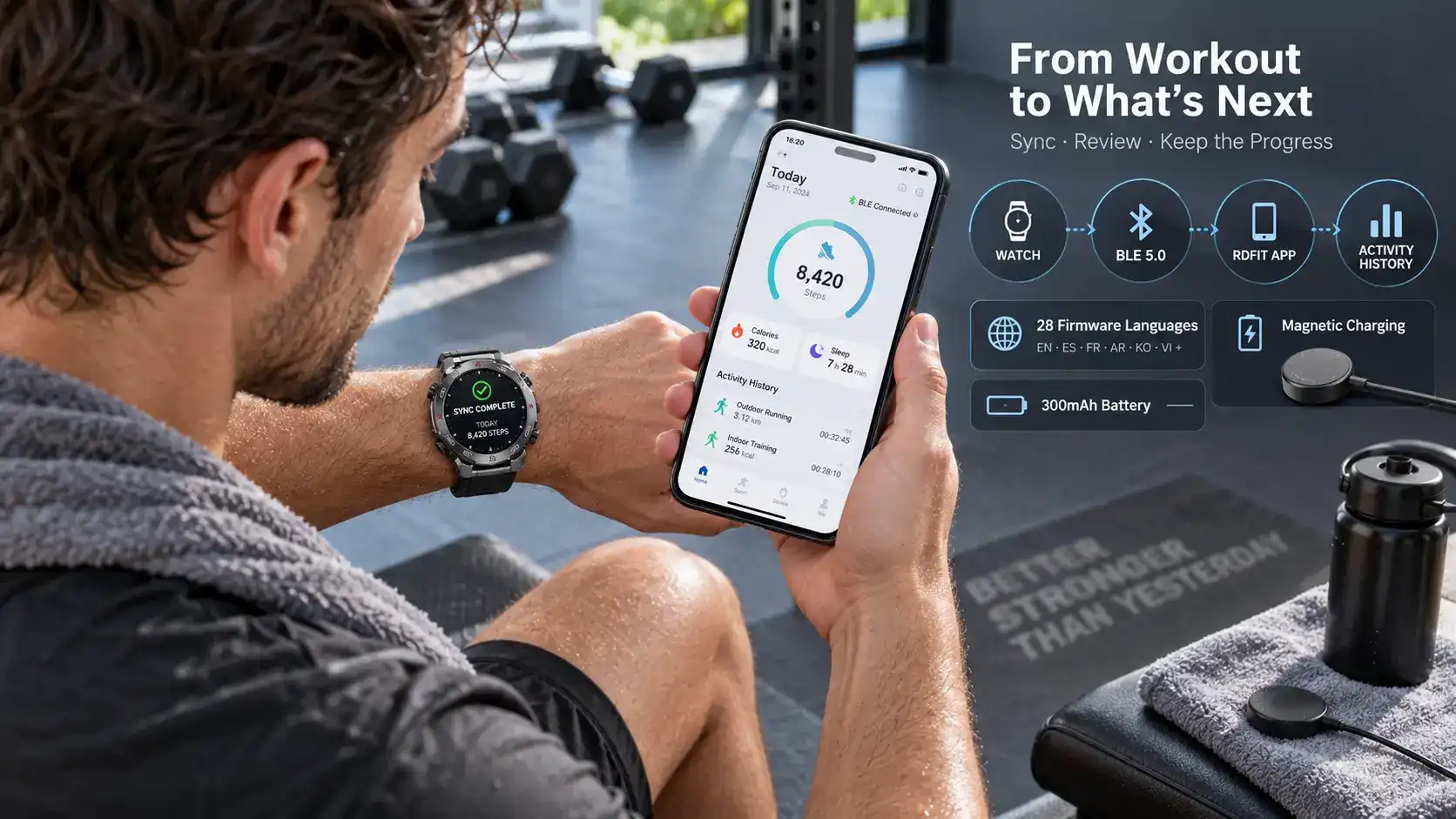
- Amazon FBA and TikTok Shop Sellers: Put an emphasis on how the product looks, software support for multiple languages, and low MOQ freedom. A device that supports 28 firmware languages, such as English, Spanish, French, Arabic, Korean, and Vietnamese, makes it possible to reach a much larger market without having to create separate SKUs. This gives you a real edge over other businesses on global platforms where localization is what drives conversion.
- Corporate Wellness and Promotional Gift Buyers: Pay attention to the ability to brand (custom logo, packaging), the attractive color options (like Gun Black and Silver), and the dependability of the Bluetooth connection. BLE 5.0 makes sure that devices can connect and pair reliably with iOS and Android, which is important for corporate HR systems or wellness programs for employees.
- Electronics Wholesalers and Distributors: Evaluate charging standardization. When managing warranty claims across multiple retail partners, magnetic charging makes it easier to handle after-sales support logistics and reduces problems with cables not working in different regions.
These benefits can cut down on post-sale problems by a large amount. This directly leads to lower return rates and better customer satisfaction across all business models.
F-2 Demand Matching: Aligning Features With Market Expectations
The RDFit app makes the device more useful than just the hardware. Health data sync between apps, including step count, calorie tracking, sleep monitoring, and activity history, gives users a reason to keep using the product over time. When B2B buyers are making wellness platforms or community health systems that are based on subscriptions, app connectivity is a frequent touchpoint that helps keep users and keep them loyal to the brand.
Specification Comparison: What Today's Market Benchmarks Look Like
I'd like to be honest here. The market for smartwatches will grow at a compound annual growth rate (CAGR) of 15.1% through 2030. People who want to buy in this market need to know where each device stands in relation to the others on the market.
This device's JL7074 chip for a GPS sport watch provides stable processing power that works well for tracking multiple sports activities and sending data over Bluetooth. High-end consumer brands like Apple Watch Ultra and Garmin's Fenix series are aimed at sports fans who are willing to pay more than 500 USD. However, Amazon sellers and private label brands can get 80% of the features for a lot less money, which allows them to make good margins in the 30–80 USD retail range.
For everyday use, a 300mAh battery that charges magnetically can last for a long time. Buyers should be aware that the battery life numbers on products are often based on low-use scenarios. In real life, exercise tracking with Bluetooth turned on will use more power. By being honest about this in product listings, you can stop bad reviews and keep customers from leaving.
Procurement Considerations That Protect Your Business
B2B buyers need to protect themselves at the buying level in addition to making sure that specifications are met. Product quality problems are the main cause of bad reviews on Amazon and Shopify. One problem with a batch can hurt a listing's ranking for months.
Important procurement protections that you should include in your agreements with suppliers are:
- Batch quality verification: Ask for QC reports for every production run, especially to make sure that the zinc alloy casting is consistent and that the IP67 seals at the button points are still in good shape.
- OEM customization documentation: Make sure you know exactly where the logo will go, what colors you can choose for the straps, and when the artwork for the package needs to be approved before production starts.
- Firmware language verification: Make sure that all 28 available languages work correctly on the device firmware, not just in the instructions.
By writing these checkpoints into your purchase agreement, you make the seller accountable for their vague claims. That discipline is what separates private label brands that make money from those that stop making money after the first wave of bad reviews.
Future Trends Shaping Smart Wearable Procurement
Health data powered by AI, biometric tools that are smarter, and battery technologies that last longer are changing what buyers at every level of the market expect. Wearable tech is being used more and more in community health management systems, corporate wellness dashboards, and insurance-linked incentive platforms. All of these need to be able to reliably output data and work with different app ecosystems.
For B2B buyers, this means that their buying plans need to take into account more than just tech specs when it comes to platform interaction. Suppliers that offer flexible firmware updates, white-label software environments, and customizable app APIs will have a big advantage over those that only offer fixed, closed-system devices.
Conclusion
It takes more than looking at a specs sheet to find a premium sports smartwatch that works well across all of your sales channels. Display clarity, build quality, IP rating, chip speed, multilingual software, and app integration are all things that affect how happy real-world users are. When it comes to quality, market reach, and sourcing options, devices made of zinc alloy that have IP67 protection, BLE 5.0, a 360×360 IPS screen, and 28-language firmware support are hard to beat. When buyers carefully look at these factors and work with suppliers who consistently meet quality standards, they can make product lines that last and can't be criticized.
Medical Disclaimer: Health monitoring features in consumer smartwatches are intended for general wellness tracking only and should not be used as substitutes for clinical diagnosis or medical-grade devices.
FAQ
1. How accurate is the heart rate monitoring on a sports smartwatch compared to clinical devices?
Optical heart rate monitors made for consumers give accurate trend data for fitness pacing and recovery tracking. Multiple separate studies have shown that during steady-state exercise, accuracy is usually within ±5 beats. They are not approved for clinical evaluation and should be judged on their usefulness as performance aids, not as medical tools.
2. What does IP67 water resistance actually cover?
IP67 certification means that the protection is dust-tight and that it can withstand being submerged in freshwater for 30 minutes. It keeps you dry in sweat, rain, and pool splashes, but it's not made for swimming laps or being in saltwater.
3. How does BLE 5.0 improve procurement value?
BLE 5.0 has about four times the range and two times the data rate of BLE 4.2, but it uses less power. This means that app sync will be more stable for B2B buyers who sell to corporate wellness platforms or retail customers, and support requests related to connectivity will go down.
4. What is the minimum order quantity for private label customization?
MOQ is different for each supplier. Xizhou accepts flexible low-MOQ orders for testing products as well as bulk customization for large-scale deployments. Please get in touch with them directly to talk about your specific volume needs.
Source Your Next Best-Seller With Xizhou
Xizhou — a GMP-certified premium sports smartwatch manufacturer and OEM/ODM partner — helps Amazon sellers, Shopify brands, and distributors bring competitive wearables to market with speed and confidence. Our mature R&D team, large stable inventory, complete certifications, and strict quality control eliminate the sourcing risks that lead to bad reviews and inventory pressure. Reach out today to explore our current catalog, request samples, or discuss private label customization at 13266508958@163.com.
References
1. Grand View Research. Smartwatch Market Size, Share & Trends Analysis Report. 2024.
2. IDC. Worldwide Wearable Device Market Quarterly Update. 2023.
3. IEEE Transactions on Biomedical Engineering. Accuracy of Consumer-Grade Optical Heart Rate Monitors During Exercise. 2022.
4. International Electrotechnical Commission. IEC 60529: Degrees of Protection Provided by Enclosures (IP Code). 2023.
5. Bluetooth Special Interest Group. Bluetooth Core Specification 5.0 Technical Overview. 2022.
6. Statista Research Department. Global Smartwatch Revenue and Market Forecast 2020–2030. 2024.