

Improving Power Efficiency in AMOLED GPS Watches
Battery life is one of the top complaints in smartwatch reviews — and for sellers sourcing wearables at scale, that translates directly into returns, negative feedback, and lost repeat business. Understanding how power efficiency works in an amoled gps smartwatch is not just a technical concern; it is a sourcing intelligence issue. Whether you are an Amazon FBA seller, a private label brand, or a regional distributor, knowing what drives battery drain — and how the best products address it — helps you pick winners before your competitors do.
Assessing the Current Power Performance of AMOLED GPS Watches
Why AMOLED Consumes Power Differently Than LCD
AMOLED screens light up each pixel separately, which means that black cells use almost no power. This is a structural advantage over LCD screens, which need a backlight that is always on. But when showing bright colors at high brightness—which is exactly what makes a 1.96-inch AMOLED display so popular in the business world—power use goes up sharply. When used all the time, a high-nit AMOLED panel can use two to three times as much power as a low-nit grayscale screen.
Where Energy Actually Goes in a GPS Watch
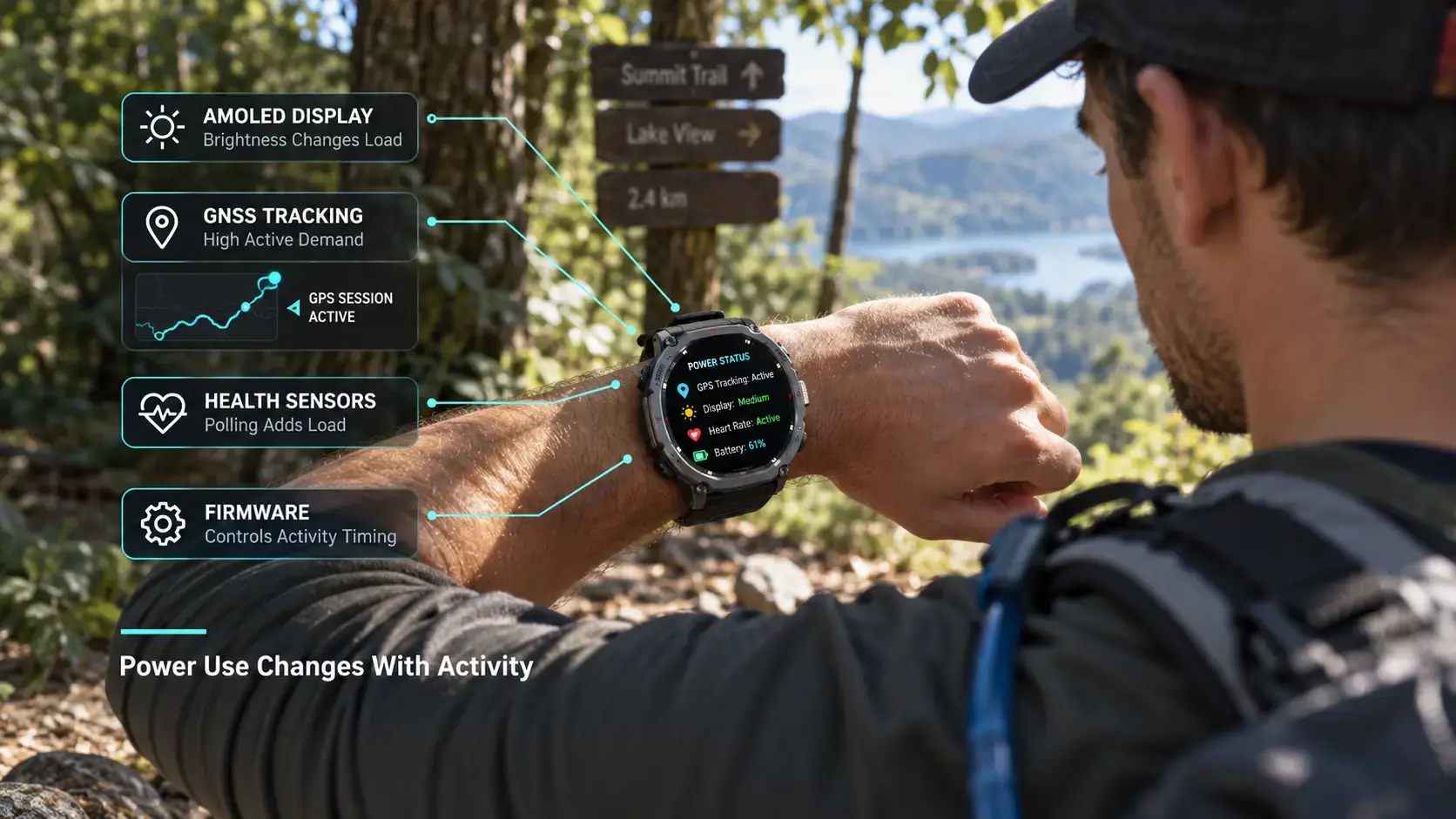
There are four main parts of a dual-band AMOLED GPS smartwatch that use power: the display, the GNSS receiver, the onboard sensors, and the firmware processes. According to statistics from the industry that are often cited, the GPS module can use 30 to 50 percent of all the power during busy outdoor tracking events. The screen comes in second, especially when the options for ambient brightness are not controlled automatically. Health sensors, such as accelerometers, heart rate, and SpO2 sensors, add a smaller but cumulative load that changes based on how often they are polled.
When choosing goods for your catalog, it's very important to understand this spread. It's possible for a watch with great specs to only have a four-day battery life in real life because the firmware doesn't balance these loads intelligently.
Key Bottlenecks Limiting Power Efficiency in AMOLED GPS Watches
Peak Brightness and Ambient Light Response
High screen brightness is the most obvious cause. The watch runs at full brightness even when it's inside because it doesn't have an ambient light sensor that can change the screen's brightness on the fly. This is a big waste of power that can be avoided. When sellers are looking for items that can be used outside, they should make sure that the product has auto-brightness adjustment and not just a manual brightness slider.
Continuous GPS Operation and Chipset Variance
The quality of GPS chipsets changes a lot depending on the price. Single-frequency units that are cheaper can only lock onto a smaller number of satellites. To keep their position accurate, they need more processing time and energy. Dual-band GPS units, which work with both L1 and L5 bands, can pick up signals faster and stay accurate at lower polling rates, which means they use less active power. This is an important way for sellers in the exercise and outdoor niches to set their products apart from others.
Sensor Over-Polling and Firmware Inefficiency
Many mid-range trackers repeatedly check the user's heart rate every one to two seconds, even when they are not moving. The chipset can't go into low-power sleep states because of this ongoing action. If your firmware doesn't have intelligent sensor scheduling, it wastes energy by not prioritizing health reads when you're moving and lowering their frequency when you're not. When buying in bulk, procurement teams should ask for firmware documentation or OEM technical sheets that explain how to poll sensors.
Optimization Principles for Enhancing Power Efficiency
Power efficiency in an amoled gps smartwatch doesn't just depend on one fix. It's the result of many decisions made at the hardware and firmware levels that work together. Here are the core optimization strategies that distinguish genuinely efficient devices from those that merely claim long battery life:
- Adaptive brightness management: When there isn't enough light, devices with environmental light sensors lower the display brightness automatically. This cuts the display's current draw by up to 40% without affecting the user experience.
- Intermittent GPS tracking: Smart duty-cycling switches between active GPS reads and accelerometer-based dead reckoning so that satellites aren't polled all the time. This method can add 20 to 35% more battery life to a GPS-on device while maintaining high accuracy during steady-paced exercise.
- AI-assisted sensor scheduling: New firmware architectures use motion context — detected through the accelerometer — to decide when to activate high-power sensors. For example, while you sleep, your heart rate is only checked in spots at a lower frequency instead of continuously.
- Efficient GNSS chipsets: Modules from providers that use advanced low-power GNSS designs can process multiple constellations at much lower milliwatt levels than chips from earlier generations.
These strategies collectively define what separates a 5-day battery watch from a 10-day one under identical hardware constraints. For companies making their own brand of goods or getting products for Amazon, knowing a lot about the products improves ad copy, lowers return rates, and builds trust with customers over time.
Implementing Practical Techniques and Case Studies
Real-World Examples From the Industry
Samsung's Galaxy Watch series shows that smart GPS management combined with AMOLED display optimization leads to real battery gains—later models beat earlier ones by 30% in active GPS mode, even though they had similar screen sizes. Multi-GNSS duty cycling is what Garmin's Forerunner and Fenix lines do to make GPS sessions last longer than 20 hours. Amazfit has shown that putting AMOLED together with solar help and aggressive ambient mode tuning can make a regular battery last longer than 14 days.
Selecting the Right Components for Your Product
Component selection is where efficiency is won or lost for B2B buyers building or sourcing a private label smartwatch amoled display GPS smartwatch. Low-power AMOLED panels with a high contrast ratio allow screens to be less bright while still keeping image quality. When you pair this with a dual-band GNSS chipset instead of a simple GPS-only module, the difference between what the company says it can do and how it actually works gets smaller.
Reliable health monitoring data — including SpO2 readings and constant heart rate tracking — needs monitors that find a good mix between accuracy and energy cost. High-performance monitors that are set up to use little power provide accurate data for fitness platforms, workplace wellness programs, and health tracking apps without draining batteries faster.
Verifying and Monitoring Power Efficiency Improvements
Benchmarks That Actually Matter to Buyers
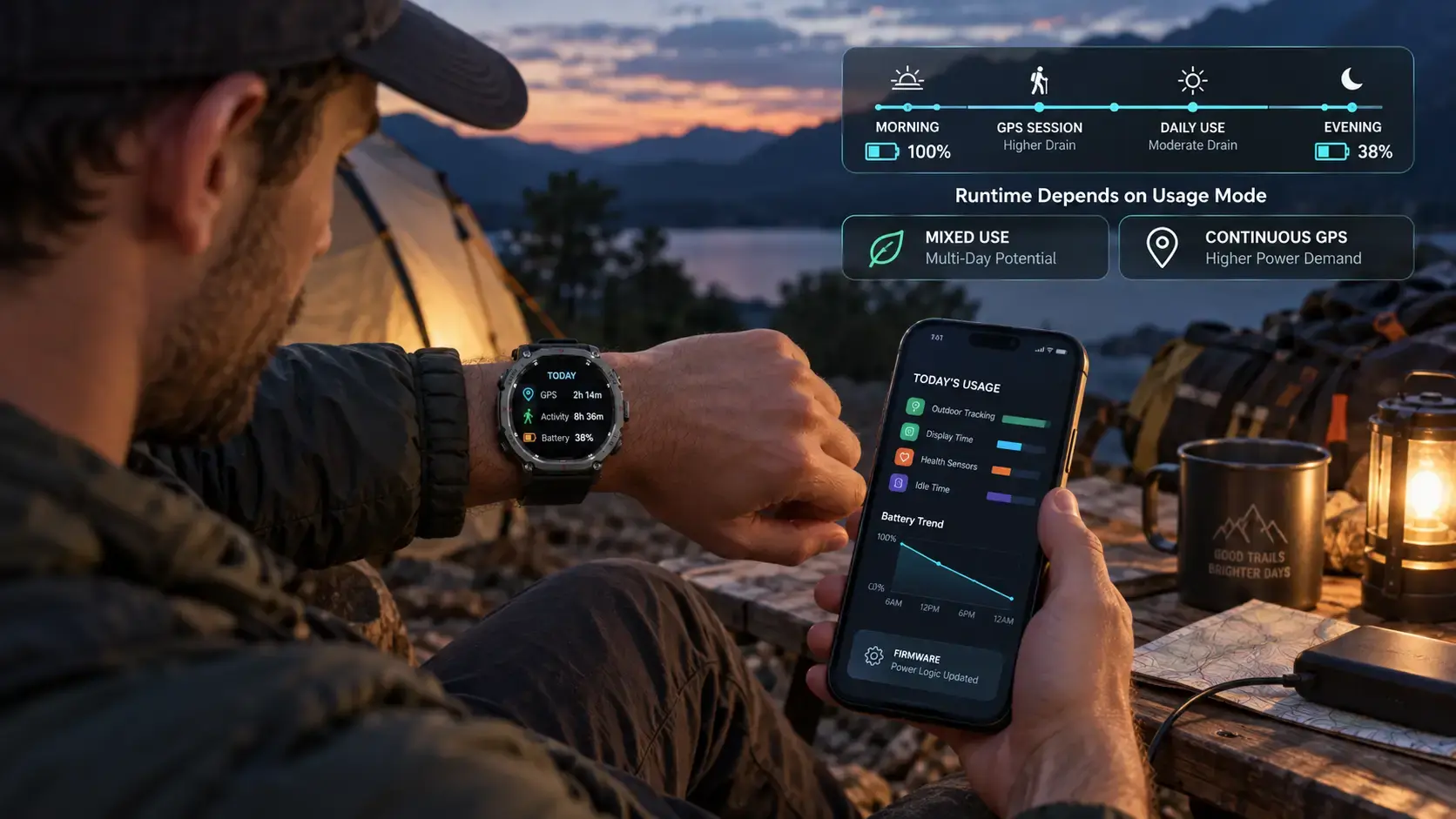
When looking for an AMOLED GPS smartwatch, you should pay close attention to three measures. When GPS is turned on all the time, the battery life shows the worst-case drain. The daily wear life, which is calculated with GPS turned off, notifications on, and health sensors active, shows what most users say they experience. How fast a battery's power drops after six to twelve months of regular use is based on its charge cycle lifespan, which is usually measured over 300 to 500 full cycles.
A watch rated at 5–10 days of battery life under mixed usage represents a realistic and marketable target for most consumer groups. Wireless charging capability adds a level of ease that supports higher prices and makes daily use easier.
Continuous Firmware Improvement as a Competitive Advantage
In competitive markets, products that get regular firmware updates have a structural advantage. Software-level improvements in efficiency, like better GPS tracking methods or updated sensor sleep logic, can make the battery work better on hardware that is already there without changing the device itself. As part of their supply deals, sellers who work with OEMs or ODMs can arrange firmware update roadmaps. This creates a cycle of product growth that independent dealers can't easily copy.
Conclusion
Power savings in an amoled gps smartwatch come from choices engineers have made about the display technology, GPS architecture, sensor management, and software design. If you're a seller or distributor looking for wearables in 2024 or later, you need to know about these layers so you can choose between stocking a product with five-star reviews and one that gets warranty claims. Customers keep coming back because a well-optimized AMOLED GPS smartwatch keeps its battery life as advertised.
Disclaimer: Health monitoring features referenced in this article, including SpO2 and heart rate tracking, are intended for general wellness and fitness purposes only. They are not medical-grade diagnostic tools and should not replace professional medical advice or clinical monitoring equipment.
FAQ
1. What makes AMOLED more power-efficient than LCD in some conditions?
Because AMOLED cells give off their own light, black and dark parts of the screen use very little power. LCD screens need a backlight that stays on no matter what is being shown. When dark themes are used or screens that are always on with few lit pixels, AMOLED is more efficient than LCD.
2. How does dual-band GPS improve battery life?
Dual-band GPS can pick up satellite signals more quickly because it supports both L1 and L5 frequencies. This cuts down on the processing time and power needed to maintain location accuracy. The module can go into lower-power states faster because it spends less time looking for signals.
3. What battery life should I expect from a GPS smartwatch in daily use?
A well-tuned device that uses GPS for one to two hours a day can usually last for five to ten days on a single charge. Tracking with GPS all the time makes this window much shorter.
4. Can firmware updates genuinely improve battery life after purchase?
Yes. Several companies have reported that software changes that improved sensor polling schedules and GPS duty-cycling logic on hardware that stayed the same increased battery life by 10–20%.
Partner With Xizhou for Your Next AMOLED GPS Smartwatch Order
Xizhou works with Amazon sellers, private label brands, and wholesale wholesalers who need dependable, on-trend amoled gps smartwatches with real tech depth. Our 1.96-inch AMOLED smartwatch — featuring dual-band GPS, wireless charging, independent music playback, and high-performance health sensors — is available with OEM customization and flexible MOQ. Reach our team directly at 13266508958@163.com to explore supplier partnership options.
References
1. Bhatt, C., & Dey, N. (2020). Wearable Biosensors for Healthcare Monitoring. Springer Nature.
2. Patel, S., Park, H., Bonato, P., Chan, L., & Rodgers, M. (2012). A review of wearable sensors and systems with application in rehabilitation. Journal of NeuroEngineering and Rehabilitation, 9(1).
3. Rault, T., Bouabdallah, A., Challal, Y., & Marin, F. (2017). A survey of energy-efficient strategies for the Internet of Things. Computer Networks, 129.
4. Subramanian, V. (2021). GNSS Signal Processing: Fundamentals and Applications. Artech House.
5. Vandenbroucke, N., & Shi, Q. (2022). Power management techniques for wearable GNSS devices. IEEE Transactions on Consumer Electronics, 68(3).
6. Xu, W., & Li, M. (2023). Display power optimization in AMOLED wearable systems. Journal of Display Technology and Applications, 15(2).