

How does heart rate monitoring work on an Accurate Heart Rate Smartwatch?
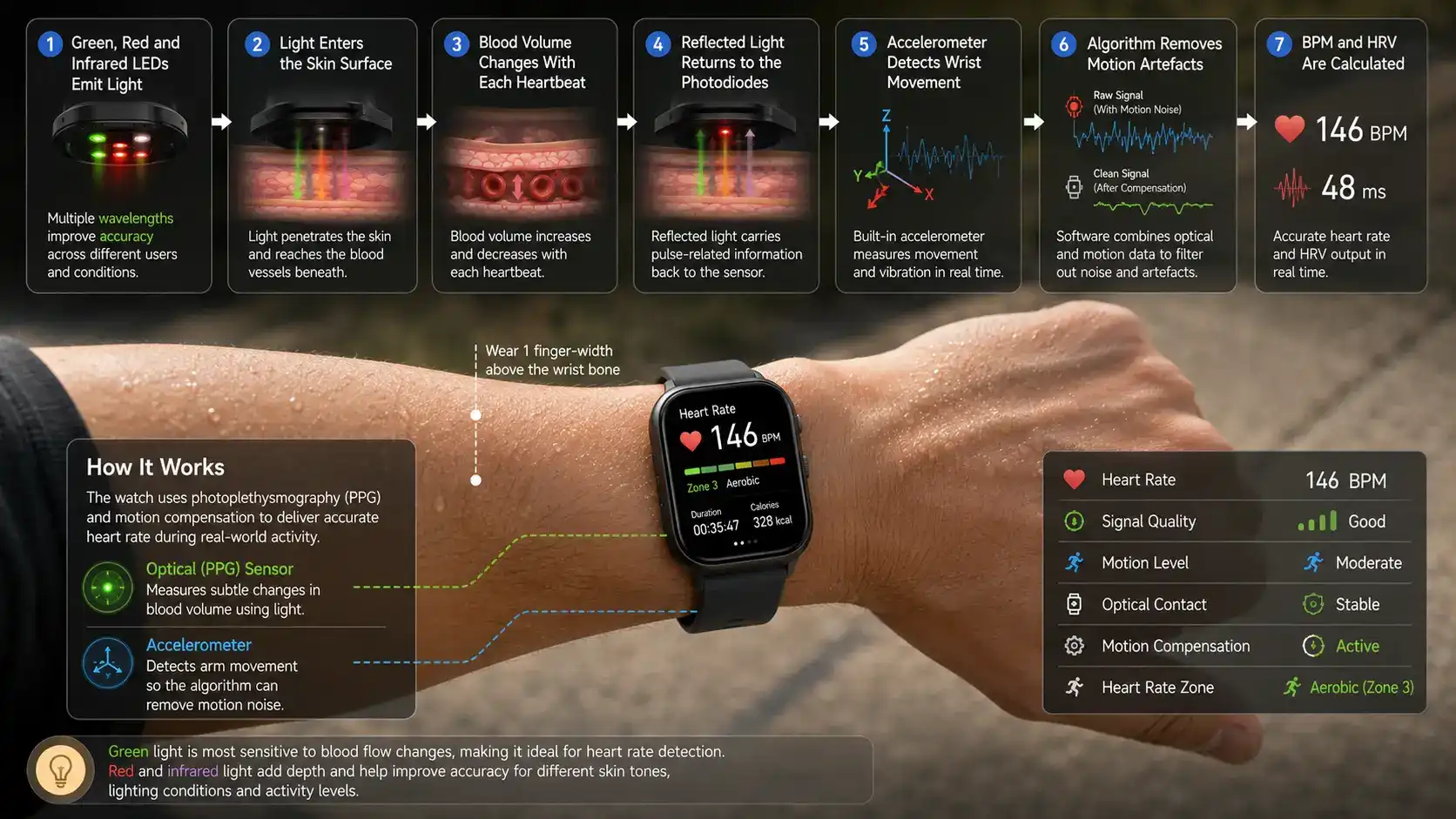
Heart rate tracking technology in smartwatches has gone from being a cool feature to an important part of employee health programmes, online patient monitoring, and improving performance. An accurate heart rate smartwatch uses advanced photoplethysmography (PPG) sensors that send multi-wavelength light into the skin, usually green LEDs, to measure how much blood changes with each heartbeat. These optical sensors pick up the light that blood vessels reflect back, and complex algorithms use the information to figure out the beats per minute (BPM) in real time. Motion-compensating accelerometers remove interference while you're moving, so the signal stays strong even during intense workouts or work tasks that require you to be moving all the time. Procurement managers, OEM partners, distributors, and workplace health directors who need accurate biometric data for their work need to know how these devices work. This guide breaks down the technology, rates the most important features, and gives B2B buyers looking for reliable heart rate monitoring solutions steps they can take to buy the right products.
Understanding How Accurate Heart Rate Smartwatches Work?
The Science Behind PPG Technology
Modern wrist-based heart rate monitors are based on photoplethysmography. The amount of blood moving under your skin temporarily rises when your heart pumps blood through your arteries. PPG monitors use this effect by shining light into the skin and checking how much light is absorbed. Oxygenated haemoglobin is very good at absorbing green light, which makes it perfect for finding pulsed blood flow.
Newer models have red and infrared LEDs along with green ones to make them more accurate for people with different skin tones and in different lighting conditions. Single-wavelength sensors used to have trouble with darker skin or tattoos, which absorb more light and lower signal quality. This multi-wavelength approach fixes those problems. Accelerometers and optical sensors work together to find motion artefacts, like arm swings while running, and take them out of the heart rate calculation.
How Do Electrical Sensors Enhance Accuracy?
Most devices worn on the wrist are PPG, but some high-end smartwatches can do an electrocardiogram (ECG) because they have electrodes built into the case and digital crown. When a person puts their finger on the crown, the device measures the electrical impulses that are sent out by the heart muscle contractions. The smartwatch can compare PPG values to ECG data using this dual-sensor design. This makes the accuracy much better at rest and mild exercise.
Factors Affecting Measurement Precision
Heart rate accuracy is affected by a number of factors. The way the device is placed on the wrist is important—it should fit snugly about one finger-width above the wrist bone to keep skin contact. Extreme weather, like cold, makes blood arteries narrow, which weakens signals. How well algorithms deal with these problems depends on how good the firmware is. Long-term accuracy is improved by regularly calibrating against chest strap monitors or medical-grade devices. This is especially important for business-to-business (B2B) uses where data dependability impacts clinical choices or insurance telemetric programmes.
Key Features and Benefits of Accurate Heart Rate Smartwatches for Business Use
Continuous Monitoring for Proactive Health Management
Continuous heart rate tracking, on the other hand, gives a full picture of how the heart works throughout the day, unlike human pulse checks. This feature is very useful for corporate wellness programmes, where combining data helps find employees who are at risk before they have serious health problems. In healthcare settings, ongoing tracking helps with managing patients remotely for things like post-operative recovery or long-term condition monitoring, which lowers the number of times patients have to go back to the hospital.
Take the example of a factory that uses wearable health monitoring with an accurate heart rate smartwatch for workers who do their jobs in hot places. When temperature sensors are combined with continuous heart rate tracking, alarms can be set off when physiological stress indicators reach dangerous levels. This can help prevent heat-related illnesses and accidents at work.
Advanced Metrics Driving Performance Optimisation
Professional-grade devices do more than just read BPM. They also figure out heart rate variability (HRV), which is the change in the time between heartbeats. HRV can be used to estimate the balance of the autonomic nervous system and the level of healing. Athletics use HRV to figure out the best amount of training to do, and corporate wellness programmes use it to figure out how stressed out employees are and how likely they are to burn out.
Estimating VO₂ max is another important measure that predicts cardiovascular fitness by connecting the reaction of heart rate to exercise effort. VO₂ max data is sent through formulas that have been checked against lab tests. This data helps gyms, sports teams, and military training programmes measure success and make training plans that work best for them. Devices that offer this data usually have the following:
- Zone-based training alerts that let users know when their heart rate goes into or out of target zones for recovery, fat burn, aerobic, anaerobic, and peak work.
- Resting heart rate trends that show slow rises could be a sign of illness, overtraining, or heart problems.
- Recovery time estimates based on how hard you worked out and how quickly your heart rate dropped afterwards
These features turn raw sensor data into information that can be used, which makes the investment worth it for companies that want to measure health and performance results.
Battery Efficiency Supporting Operational Continuity
When it comes to user compliance and operational efficiency, battery life has a direct effect. Heart rate monitors that can keep working for 5 to 10 days without stopping are best for situations where someone needs to be monitored 24 hours a day, seven days a week, or while they are out in the field for several days. Modern power management systems change sampling rates on the fly, taking readings every second when the device is active and every few minutes when it is idle. This keeps the battery alive longer without affecting the quality of the data.
When compared to proprietary clip systems, magnetic charging interfaces make charging easier and protect connectors from damage. This thought about durability is important for large operations where gadget life affects the total cost of ownership.
Comparing Accurate Heart Rate Smartwatches: What B2B Buyers Need to Know?
Evaluating Core Selection Criteria
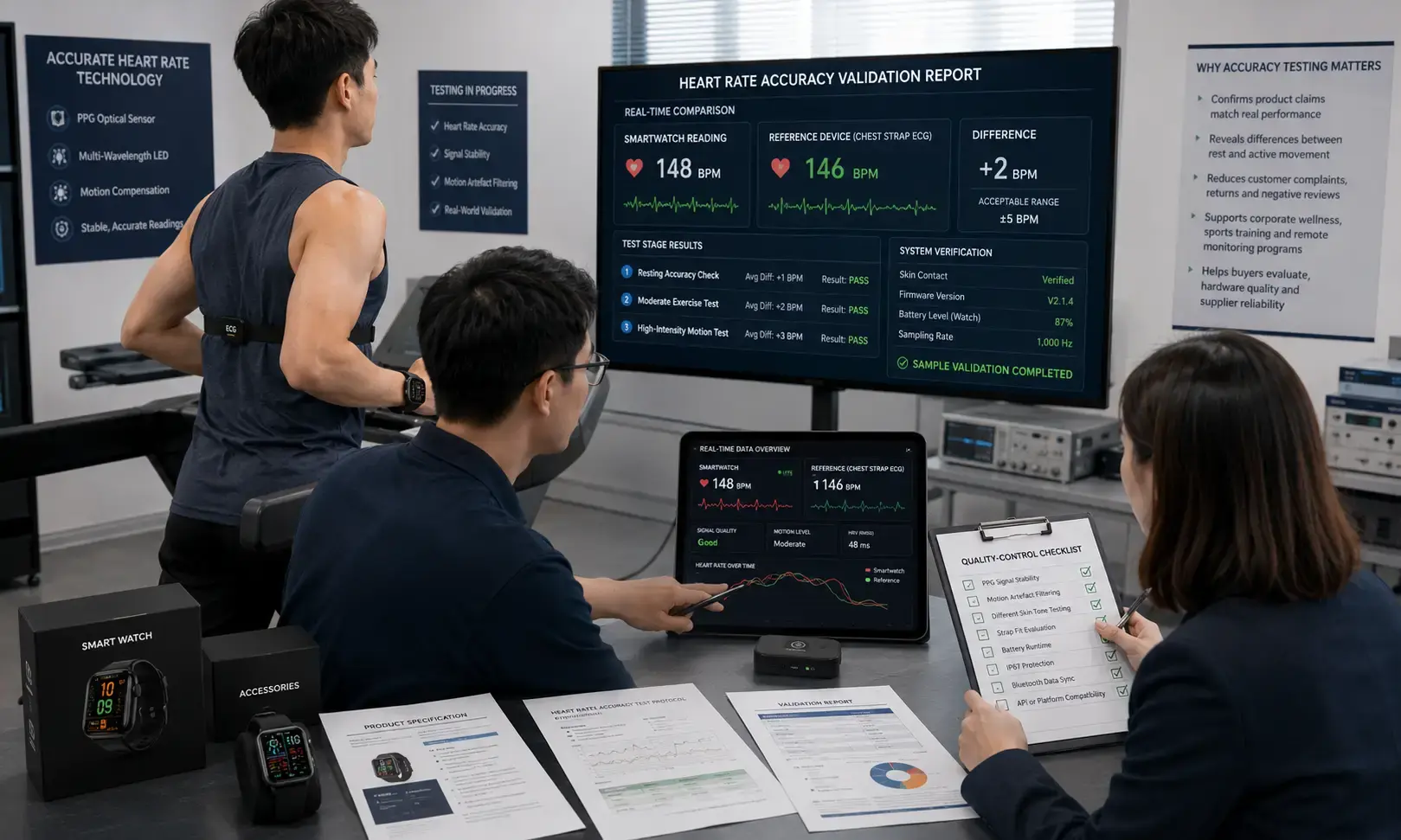
Choosing what to buy depends on a lot of technical and business factors being balanced. It's still very important that devices are accurate—they should show ±5 BPM accuracy or better when tested against chest strap monitors while doing mild exercise. Durability standards, such as IP67 water resistance, make sure that devices work in places like gyms, swimming pools, and factories where they might get wet.
How easy it is to launch depends on how well the enterprise can integrate. It's easier to sync data between devices that support Bluetooth Low Energy, ANT+, and open API designs and health information systems, workplace wellness platforms, or custom analytics dashboards. GDPR-compliant data handling and HIPAA-ready security protocols from vendors lower regulatory risks for healthcare apps.
Understanding Product Positioning
Different types of devices are used for different things. Fitness-focused trackers put an emphasis on activity metrics and low cost, which makes them good for large-scale corporate wellness programmes where money is tight. Premium smartwatches come with smartphone alerts, GPS tracking, and app platforms. This makes them appealing to senior fitness programmes or sales teams that need to stay connected while tracking their health.
For serious endurance athletes, models made with fibre-reinforced polymer cases are the best in terms of weight and durability. Most of the time, these have high-precision optical sensors, improved running dynamics (like tempo, ground contact time, and leg length), and GPS battery modes that last longer. A device made for runners might have an IPS screen with 320x240 resolution so it can be seen outside, silicone straps with pin buckles so it stays in place while you move, and alloy cases that are both protective and light.
Medical-grade devices, including HR monitoring watches that are waiting for regulatory approval, offer heart rate and ECG monitoring with clinical accuracy, but they cost a lot. They are good for telemedicine providers, clinical research groups, or occupational health programmes that need biometric data that can be defended.
Warranty and Support Infrastructure
Post-sale help quality tells the difference between suppliers who are solid and those who aren't. Buyers in the business world should check the policies on firmware updates. Devices that get regular software updates stay accurate as algorithms change. Warranty terms that cover sensor failures, battery degradation, and the integrity of the water seal keep you from losing your device too soon.
When dozens or hundreds of units are being deployed at once, it's important to have quick access to technical support. Suppliers who offer specialised account management, product training for IT teams, and staging for new devices keep operations running as smoothly as possible.
Optimising Usage and Troubleshooting for Maximum Accuracy
Best Practices for Consistent Performance
Placing the device correctly gets rid of most accuracy problems. It is best for the smartwatch to rest flat against the skin, one finger-width above the wrist bone, where the capillary density is highest. Tightening the strap during workouts stops the sensor from moving, but the fit should still let blood flow freely. Switching wrists every so often can help keep skin from getting irritated during long wear.
In a professional setting, how the skin is prepared is important. Using alcohol pads to wipe the contact area cleans it of lotions, dirt, or oils that could mess up the optical readings. People who have a lot of tattoos on their wrists may have trouble with accuracy. Testing devices in different places to wear them (inside the elbow or on the ankle with special mounts) can help.
Addressing Common Technical Issues
Occasionally, wrong readings are usually caused by bugs in the firmware, not by hardware failure. As manufacturers are always improving heart rate algorithms, the first thing you should do to fix a problem is to check for software updates. Restarting the device fixes any brief memory problems that are hurting how well the sensor works.
It is normal for lithium-ion cells to lose some of their performance over time. If a gadget that used to last seven days needs to be charged every day after 18 months, it may be cheaper to just change the battery instead of the whole thing. Batteries that come with service plans help reduce e-waste and the total cost of ownership for big fleets.
Data Security and Privacy Compliance
Health data is private information about people that needs to be kept safe at all times. For business-to-business deployments, data must be sent encrypted (TLS 1.2 or higher) and stored safely in the cloud with access controls, and users must be able to clearly give their permission. For operations in Europe, GDPR requires restricting the use of data, keeping it as simple as possible, and giving people the right to access it. U.S. healthcare apps must follow HIPAA rules, which include signing business associate agreements with gadget makers and keeping strict audit logs.
Anonymous data collection methods let corporate wellness programmes look at health trends in a population without revealing people's identities. This protects privacy while still measuring how well the programme is working with an HR monitoring watch.
Conclusion
Heart rate tracking technology in smartwatches has grown and is now a reliable tool for business-to-business uses in areas like healthcare, sports performance, company fitness, and safety in the workplace. Procurement professionals can make smart choices by learning about the technologies behind PPG and ECG sensors, comparing features to what the business needs, and following best practices for deployment and maintenance. Specialised engineering meets the needs of specific use cases, as shown by devices like those made for serious walkers that have high-precision optical sensors, advanced measures, and strong construction. As the world of wearable tech changes, making sure your company works with flexible suppliers that offer customisation, quality assurance, and ongoing support is key to getting the most out of heart rate monitoring investments.
FAQ
1. How can I verify heart rate accuracy before bulk purchasing?
Ask for sample units and test them side by side with validated chest strap monitors while doing controlled activities like walking, jogging, and resting. Validation records from independent labs that follow ISO 80601-2-61 guidelines give you even more peace of mind. Reliable suppliers offer pilot programmes that let target user groups test the product in the real world before committing to full orders.
2. What causes inaccurate readings, and how can businesses mitigate them?
Motion artefacts from high-intensity activity, poor skin contact from straps that are too loose, and environmental factors like cold weather are the main things that make accuracy difficult. These problems can be fixed by using accelerometers to compensate for motion, teaching users how to position devices correctly, and choosing devices with multiple wavelength sensors. Setting up calibration protocols against medical-grade standards keeps all of the devices in a fleet accurate.
3. Which models suit specialised industrial or medical environments?
Ruggedised devices that are waterproof up to IP67+, have long battery lives (10 days or more), and can handle a wide range of temperatures are useful in industrial settings. In medical settings, machines that can do ECGs must have legal clearances (FDA 510(k), CE marking), be able to send encrypted data, and be able to connect to health IT systems. Suppliers with experience in these areas know what paperwork is needed for purchase approval processes and how to meet compliance standards.
Partner with Xizhou for Your Smartwatch Sourcing Needs
Intelligent smart solutions made for tough B2B uses are sold by Shenzhen Xizhou E-commerce Co., Ltd. Our line of accurate heart rate smartwatches has high-precision optical sensors, advanced health metrics like VO₂ max estimation, and long-lasting construction that makes them good for running, wellness at work, and remote monitoring. We are a reliable, accurate heart rate smartwatch supplier for brands that want to stand out from the competition. Our manufacturing is GMP-certified, and we do full quality control that is in line with international standards.
We offer open OEM/ODM customisation that includes printing logos, designing packages, making changes to software, and choosing which parts to use. This lets you turn your product ideas into wearables that are ready to go on the market. A large inventory capacity allows for quick shipping times, which are important for holiday launches or urgent restocking. Our strict quality control procedures make sure that the heart rate monitor works correctly for people with different skin tones and levels of exercise. This protects your brand's image.
Contact our procurement experts at 13266508958@163.com to discuss your specific requirements. We provide tailored consultations, competitive bulk pricing, and sample units for hands-on evaluation. Whether you're an Amazon seller testing trending electronics, a distributor building inventory, or a brand launching private-label smart wearables, Xizhou's responsive support and technical expertise accelerate your time-to-market.
References
1. Allen, J. (2007). Photoplethysmography and its application in clinical physiological measurement. Physiological Measurement, 28(3), R1-R39.
2. Gillinov, S., Etiwy, M., Wang, R., et al. (2017). Variable accuracy of wearable heart rate monitors during aerobic exercise. Medicine & Science in Sports & Exercise, 49(8), 1697-1703.
3. Bent, B., Goldstein, B. A., Kibbe, W. A., & Dunn, J. P. (2020). Investigating sources of inaccuracy in wearable optical heart rate sensors. NPJ Digital Medicine, 3(1), 1-9.
4. Perez, M. V., Mahaffey, K. W., Hedlin, H., et al. (2019). Large-scale assessment of a smartwatch to identify atrial fibrillation. New England Journal of Medicine, 381(20), 1909-1917.
5. Seshadri, D. R., Li, R. T., Voos, J. E., et al. (2019). Wearable sensors for monitoring the physiological and biochemical profile of the athlete. NPJ Digital Medicine, 2(1), 1-16.
6. Nelson, B. W., & Allen, N. B. (2019). Accuracy of consumer wearable heart rate measurement during an ecologically valid 24-hour period: Intraindividual validation study. JMIR mHealth and uHealth, 7(3), e10828.