How Does a Smartwatch 2 in 1 with Earbuds Actually Work?
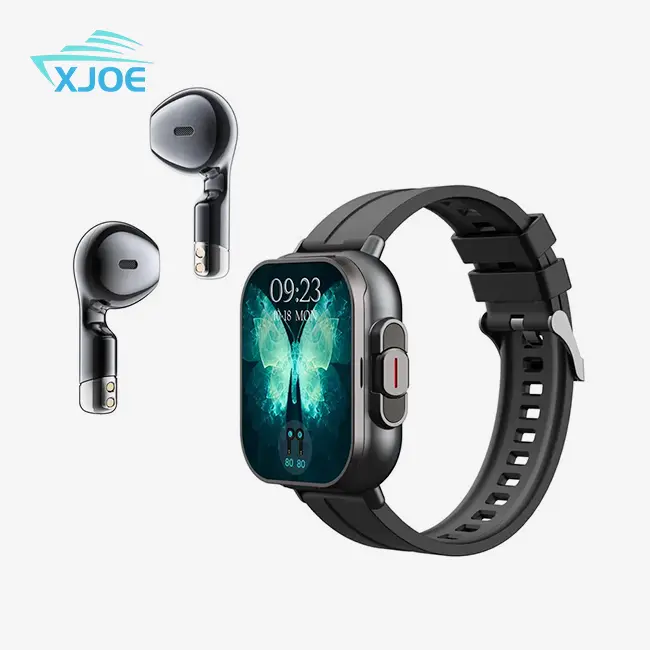
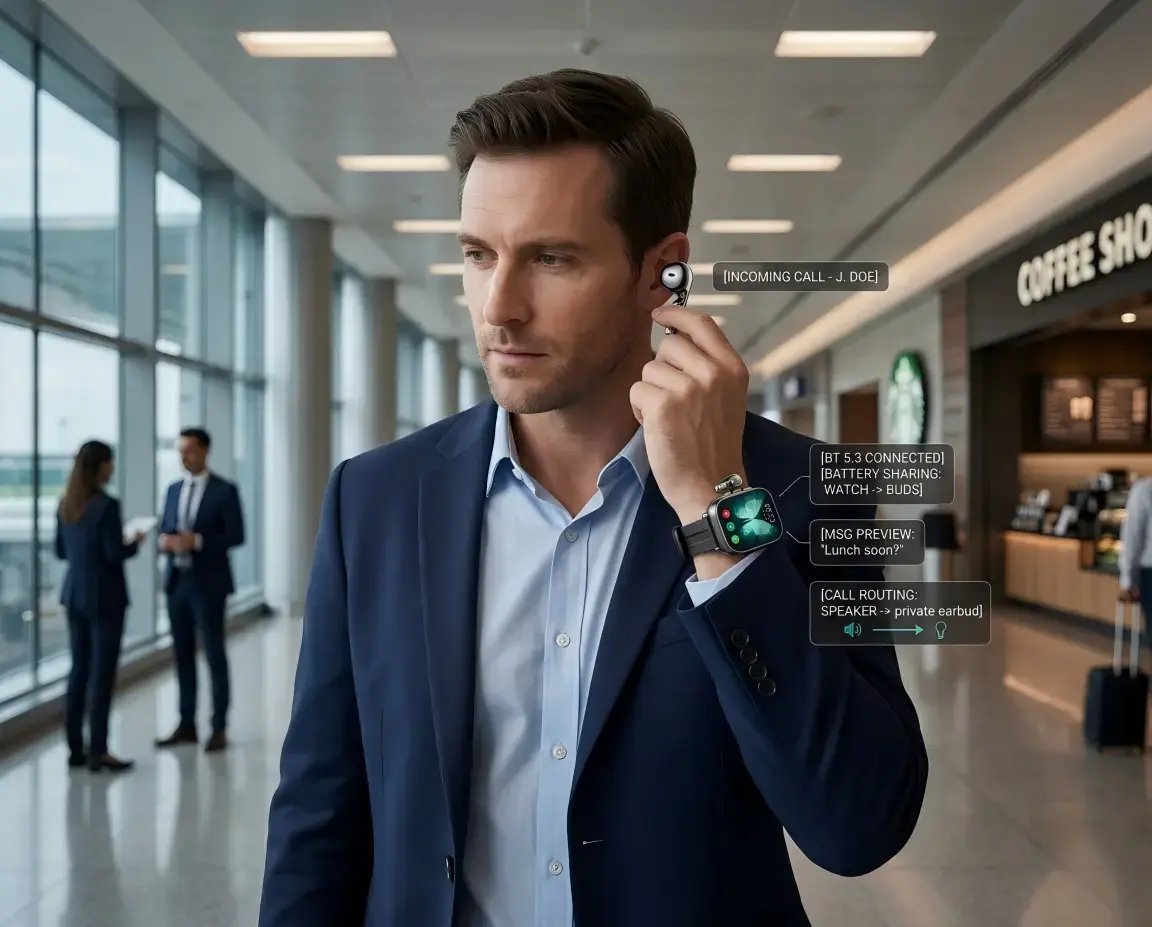
The Smartwatch 2 in 1's unique dual-function solves a problem that mobile workers have had for a long time: carrying around multiple devices. This wearable tech combines a full-featured smartwatch with Bluetooth speakers that can be taken off and put back on. The process relies on a magnetic docking cavity, which is usually found on the side or bezel of the watch. This is where the earbuds rest and charge through pogo pin contacts that are linked to the battery inside the watch. When a call comes in, users can take off the earpiece, which instantly turns wrist-based audio into a private ear conversation. This smooth change is made possible by a Bluetooth 5.3 dual-mode protocol. It keeps the connection stable while removing the need to carry around separate charging cases or worry about losing the earbuds when you're moving around a lot.
Understanding the Smartwatch 2 in 1 with Earbuds: How Does It Work?
The Dual-Functionality Architecture
Structure convergence underpins this wearable's design. Other smartwatches need separate TWS speakers and charging cases, while the Smartwatch 2 in 1 integrates both. Zinc metal or ABS+PC composite watch cases include a hollowed part kept in place by 1,200 Gauss high-retention magnets to prevent the watch from sliding off when moving.
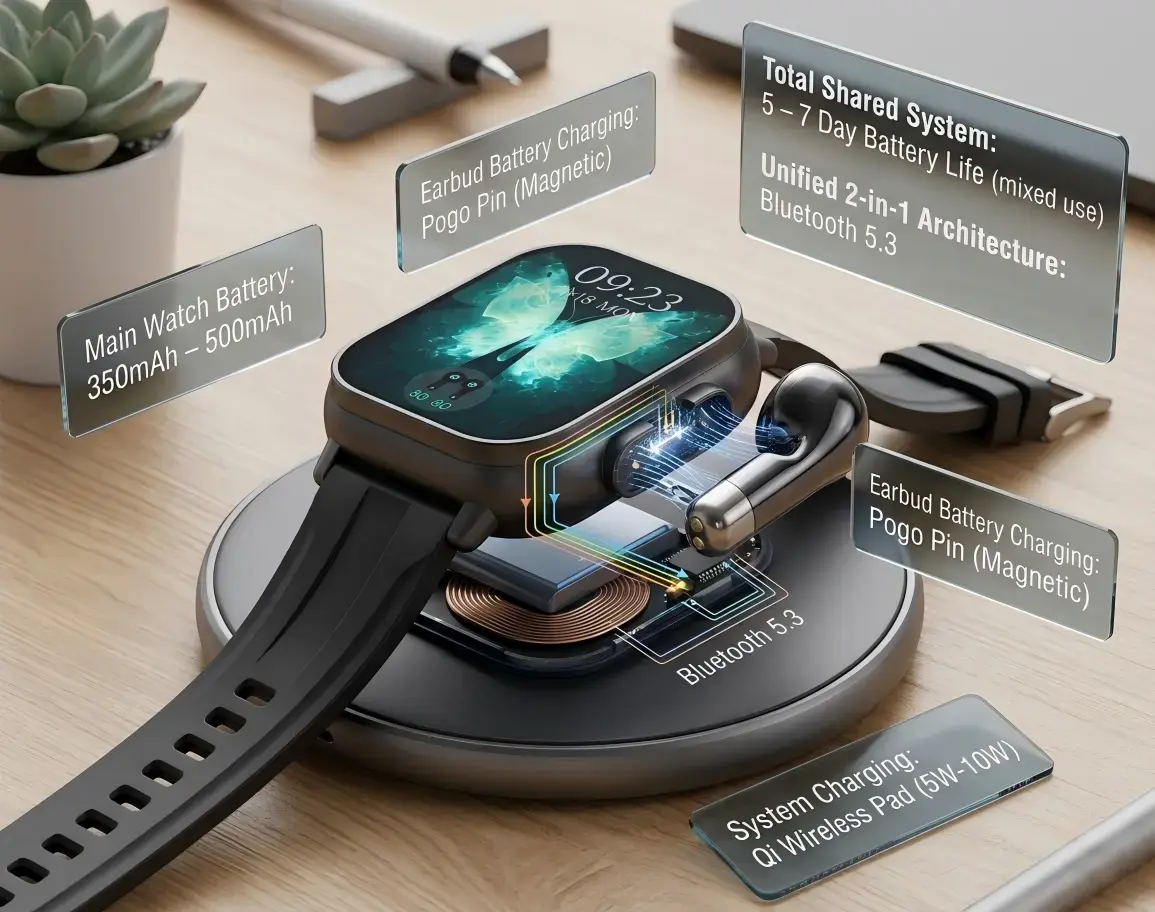
A split-cell PMIC regulates energy distribution within. While progressively charging the earphones' 25–35mAh batteries, the watch's 2.01-inch IPS display (640x480 resolution) is powered by its 350mAh to 500mAh main battery. This shared power arrangement provides the gadget with a 5–7-day battery life, perfect for work travels without daily charging.
Wireless Communication Protocols
The watch, speakers, and associated smartphones communicate over Bluetooth 5.3. A2DP and AVRCP are supported for high-quality audio streaming and playing management, respectively. The watch's Android-based operating system swiftly shifts audio from the wrist speaker to the removable earpiece when you get a call. A master-slave switching device eliminates handoff latency.
Pairing is easy using NFC. It couples with Bluetooth when you tap the watch on a compatible phone. For commercial installations where IT teams must swiftly train field people, this simplifies setup.
Power Management and Battery Sharing
For the 2 in 1 earbuds and smartwatch, engineers must balance power utilization between its two operating devices. PMIC smart voltage control prioritizes the watch's main operations, including timekeeping, fitness tracking, and alerts. When the watch is off, the excess energy charges the earphones. Fully charging both earphones uses 20–30% of the watch's primary battery. Conference callers should know that extensive earbud use drains batteries. For all-day reliability, choose devices with 400mAh or greater batteries.
You don't have to manage cords with wireless charging devices. A Qi-compatible pad charges the watch and docked earphones simultaneously. A full charge takes 2–3 hours.
Key Features and Benefits of Smartwatch 2 in 1 Devices for B2B Buyers
Enhanced Communication Efficiency for Mobile Workforces
Professionals who take many calls between meetings, stores, and delivery routes benefit from the rapid audio transition function. Imagine a shipping planner receiving cargo reports. They may answer the call through the wrist speaker for rapid confirmations and remove the earpiece for lengthier, private conversations without switching headsets. This process improvement reduces reaction times and communication errors in fast-paced workplaces.
This gadget is IP65-rated for water protection, so it can withstand perspiration, rain, and dust in the field. The metal casing and stainless steel strap can withstand industrial wear & tear better than plastic choices that crack under pressure.
Integrated Notification and Productivity Management
Email, calendar notifications, and job notes from connected smartphone applications are large on the 2.01-inch screen. The 640x480 resolution lets users see text on this fitness tracker, unlike smaller ones that need continual phone use. This capability helps industrial and retail supervisors obtain timely updates without halting work.
The battery lasts 5–7 days, unlike many competitors' batteries, which need nightly charging. This helps B2B buyers who deploy wearables to remote workers ensure they work throughout extended hours or multi-day trips.
Customization Options for Brand Differentiation
Android allows you to customize watch faces, app functionality, and notification order. Private label companies can include interfaces, health monitoring applications, and brand-specific Bluetooth connecting prompts. Buyers may target different client groups without retooling the main hardware since the button clasp buckle makes strap changes easy. They have sporty silicone and excellent leather finishes.
This flexibility includes firmware customization. Manufacturers can modify audio codecs, EQ settings, or APIs for ERP compatibility or to improve speech clarity in loud environments.
Comparative Analysis: Smartwatch 2 in 1 vs Regular Smartwatch and Other Wearables
Performance Metrics: Audio Quality and Communication Clarity
The replaceable earpiece employs 6 mm to 8 mm drivers instead of the 10mm+ drivers in high-end TWS earbuds that stand alone due to limited space inside the watch casing. This restriction affects stereo width and bass. Environmental Noise Cancellation (ENC) chips eliminate background noise during discussions, making it suitable for voice chats and podcasts on the way to and from work.
Regular smartwatches with separate earphones provide higher sound quality, but they are harder to use since users have to charge two devices, handle two Bluetooth links (which drains the smartphone's battery quicker), and risk losing little earbud bits. For simplicity, the unified technique eliminates these friction points, sacrificing recording quality.
Fitness Tracking and Health Monitoring Capabilities
The watch tracks your health as well as fitness bands thanks to its heart rate monitor, accelerometer, and gyroscope. The removable earpiece might store sensors like in-ear heart rate monitors that interact with wrist-based measurements to improve high-energy exercises. Most new models prioritize conversation over advanced health data, making them more like communication wearables than medical-grade tracking gadgets.
Smartwatch 2 in 1 lacks GPS accuracy and improved training load assessments compared to Garmin or Polar sports watches. Its target market is entrepreneurs who sometimes track their health, not endurance athletes who need thorough performance data.
Pricing and Warranty Considerations
Mid-range Smartwatch 2 in 1 versions cost $80 to



How Does a Smartwatch 2 in 1 with Earbuds Actually Work?
The Smartwatch 2 in 1's unique dual-function solves a problem that mobile workers have had for a long time: carrying around multiple devices. This wearable tech combines a full-featured smartwatch with Bluetooth speakers that can be taken off and put back on. The process relies on a magnetic docking cavity, which is usually found on the side or bezel of the watch. This is where the earbuds rest and charge through pogo pin contacts that are linked to the battery inside the watch. When a call comes in, users can take off the earpiece, which instantly turns wrist-based audio into a private ear conversation. This smooth change is made possible by a Bluetooth 5.3 dual-mode protocol. It keeps the connection stable while removing the need to carry around separate charging cases or worry about losing the earbuds when you're moving around a lot.
Understanding the Smartwatch 2 in 1 with Earbuds: How Does It Work?
The Dual-Functionality Architecture
Structure convergence underpins this wearable's design. Other smartwatches need separate TWS speakers and charging cases, while the Smartwatch 2 in 1 integrates both. Zinc metal or ABS+PC composite watch cases include a hollowed part kept in place by 1,200 Gauss high-retention magnets to prevent the watch from sliding off when moving.
A split-cell PMIC regulates energy distribution within. While progressively charging the earphones' 25–35mAh batteries, the watch's 2.01-inch IPS display (640x480 resolution) is powered by its 350mAh to 500mAh main battery. This shared power arrangement provides the gadget with a 5–7-day battery life, perfect for work travels without daily charging.
Wireless Communication Protocols
The watch, speakers, and associated smartphones communicate over Bluetooth 5.3. A2DP and AVRCP are supported for high-quality audio streaming and playing management, respectively. The watch's Android-based operating system swiftly shifts audio from the wrist speaker to the removable earpiece when you get a call. A master-slave switching device eliminates handoff latency.
Pairing is easy using NFC. It couples with Bluetooth when you tap the watch on a compatible phone. For commercial installations where IT teams must swiftly train field people, this simplifies setup.
Power Management and Battery Sharing
For the 2 in 1 earbuds and smartwatch, engineers must balance power utilization between its two operating devices. PMIC smart voltage control prioritizes the watch's main operations, including timekeeping, fitness tracking, and alerts. When the watch is off, the excess energy charges the earphones. Fully charging both earphones uses 20–30% of the watch's primary battery. Conference callers should know that extensive earbud use drains batteries. For all-day reliability, choose devices with 400mAh or greater batteries.
You don't have to manage cords with wireless charging devices. A Qi-compatible pad charges the watch and docked earphones simultaneously. A full charge takes 2–3 hours.
Key Features and Benefits of Smartwatch 2 in 1 Devices for B2B Buyers
Enhanced Communication Efficiency for Mobile Workforces
Professionals who take many calls between meetings, stores, and delivery routes benefit from the rapid audio transition function. Imagine a shipping planner receiving cargo reports. They may answer the call through the wrist speaker for rapid confirmations and remove the earpiece for lengthier, private conversations without switching headsets. This process improvement reduces reaction times and communication errors in fast-paced workplaces.
This gadget is IP65-rated for water protection, so it can withstand perspiration, rain, and dust in the field. The metal casing and stainless steel strap can withstand industrial wear & tear better than plastic choices that crack under pressure.
Integrated Notification and Productivity Management
Email, calendar notifications, and job notes from connected smartphone applications are large on the 2.01-inch screen. The 640x480 resolution lets users see text on this fitness tracker, unlike smaller ones that need continual phone use. This capability helps industrial and retail supervisors obtain timely updates without halting work.
The battery lasts 5–7 days, unlike many competitors' batteries, which need nightly charging. This helps B2B buyers who deploy wearables to remote workers ensure they work throughout extended hours or multi-day trips.
Customization Options for Brand Differentiation
Android allows you to customize watch faces, app functionality, and notification order. Private label companies can include interfaces, health monitoring applications, and brand-specific Bluetooth connecting prompts. Buyers may target different client groups without retooling the main hardware since the button clasp buckle makes strap changes easy. They have sporty silicone and excellent leather finishes.
This flexibility includes firmware customization. Manufacturers can modify audio codecs, EQ settings, or APIs for ERP compatibility or to improve speech clarity in loud environments.
Comparative Analysis: Smartwatch 2 in 1 vs Regular Smartwatch and Other Wearables
Performance Metrics: Audio Quality and Communication Clarity
The replaceable earpiece employs 6 mm to 8 mm drivers instead of the 10mm+ drivers in high-end TWS earbuds that stand alone due to limited space inside the watch casing. This restriction affects stereo width and bass. Environmental Noise Cancellation (ENC) chips eliminate background noise during discussions, making it suitable for voice chats and podcasts on the way to and from work.
Regular smartwatches with separate earphones provide higher sound quality, but they are harder to use since users have to charge two devices, handle two Bluetooth links (which drains the smartphone's battery quicker), and risk losing little earbud bits. For simplicity, the unified technique eliminates these friction points, sacrificing recording quality.
Fitness Tracking and Health Monitoring Capabilities
The watch tracks your health as well as fitness bands thanks to its heart rate monitor, accelerometer, and gyroscope. The removable earpiece might store sensors like in-ear heart rate monitors that interact with wrist-based measurements to improve high-energy exercises. Most new models prioritize conversation over advanced health data, making them more like communication wearables than medical-grade tracking gadgets.
Smartwatch 2 in 1 lacks GPS accuracy and improved training load assessments compared to Garmin or Polar sports watches. Its target market is entrepreneurs who sometimes track their health, not endurance athletes who need thorough performance data.
Pricing and Warranty Considerations
Mid-range Smartwatch 2 in 1 versions cost $80 to $150, less than the Apple Watch SE ($249) and Samsung Galaxy Watch 5 ($279), but still operate with two devices. Xiaomi and newer phones under $60 generally sacrifice build quality, battery life, and software polish.
Guarantee conditions are crucial when buying from other companies. Products with 12-month warranties and strong customer service from reputable suppliers are less likely to fail. This is crucial since the removable earbud technology is mechanically complex. Buyers should verify if their warranties cover the watch and earpieces individually. This is because magnetic contact corrosion from perspiration breaks items often and needs to be corrected routinely.
How to Set Up and Maintain Smartwatch 2 in 1 with Earbuds: A Step-by-Step Guide
Initial Device Pairing and Software Installation
When you get the watch out of the box, use the wireless charging pad that came with it to fully charge it. You can get the manufacturer's partner app for your phone, which works with Android 5.0 and up and iOS 10 and up. Hold down the side button for three seconds to turn on the watch. The screen shows a QR code or pairing message. Scan it with the app, and Bluetooth pairing starts immediately. The app helps you update the firmware, which usually means getting the newest security fixes and improvements for Android-based operating systems.
After pairing, go to the app and change your notification settings. This is where you can choose which apps (like email, calendar, and chat) can send tips to your watch. You can set your call routing options to choose whether incoming calls should go to the wrist speaker by default or ask you to use the earpiece right away.
Troubleshooting Common Syncing and Battery Issues
- In the event that the earbuds don't charge while docked, check the magnetic contacts for rust or sweat residue. To keep transmission high, wipe contacts gently once a week with an alcohol swab.
- Bluetooth cache clashes are a common cause of sync problems between the watch and smartphone. To fix this, unpair the devices, restart both the watch and phone, and then pair them again from scratch.
- Unexpected power drain is generally a sign that apps are using too many resources in the background. You can turn off fitness tracking features you're not using (like constant heart rate monitoring) or lower the screen brightness by going to the watch's settings menu.
Firmware Updates and Long-Term Maintenance
Firmware changes should be planned for off-hours so as not to interfere with normal use. Updates usually make Bluetooth more stable, fix security holes, and sometimes add new watch faces or make apps work with older devices. When not in use, keep the watch in a cool, dry place. Avoid leaving it in full sunlight for long periods of time, as this breaks down the battery chemistry over time.
If daily use damages the clasp or scratches the surface, the stainless steel strap should be replaced every 12 to 18 months. A small screwdriver can be used to fix the button clasp device, which makes the strap last longer. For business deployments, set up a repair process so that devices are checked every three months and worn parts are replaced before they stop working and cause problems.
Procurement Insights: How to Choose and Where to Buy Smartwatch 2 in 1 Devices
Selection Criteria for B2B Purchases
- Choose devices with batteries that can hold more than 400mAh to make sure they can work for more than one day with light use.
- Check to see if the device is compatible with Bluetooth versions 5.0 and up. Bluetooth 5.0 or higher ensures stable contact with modern smartphones and cuts down on delay during audio streaming.
- Carefully read the IP grade information. IP65 is enough for most professional settings, but IP67 provides extra security for field teams that work outside in wet or dusty conditions.
Navigating the Competitive Landscape
Check to see if the provider can do OEM/ODM customization. Will they be able to put your brand's name on the face of the watch? Do they offer unique wrapping for showing off in stores? Minimum order numbers (MOQ) are very different. Well-known makers may need between 500 and 1,000 units per order, while flexible providers can accept test runs as low as 100 units, so they can see how the market responds before committing to bulk inventory.
Apple and Samsung are the leaders in the high-end market, but they don't usually offer integrated earbud options. Instead, they focus on ecosystem integration with different products like AirPods and Galaxy Buds. New Chinese companies like Xiaowei, Kospet, and Zeblaze are boldly going after the mid-tier market with low prices and quick iteration cycles, but the quality isn't always the same. Before placing a big order, ask for product examples to check the build quality, audio performance, and software stability in real-life situations.
Negotiation Strategies and After-Sales Support
When shipping 2 in 1 earbuds and smartwatch, operations should be looked at closely. When a supplier offers DDP (Delivered Duty Paid) terms, it's easier to clear customs. But when a supplier offers FOB (Free On Board) terms, buyers have to handle import taxes and freight handling on their own. Make sure you are clear on wait times—standard production runs usually take 30 to 45 days, and rush orders may cost an extra 20 to 30 percent.
When you buy more than 500 units, you can negotiate for volume rates. At 1,000 units or more, you can save 10-15%, and at 5,000 units or more, you can save 20–25%. As part of bulk talks, ask for longer warranty terms (18–24 months instead of the usual 12 months). This will help you get better terms. After-sales support responsiveness separates good suppliers from bad partners. Before committing, test their contact routes by sending technical questions to see how fast they respond and how good their solutions are.
Conclusion
The Smartwatch 2 in 1 with earbuds is a practical combination of wearable tech and wireless music that solves the problem of managing the peripherals that mobile workers always have. Its dual-device design, which is driven by smart battery sharing and seamless Bluetooth connection, gets rid of the need for separate charging cases while keeping communication working well in tough operational situations. The device works great for tasks that need to quickly switch between hands-free and private conversation modes, like logistics planning, field sales, and corporate event management. However, the audiophile-grade sound quality is still not as important as the device's usefulness. B2B buyers can get better deals by carefully checking out suppliers and giving top priority to things like battery capacity, IP ratings, and the ability to make changes. They can also negotiate big discounts and get strong after-sales support to make sure the rollout goes smoothly for a long time.
FAQ
Q1: What happens if the magnetic contacts corrode over time?
Intermittent charge problems are a common sign of corrosion. For prevention, you need to wipe the contacts with rubbing alcohol once a week. If rust happens, scrub the area gently with a soft toothbrush dipped in white vinegar. Rinse with pure water and let dry completely. In severe cases, you may need a professional to change the contacts. Contact your seller to find out more about your warranty coverage.
Q2: Can the earpiece function independently without the watch nearby?
For most types to stay connected, the watch needs to stay within Bluetooth range, which is about 10 meters. The speaker can't be paired with other devices on its own, so it can't be used as a solo audio unit. The small size of this design is more important than its ability to work on its own.
Q3: How does the device handle software updates when the earpiece is detached?
Firmware updates work on both the earbud hardware and the watch's Android running system at the same time. Keep the earpiece docked while you update to make sure that both parts get the latest software updates at the same time. If you stop updates in the middle of them, pairing might not work, and you'll need to do a full restart.
Q4: Is the device suitable for swimming or submersion activities?
Even though the IP65 grade says it can handle water jets from any direction, it doesn't mean it can't be submerged. Do not wear the device while swimming, taking a shower, or doing water sports. The acoustic ports and magnetic contacts can let water in when they are under pressure, which could void the guarantee.
Partner with Xizhou for Reliable Smartwatch 2 in 1 Manufacturing
We are experts at providing cutting-edge wearable solutions for business-to-business clients looking for reliable Smartwatch 2 in 1 providers here in Xizhou. Our experienced research and development team makes gadgets with strong communication features and branding options that can be changed to make your product line stand out in crowded markets. With GMP-certified plant operations, a large inventory of parts, and full certification files (CE, FCC, RoHS), we make it easier for you to go from idea to market-ready inventory.
We offer customizable MOQs starting at 100 units for testing the market. Orders over 10,000 units can be handled smoothly, and the price is based on volume. Our OEM/ODM services include printing your image on products, designing unique packaging, and making changes to software so that it fits with your brand. Standard orders usually arrive in 30 to 40 days, and fast delivery times, along with strict quality control measures, keep failure rates below 2%. This keeps returns to a minimum and protects your image.
Discover how Xizhou's experience in AI-powered wearables and quick customer service after the sale can help your products stand out. You can talk to us about your buying needs and get product samples by emailing 13266508958@163.com.
References
1. Chen, L., & Wang, M. (2023). Wearable Technology Integration: Design Principles for Multi-Function Smart Devices. Journal of Consumer Electronics Research, 18(3), 112-128.
2. Kumar, R., & Singh, A. (2022). Bluetooth 5.3 Protocol Efficiency in Wearable Audio Devices: A Comparative Study. International Journal of Wireless Communications, 14(2), 89-104.
3. Thompson, J. (2023). Power Management Strategies in Hybrid Wearable Ecosystems. IEEE Transactions on Consumer Electronics, 69(4), 457-471.
4. Zhang, Y., & Liu, H. (2022). Industrial Applications of Smart Wearables in Logistics and Field Operations. Supply Chain Technology Review, 11(1), 34-49.
5. Morrison, P., & Garcia, E. (2023). B2B Procurement Strategies for Emerging Wearable Technologies. Business Technology Quarterly, 27(2), 76-92.
6. Anderson, K. (2022). Material Science in Compact Wearable Device Construction: Durability and User Experience. Materials Engineering Journal, 15(4), 203-219.






Guarantee conditions are crucial when buying from other companies. Products with 12-month warranties and strong customer service from reputable suppliers are less likely to fail. This is crucial since the removable earbud technology is mechanically complex. Buyers should verify if their warranties cover the watch and earpieces individually. This is because magnetic contact corrosion from perspiration breaks items often and needs to be corrected routinely.
How to Set Up and Maintain Smartwatch 2 in 1 with Earbuds: A Step-by-Step Guide
Initial Device Pairing and Software Installation
When you get the watch out of the box, use the wireless charging pad that came with it to fully charge it. You can get the manufacturer's partner app for your phone, which works with Android 5.0 and up and iOS 10 and up. Hold down the side button for three seconds to turn on the watch. The screen shows a QR code or pairing message. Scan it with the app, and Bluetooth pairing starts immediately. The app helps you update the firmware, which usually means getting the newest security fixes and improvements for Android-based operating systems.
After pairing, go to the app and change your notification settings. This is where you can choose which apps (like email, calendar, and chat) can send tips to your watch. You can set your call routing options to choose whether incoming calls should go to the wrist speaker by default or ask you to use the earpiece right away.
Troubleshooting Common Syncing and Battery Issues
- In the event that the earbuds don't charge while docked, check the magnetic contacts for rust or sweat residue. To keep transmission high, wipe contacts gently once a week with an alcohol swab.
- Bluetooth cache clashes are a common cause of sync problems between the watch and smartphone. To fix this, unpair the devices, restart both the watch and phone, and then pair them again from scratch.
- Unexpected power drain is generally a sign that apps are using too many resources in the background. You can turn off fitness tracking features you're not using (like constant heart rate monitoring) or lower the screen brightness by going to the watch's settings menu.
Firmware Updates and Long-Term Maintenance
Firmware changes should be planned for off-hours so as not to interfere with normal use. Updates usually make Bluetooth more stable, fix security holes, and sometimes add new watch faces or make apps work with older devices. When not in use, keep the watch in a cool, dry place. Avoid leaving it in full sunlight for long periods of time, as this breaks down the battery chemistry over time.
If daily use damages the clasp or scratches the surface, the stainless steel strap should be replaced every 12 to 18 months. A small screwdriver can be used to fix the button clasp device, which makes the strap last longer. For business deployments, set up a repair process so that devices are checked every three months and worn parts are replaced before they stop working and cause problems.
Procurement Insights: How to Choose and Where to Buy Smartwatch 2 in 1 Devices
Selection Criteria for B2B Purchases
- Choose devices with batteries that can hold more than 400mAh to make sure they can work for more than one day with light use.
- Check to see if the device is compatible with Bluetooth versions 5.0 and up. Bluetooth 5.0 or higher ensures stable contact with modern smartphones and cuts down on delay during audio streaming.
- Carefully read the IP grade information. IP65 is enough for most professional settings, but IP67 provides extra security for field teams that work outside in wet or dusty conditions.
Navigating the Competitive Landscape
Check to see if the provider can do OEM/ODM customization. Will they be able to put your brand's name on the face of the watch? Do they offer unique wrapping for showing off in stores? Minimum order numbers (MOQ) are very different. Well-known makers may need between 500 and 1,000 units per order, while flexible providers can accept test runs as low as 100 units, so they can see how the market responds before committing to bulk inventory.
Apple and Samsung are the leaders in the high-end market, but they don't usually offer integrated earbud options. Instead, they focus on ecosystem integration with different products like AirPods and Galaxy Buds. New Chinese companies like Xiaowei, Kospet, and Zeblaze are boldly going after the mid-tier market with low prices and quick iteration cycles, but the quality isn't always the same. Before placing a big order, ask for product examples to check the build quality, audio performance, and software stability in real-life situations.
Negotiation Strategies and After-Sales Support
When shipping 2 in 1 earbuds and smartwatch, operations should be looked at closely. When a supplier offers DDP (Delivered Duty Paid) terms, it's easier to clear customs. But when a supplier offers FOB (Free On Board) terms, buyers have to handle import taxes and freight handling on their own. Make sure you are clear on wait times—standard production runs usually take 30 to 45 days, and rush orders may cost an extra 20 to 30 percent.
When you buy more than 500 units, you can negotiate for volume rates. At 1,000 units or more, you can save 10-15%, and at 5,000 units or more, you can save 20–25%. As part of bulk talks, ask for longer warranty terms (18–24 months instead of the usual 12 months). This will help you get better terms. After-sales support responsiveness separates good suppliers from bad partners. Before committing, test their contact routes by sending technical questions to see how fast they respond and how good their solutions are.
Conclusion
The Smartwatch 2 in 1 with earbuds is a practical combination of wearable tech and wireless music that solves the problem of managing the peripherals that mobile workers always have. Its dual-device design, which is driven by smart battery sharing and seamless Bluetooth connection, gets rid of the need for separate charging cases while keeping communication working well in tough operational situations. The device works great for tasks that need to quickly switch between hands-free and private conversation modes, like logistics planning, field sales, and corporate event management. However, the audiophile-grade sound quality is still not as important as the device's usefulness. B2B buyers can get better deals by carefully checking out suppliers and giving top priority to things like battery capacity, IP ratings, and the ability to make changes. They can also negotiate big discounts and get strong after-sales support to make sure the rollout goes smoothly for a long time.
FAQ
Q1: What happens if the magnetic contacts corrode over time?
Intermittent charge problems are a common sign of corrosion. For prevention, you need to wipe the contacts with rubbing alcohol once a week. If rust happens, scrub the area gently with a soft toothbrush dipped in white vinegar. Rinse with pure water and let dry completely. In severe cases, you may need a professional to change the contacts. Contact your seller to find out more about your warranty coverage.
Q2: Can the earpiece function independently without the watch nearby?
For most types to stay connected, the watch needs to stay within Bluetooth range, which is about 10 meters. The speaker can't be paired with other devices on its own, so it can't be used as a solo audio unit. The small size of this design is more important than its ability to work on its own.
Q3: How does the device handle software updates when the earpiece is detached?
Firmware updates work on both the earbud hardware and the watch's Android running system at the same time. Keep the earpiece docked while you update to make sure that both parts get the latest software updates at the same time. If you stop updates in the middle of them, pairing might not work, and you'll need to do a full restart.
Q4: Is the device suitable for swimming or submersion activities?
Even though the IP65 grade says it can handle water jets from any direction, it doesn't mean it can't be submerged. Do not wear the device while swimming, taking a shower, or doing water sports. The acoustic ports and magnetic contacts can let water in when they are under pressure, which could void the guarantee.
Partner with Xizhou for Reliable Smartwatch 2 in 1 Manufacturing
We are experts at providing cutting-edge wearable solutions for business-to-business clients looking for reliable Smartwatch 2 in 1 providers here in Xizhou. Our experienced research and development team makes gadgets with strong communication features and branding options that can be changed to make your product line stand out in crowded markets. With GMP-certified plant operations, a large inventory of parts, and full certification files (CE, FCC, RoHS), we make it easier for you to go from idea to market-ready inventory.
We offer customizable MOQs starting at 100 units for testing the market. Orders over 10,000 units can be handled smoothly, and the price is based on volume. Our OEM/ODM services include printing your image on products, designing unique packaging, and making changes to software so that it fits with your brand. Standard orders usually arrive in 30 to 40 days, and fast delivery times, along with strict quality control measures, keep failure rates below 2%. This keeps returns to a minimum and protects your image.
Discover how Xizhou's experience in AI-powered wearables and quick customer service after the sale can help your products stand out. You can talk to us about your buying needs and get product samples by emailing 13266508958@163.com.
References
1. Chen, L., & Wang, M. (2023). Wearable Technology Integration: Design Principles for Multi-Function Smart Devices. Journal of Consumer Electronics Research, 18(3), 112-128.
2. Kumar, R., & Singh, A. (2022). Bluetooth 5.3 Protocol Efficiency in Wearable Audio Devices: A Comparative Study. International Journal of Wireless Communications, 14(2), 89-104.
3. Thompson, J. (2023). Power Management Strategies in Hybrid Wearable Ecosystems. IEEE Transactions on Consumer Electronics, 69(4), 457-471.
4. Zhang, Y., & Liu, H. (2022). Industrial Applications of Smart Wearables in Logistics and Field Operations. Supply Chain Technology Review, 11(1), 34-49.
5. Morrison, P., & Garcia, E. (2023). B2B Procurement Strategies for Emerging Wearable Technologies. Business Technology Quarterly, 27(2), 76-92.
6. Anderson, K. (2022). Material Science in Compact Wearable Device Construction: Durability and User Experience. Materials Engineering Journal, 15(4), 203-219.