

ECG SpO2 Smartwatch Maintenance Tips for Long-Term Reliability
Medical Disclaimer: The health monitoring features discussed in this article, including ECG and SpO2 readings, are intended for general wellness tracking purposes only. They do not constitute medical advice, diagnosis, or treatment. Always consult a qualified healthcare professional for any medical concerns.
If you source or sell health-focused wearables, you already know that device reliability directly shapes customer satisfaction and repeat business. An endurance smartwatch packed with ECG and SpO2 sensors is a high-value product — but without proper maintenance guidance, those sensors degrade faster than expected, battery performance drops, and returns start piling up. I want to walk you through what actually keeps these devices running accurately over the long term, so you can make smarter procurement decisions and support your customers more effectively.
Understanding ECG SpO2 Smartwatch Technology and Common Maintenance Challenges
What Makes These Devices Technically Demanding
Electrocardiogram (ECG) and SpO2 monitors are precise instruments that are placed in compact casings that may be worn. For the purpose of determining the electrical activity of the heart, the electrocardiogram feature employs electrodes that are applied to the skin. In contrast, the SpO2 monitor employs photoplethysmography (PPG) with LED light in order to estimate the amount of oxygen present in the blood. Both are susceptible to damage from dirt on the surface, wear and tear during physical use, and faults in software.
If you are a business-to-business (B2B) buyer, such as an Amazon FBA seller, a reseller, or a customer of an OEM brand, being aware of these shortcomings may assist you in avoiding support issues, reducing the number of returns, and producing items that get positive ratings. Given the frequency with which endurance smartwatches are used in corporate wellness programs, community health monitoring systems, or fitness coaching platforms, it is of the utmost importance to be aware of the maintenance requirements for these types of smartwatches.
The loss of battery capacity over time, oxidation of the electrocardiogram electrode as a result of perspiration and humidity, SpO2 LED alignment drift, watertight seal wear at the charging port, and firmware compatibility gaps between the Android and iOS ecosystems are some of the issues that procurement teams have to be aware of.
Essential Daily and Periodic Maintenance Practices for Endurance Smartwatches
Daily Habits That Protect Sensor Accuracy
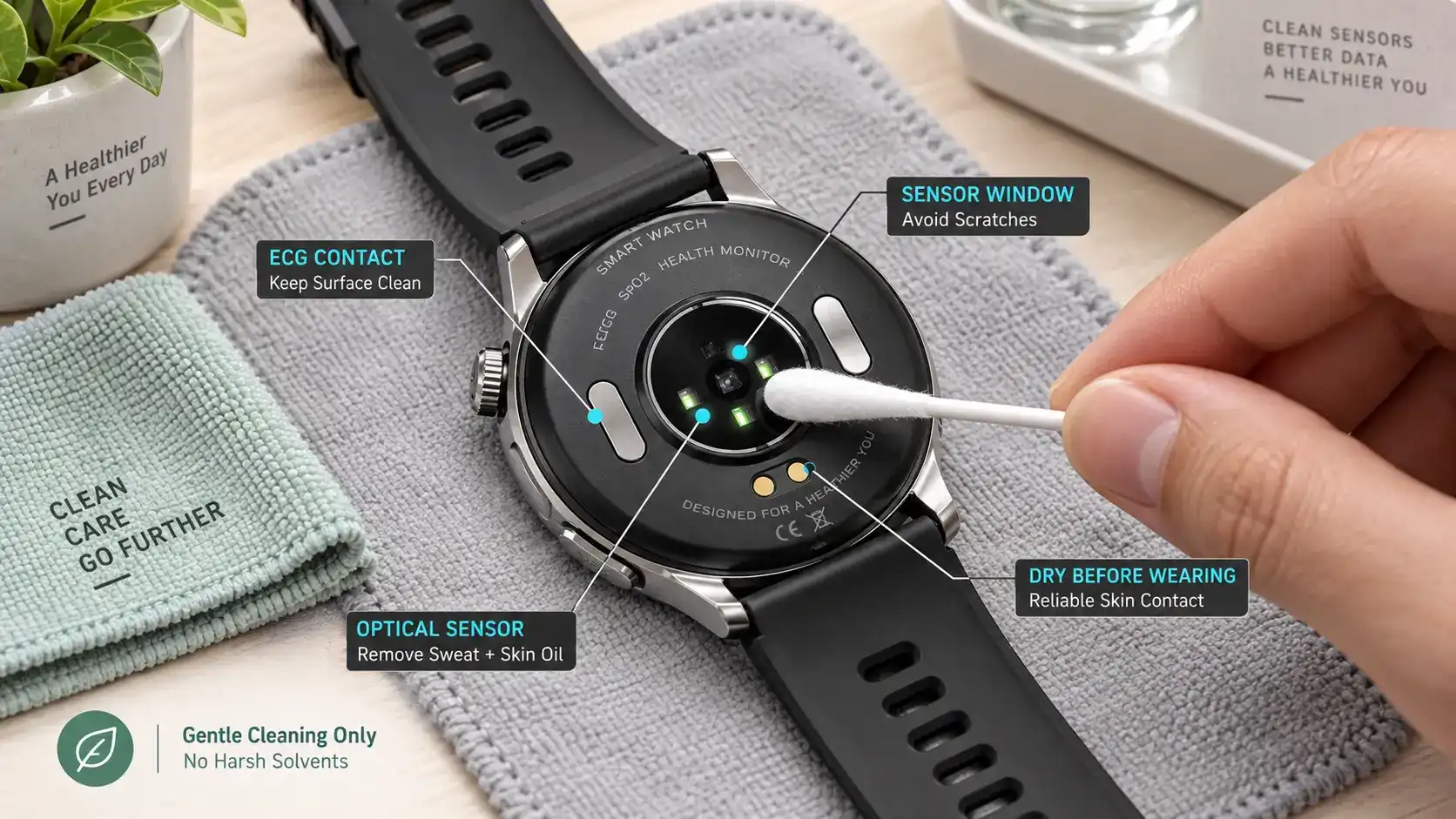
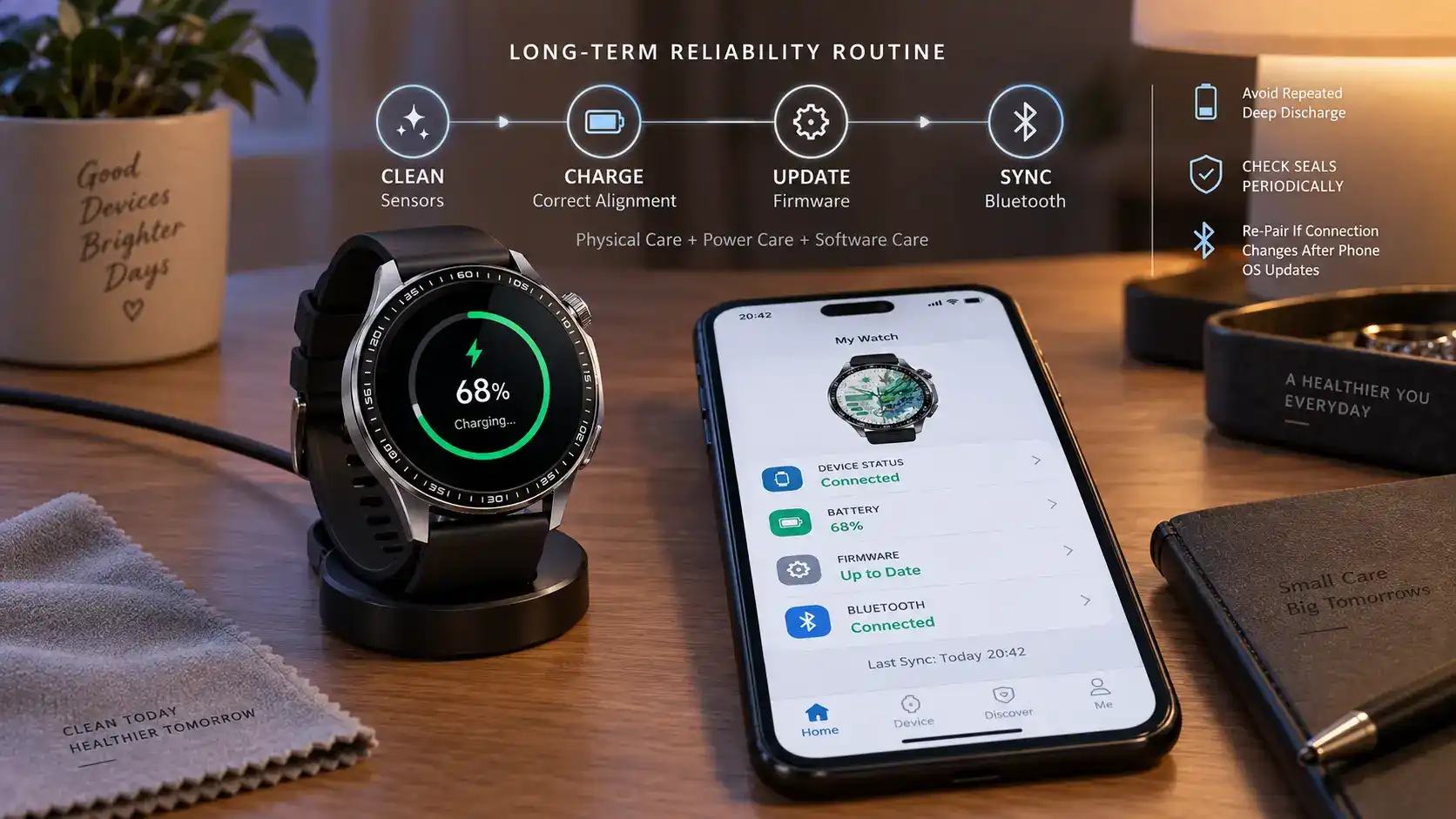
Sensor surfaces get dirty with sweat, skin oils, and dust from the air faster than most users know. After each workout, wipe the bottom of the watch with a slightly damp, lint-free cloth to stop buildup that could affect the optical SpO2 readings. Alcohol-based cleaners should not be used because they speed up the breakdown of silicone straps and can damage the finish on zinc metal frames.
As important as cleaning is being disciplined. Full deep cycles done every day are harder on lithium cells than partial charges that keep the battery between 20% and 80% charged. For an endurance smartwatch with a 300mAh battery, this practice extends the useful charge capacity over 12 to 18 months of regular use.
Periodic Checks That Prevent Bigger Problems
Habits that are performed on a regular basis, in addition to procedures for planned maintenance, safeguard performance over time. When you are writing up your after-sales assistance, you should include the consistent responsibilities that are listed below:
- Updates to the firmware are performed on a regular basis. Manufacturers strive to enhance algorithms that have a direct impact on the efficiency with which tracking functions. In the event that health monitoring devices get updates at inconvenient times, it is possible for SpO2 levels to fluctuate by a number of percentage points. When it comes to devices that make use of the RDFit companion app, checking for updates once a month ensures that the sensor calibration is in accordance with the most recent advancements in signal processing.
- Inspection of the waterproof seal (once every ninety days): Although devices with an IP67 rating are able to withstand dust and brief immersion in water, the seals that surround buttons and charging connections get worn down over time as a result of being bent and continuously heated and cooled. Performing a visual inspection of the port covers to look for cracks or changes in colour may assist in locating issues before they result in water damage.
- Long-term skin contact may create micro-oxidation on the ECG pads that are located on the back of the watch. This can be remedied by cleaning the sensor contact every two weeks. Maintaining the same conductivity and readings may be accomplished by applying a dry cotton swab to the contact locations in a gentle manner.
By taking these basic actions, the number of complaints connected to support for sensors is greatly reduced, which is particularly beneficial for Amazon sellers who manage product evaluations on a large scale.
Advanced Troubleshooting and Problem-Solving for Common Issues
Battery Wear and Charging Anomalies
A lithium battery that used to last 21 days in basic mode but now only lasts 10 days is showing signs of normal aging. When sellers and distributors get returns, they should check to see if the problem is actually a degrading cell or a bug in the firmware that controls power. Firmware bugs can often be fixed by updating the firmware. Keeping devices at room temperature (about 68°F/20°C) and not fully discharging them before storing them greatly increases the life of the cells.
There is a tendency for smartwatch wireless charging contacts to be sensitive to alignment. If a device only charges sometimes, cleaning the charging pins and making sure the charger pad sits flat can often fix the problem without having to buy new hardware.
Sensor Recalibration and Connectivity Diagnostics
It is not because the hardware is faulty if your SpO2 and ECG readings are consistently inaccurate, such as when a healthy person's SpO2 value is below 92%. Instead, it is likely that the sensors are not aligned properly or that the contacts are unclean. The majority of these issues may be resolved by first resetting the device to its initial settings and then re-establishing a connection between the device and the RDFit app.
It is common for BLE 5.0 devices to have difficulties connecting over Bluetooth when the operating system of the phone undergoes an upgrade that alters the way the Bluetooth stack operates. End customers are encouraged to forget the device and re-pair it following significant phone software upgrades, which results in the majority of persistent disconnection concerns being resolved. For corporate health monitoring installations in which the watch links to company mobile device management (MDM) systems, it is well worth the effort to ensure that the compatibility matrix is kept up to date.
Maintenance Needs Compared: Endurance Smartwatch vs. Standard Fitness Tracker
A basic fitness tracker uses an accelerometer to keep track of steps and calories. When it comes to upkeep needs, a long battery life smartwatch that can measure ECG and SpO2 is very different from other products.
Standard fitness trackers don't need much sensor-level maintenance because the accelerometers are passive and sealed. Wearable health monitors, on the other hand, need care for their active electrodes and visual sensors. They also update their firmware more often because the accuracy of their health algorithms is regulated in some markets and is thought to get better over time.
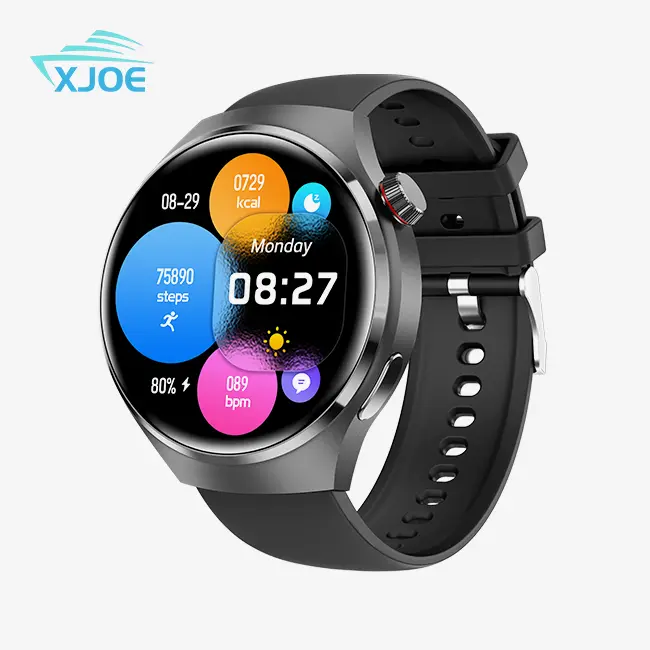
Another difference is the size of the battery. The 300mAh battery powers a 1.53-inch IPS round display with BLE 5.0 and ongoing tracking for 21 days in basic mode. This shows good power management, but it still needs more care when charging than a simple pedometer-style band. The level of waterproofing needed also changes based on the use case. For example, IP67 is good for rain and washing, but buyers who want to use these devices in swimming pools or other high-sweat areas should make sure users know what the depth limits are.
For procurement professionals, these differences help them come up with reasonable warranty policies, user guides, and the infrastructure they need for support after the sale.
Selecting Low-Maintenance Endurance Smartwatches for Procurement
When purchasing health devices with the intention of reselling them or putting them under your own brand name, the objective is to minimise the amount of total ownership friction that occurs during the duration of the product's life. The following is a list of the most important factors that make maintenance simpler while maintaining the device's value:
- Devices that are able to track for 15 to 21 days in normal mode have a longer battery life. This means that they experience less wear and tear from charging and have fewer returns due to issues with the battery.
- Materials for housing that are long-lasting: Zinc metal cases do not flex as readily as plastic ones do when they are used on a daily basis. This results in less stress on the seal and ensures that the watertight integrity is maintained for a longer period of time.
- Support for a wide range of languages: A device that supports more than thirty app languages and twenty-eight firmware languages, such as models that run the RDFit platform, eliminates translation issues in all markets, which means that consumers who do not understand English need less assistance.
- In the design of wireless charging, the elimination of a charge connector eliminates one of the most typical areas where waterproofing fails in consumer electronics.
- Connectivity with Bluetooth Low Energy (BLE) 5.0: The most recent Bluetooth standard creates connections that are more reliable and reduces the number of occasions when iOS and Android devices have difficulty connecting.
When compared to fixing quality concerns in a reactive manner, prioritising an endurance wristwatch that is created with these features from the beginning is far more cost-effective financially.
Conclusion
ECG SpO2 smartwatches like the endurance smartwatch can be kept in good shape with regular habits like keeping the sensors clean, charging them in the right way, updating the software on time, and checking the hardware from time to time. When B2B buyers buy these devices in bulk, including maintenance instructions in materials that customers see directly lowers the number of returns and improves the brand's reputation. Long-term reliability can be achieved without a lot of extra work if you choose products that are built to last, manage power well, and work with a lot of other products from the start.
FAQ
1. How often should ECG and SpO2 sensor contacts be cleaned?
Cleaning the sensor contacts with a dry cotton swab every two weeks keeps oxidation from building up and lowering the accuracy of the reading. After tasks that make you sweat a lot, it's best to give it a quick wipe-down with a warm, lint-free cloth.
2. Does wireless charging affect waterproof integrity?
The actual charging port is one of the most common places for moisture to get into wearable tech, but wireless charging gets rid of that problem. Most of the time, devices that can be charged wirelessly keep their IP67 rating better over time.
3. What causes SpO2 readings to appear inaccurate?
The main reasons for SpO2 shifts are optical sensors that are dirty, wristbands that don't fit right, and software that is too old. Most reported accuracy problems can be fixed by cleaning the sensors and then updating the firmware.
4. How does battery life degrade over time?
After 300 to 500 full charge cycles, lithium batteries usually keep about 80% of their original power. This battery lasts a lot longer if you keep charging it in parts and don't store it when it's fully charged or fully discharged.
Partner with Xizhou for Reliable Endurance Smartwatch Supply
Xizhou is a reliable company that makes endurance smartwatches for Amazon sellers, wholesalers, and private label brands all over the world. Our GMP-certified plant, experienced R&D team, and OEM/ODM flexibility ensure that the quality of every order is the same. We work quickly whether you need small test runs or a lot of replacements with your own logo. You can talk about your sourcing needs right now by emailing 13266508958@163.com.
References
1. IEEE Transactions on Biomedical Engineering — "Accuracy and Reliability of Wrist-Worn Photoplethysmography Sensors for SpO2 Monitoring" (2022)
2. Journal of Medical Internet Research — "Wearable ECG Monitors: Performance, Maintenance, and Clinical Utility" (2021)
3. Consumer Electronics Association (CTA) Annual Report — "Smartwatch Market Trends and Product Reliability Benchmarks" (2023)
4. Sensors (MDPI) — "Battery Degradation in Lithium-Ion Wearable Devices: Causes and Mitigation Strategies" (2022)
5. International Journal of Environmental Research and Public Health — "Long-Term Wearable Device Compliance in Corporate Wellness Programs" (2023)
6. Wearable Technologies Magazine — "IP Rating Standards and Waterproofing Durability in Consumer Smartwatches" (2022)