

Balancing Display Quality and Battery Life in Smartwatches
Balancing display quality and battery life in smartwatches represents a defining challenge for modern wearable technology. For AMOLED GPS smartwatches, this balance determines whether a device merely tracks data or truly empowers users throughout demanding days. These devices combine vibrant, high-contrast screens with precise satellite tracking, yet maintaining both visual brilliance and extended runtime requires careful engineering and smart power management. Understanding this equilibrium helps procurement professionals, brand owners, and end-users select devices that deliver consistent performance without compromising on the features that matter most in real-world applications.
Introduction
Smartwatches today are more than just gadgets that send notifications. They are also health monitors, navigation tools, and contact hubs. At Xizhou, we've seen how combining AMOLED screens with multiple constellation GPS systems has changed what users in the fitness, business, and lifestyle segments expect. This guide looks at the technical details of how displays work and how long batteries last. It does this by using years of manufacturing experience and direct customer feedback.
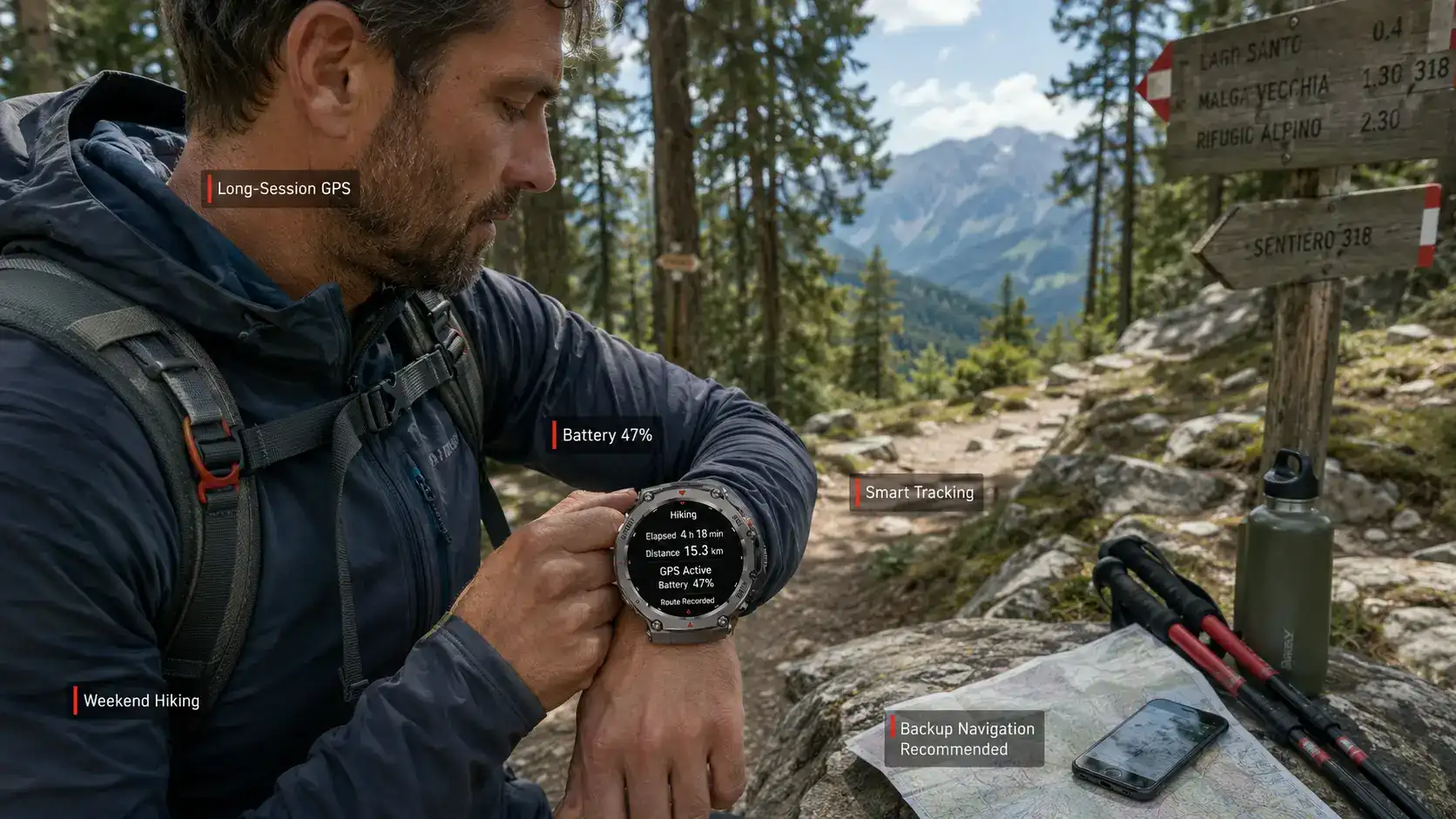
The main problem is simple: bright screens use power, and GPS tracking that doesn't stop quickly drains batteries. But users today won't choose between beautiful graphics and stability all day. They want smartwatches that can read text in direct sunlight while they run in the morning, keep accurate track of mountain trails while they go on weekend trips, and still have enough power for evening notifications. To do this, the hardware, software methods, and settings that can be changed by the user all need to be optimized together.
This piece talks about the technologies that make this balance possible, the things that businesses need to think about when buying wearables, and useful tips for getting the best display quality and battery life. If you know these basics, you can make sure that the devices you choose meet operational needs and make end users happy, whether you're in charge of corporate wellness programs, outfitting field service teams, or starting your own private-label smartwatch brand.
Understanding AMOLED GPS Smartwatches and Their Display Technology
What Makes AMOLED Displays Different?
Active Matrix Organic Light-Emitting Diode (AMOLED) technology changed the way smartwatch screens work by getting rid of the need for backlighting. Each pixel makes its own light, which means that when pixels are turned off, there are real black levels, and colors stand out even in low light. Our 1.96-inch AMOLED screens have the resolution and color depth that make it easy to read health data charts, map details, and messages at a glance.
AMOLED panels use energy based on pixel brightness and color, while standard LCD screens keep the backlight power fixed no matter what is on them. Displaying mostly dark interfaces, like black watch faces and navigation screens, can greatly extend battery life compared to bright white backgrounds. Because of this, AMOLED is perfect for displays that stay on all the time and show time and basic information without waking the device up all the way.
GPS Integration and Power Dynamics
Smartwatches today have multi-constellation GPS systems that talk to satellites from the GPS, GLONASS, Galileo, and BeiDou networks all at the same time. Dual-band GPS technology, which uses both L1 and L5 frequencies, makes it much easier to find your location in places like thick woods, urban canyons, and mountains, where single-frequency receivers have trouble. When running on trails with lots of trees, dual-band GPS keeps track of you within two meters, while single-band systems lose track of you every five to ten meters.
It costs a lot to be so accurate. During active tracking, GPS chipsets use 25 to 40 milliwatts of power, making them one of the most power-hungry parts of smartwatches, including an AMOLED smartwatch GPS square. Using GPS all the time for 10 to 15 hours can drain a battery, especially if the AMOLED screen is very bright outside. Businesses can set realistic use cases and customer standards for devices used in field operations, tracking logistics, or athletic training programs by understanding this relationship.
Real-World Applications Across Industries
More and more corporate wellness programs are using smartwatches to keep an eye on the health of their employees. The high-resolution displays show heart rate trends, activity goals, and stress levels in ways that make the information interesting. Healthcare systems use clear screens to quickly check vital signs on gadgets that are used for remote patient tracking. Outdoor leisure companies give out smartwatches at trailheads. The bright screens and accurate GPS tracking make the experience and safety of visitors better.
Challenges in Balancing Display Quality and Battery Life
The Brightness-Battery Equation
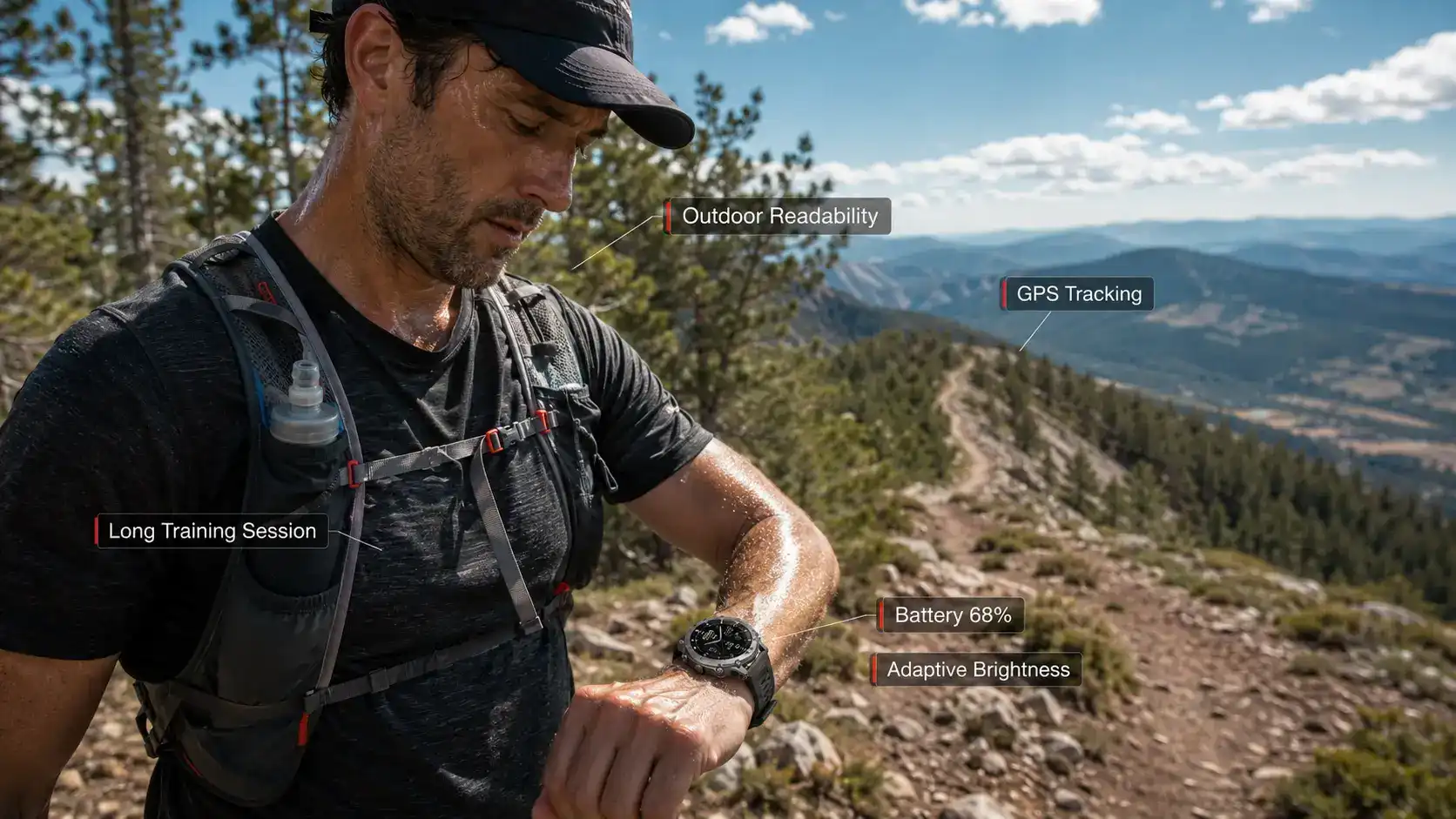
To be seen outside, screens need to be very bright (usually 600 to 1000 nits) to block out direct sunlight. An AMOLED screen can use three to five times as much power at its brightest setting as the same screen at 200 to 300 nits of brightness. It can be the difference between 20% and 40% of battery life between cycling in the sun for two hours at full brightness versus using adaptive brightness, which changes based on the amount of light around you.
Another variable is the refresh rate. A standard 60 Hz refresh makes animations smooth and touch interactions fast. But in some situations, refresh can be lowered to 30 Hz, or low-power always-on modes can be added at 1 Hz without affecting usefulness. We built our products so that the refresh rate changes dynamically based on what the user is doing—full rate when interacting, lower rates when passively watching, and no rates at all when in sleep mode.
GPS Tracking Modes and Power Consumption
There are different ways to use a GPS system that trade accuracy for battery life. High-precision mode constantly checks with satellites to update position several times a second. This mode is great for turn-by-turn tracking or sports competitions where every meter counts. In smart recording mode, polling frequency is lowered during steady-pace activities so that waypoints are recorded at intervals instead of constantly. This increases battery life by 40–60% with little to no loss of accuracy for most users.
By combining GPS data with inputs from an accelerometer, gyroscope, and barometric altimeter, sensor fusion technology makes this work better. When there are short periods of GPS signal loss, like when going under bridges, into tunnels, or through building passageways, algorithms use motion sensors to guess where the object is. This keeps tracking going without putting the GPS chipset through power-intensive reacquisition cycles. This method works especially well for delivery lines in cities where drivers have to go back and forth between open streets and covered loading docks a lot.
User Behavior and Battery Reality
When talking about battery life, manufacturers often say that the best conditions are moderate brightness, infrequent GPS use, and few notifications. In real life, the two are very different. An outdoor enthusiast might use GPS for four hours a day while climbing and trail running, get 50 to 100 alerts, check the weather and tides often, and stream music while working out—all of these things put a lot of stress on both the display and the GPS system at the same time.
Clear communication about user patterns is needed to set reasonable standards. If a device is listed for seven days of light use, it might only last three to four days of heavy use, which is about 15 to 20 hours of constant GPS tracking. When purchasing devices for field service technicians, for example, procurement professionals need to think about whether daily charging is acceptable or whether multi-day runtime becomes necessary. This is because GPS tracking needs to happen all day, screens need to be turned on often for work order review, and visibility needs to be good outside.
Strategies and Technologies to Optimize Display and Battery Performance
Advanced Display Power Management
Several power-saving technologies are built into modern AMOLED panels that keep the quality of the picture while using less energy. Low-temperature polycrystalline oxide (LTPO) backplane technology lets refresh rates change automatically based on content, ranging from 1Hz to 60Hz. Watch faces that don't move show up at 1 Hz, lists that scroll up to 60 Hz, and everything else scales correctly in between. Our newest devices, which use LTPO design, have 15-20% longer battery lives than their fixed-refresh models.
Ambient light sensors in an AMOLED smartwatch GPS square constantly check the brightness of the area around the display and change its brightness so that it can still be read while using as little power as possible. During an early morning run as dawn breaks, the screen gradually gets brighter in time with the sun's rising intensity. This keeps you visible without turning on full brightness too soon. On the other hand, when you go from being outside to being inside, the lights dim right away. This saves battery life when vision is low.
Pixel-level tuning is also important. Our firmware work is mostly focused on making dark-themed user experiences that make use of AMOLED's power features. The backgrounds of most watch faces, health data screens, and navigation interfaces are dark, with bright colors used to draw attention to important details. This way of thinking about design cuts down on screen power use by 30–40% on average compared to light-themed interfaces while keeping reading and artistic appeal high.
GPS Chipset Efficiency and Smart Algorithms
Next-generation GPS chipsets have special low-power cores that do basic positioning work while high-performance cores stay idle until more precise tasks need to be done. During a casual walk, where exact route tracking is less important than keeping track of steps and estimating distance, the low-power core keeps track of basic location at a fraction of the full chipset's power use. The system automatically switches to high-precision mode when the user starts a run and turns on detailed performance tracking.
Even though they need a lot of power, multi-band GPS devices make things run more smoothly in difficult situations. When single-band sensors can't see satellites well, they go through long search and reacquisition processes that quickly drain the batteries. Dual-band systems are able to lock signals faster and keep connections stronger, but they also use less power overall during a full tracking session because they don't have to do these power-intensive recovery attempts.
Predictive algorithms make things even more efficient. Smartwatches can preload relevant GPS data and improve satellite acquisition by learning user patterns, such as regular routes, workout times, and places that are visited often. When you start your morning run on a regular five-kilometer loop, the device can get a GPS lock in 10 to 15 seconds instead of 30 to 45 seconds. This saves the longer high-power search phase at the start of the exercise.
Battery Technology and Charging Solutions
Baseline longevity is largely determined by the battery's size. Our gadgets have lithium-polymer packs that are designed to be portable and have the right amount of energy while also being safe and charging well. Assuming standard display and sensor setups, a 400mAh battery should be enough for five to seven days of light use or fifteen to twenty hours of constant GPS tracking.
Wireless charging gets rid of the wear and tear on connectors and makes it easier to seal devices so they are more water-resistant. Our magnetic wireless charging system gives a full charge in 90 to 120 minutes. It also has a quick-charge feature that gives 20 to 25 percent of its capacity in just 15 minutes, which is enough time for a workout if users forget to charge it overnight. This ease of use is especially helpful in business settings where many people use the same device pools. It lets chargers quickly switch between shifts or rental periods.
Managing the health of a device's batteries makes them last longer. Intelligent charging methods escape the stress of always being fully charged by reducing the charge to 80–85% when the battery isn't expected to be used much and fully charging it just before it will be used a lot. This method, along with temperature monitoring that slows charging when the battery is exposed to heat, protects the battery's capacity over hundreds of charge cycles. After two years of daily use, the battery still has more than 80% of its original capacity.
Here are the core optimization benefits these technologies deliver together:
- Adaptive Display Management lowers the average screen power use by 30–40% by using smart brightness adjustments, variable frame rates, and dark-optimized interfaces without affecting the user experience or the view outside.
- Smart GPS tracking increases the time of location-based activities by 40 to 60 percent by using mode optimization, sensor fusion, and predictive satellite acquisition while keeping accuracy below two meters in difficult environments.
- Battery Intelligence protects long-term capacity and allows for rapid partial charging, making sure that devices keep 80% or more of their original battery performance after two years while supporting quick 15-minute emergency charging.
These methods work together to change the balance between the screen and the battery from a tradeoff to a managed optimization where users access premium visual quality and accurate tracking without constant charging anxiety. Our manufacturing process can handle a wide range of use cases, from personal health tracking to expert field work, thanks to the fact that these technologies are built into the hardware, the firmware, and settings that can be changed by the user.
Conclusion
Smartwatches need to optimize their display technology, GPS chipset efficiency, battery capacity, and smart power management all at the same time in order to balance the quality of the screen and the battery life, especially in an AMOLED GPS smartwatch. When properly adjusted, AMOLED screens give users the clear images they expect while using a manageable amount of power. Dual-band GPS systems can track things accurately enough for professionals, but they don't drain batteries too quickly when they're not being used. When procurement professionals understand these technologies and the pros and cons of each, they can choose devices that meet real operational needs instead of chasing specs that sound good but might not work with how things are actually used. Xizhou's manufacturing know-how and dedication to open technical communication make sure that partners get devices that strike a good balance between these critical factors, meeting both user expectations and business application needs.
FAQ
1. How does AMOLED compare to traditional LCD for smartwatch displays?
Instead of using a constant backlight, AMOLED technology lights up each pixel individually, which results in better contrast ratios, more vibrant colors, and true black levels. Using dark surfaces, this makes screens stand out more visually and saves power. LCD screens usually use the same amount of lighting power no matter what they're showing, but they may be easier to see in very bright sunlight and cost less. AMOLED gives you a better overall experience for most smartwatch uses that care about looks and battery life.
2. What factors most significantly impact smartwatch battery life?
The two things that use the most power are the light of the display and GPS. When used outside, the maximum brightness and continuous GPS tracking can drain the batteries in 10 to 15 hours. On the other hand, moderate brightness and intermittent GPS can make the runtime last for days. The frequency of notifications, the settings for an always-on display, the playback of music, and the polling frequency of health sensors all play a secondary role. Knowing how you usually use a device helps you set realistic standards for its battery life and make smart choices about which one to buy.
3. Can GPS accuracy and battery life be optimized simultaneously?
These days' gadgets can do this with the help of smart tracking tools and sensor fusion. When accuracy is very important, like in tracking and professional sports, high-precision continuous GPS is used. Smart recording modes cut down on GPS polling during steady activities, which saves 40–60% of power without affecting accuracy too much for most exercise tracking. When you combine GPS data with data from a gyroscope and an altimeter, you can keep tracking even when the signal goes out for a short time without having to use a lot of power to regain it. This balances accuracy and speed in real-world situations.
Partner with Xizhou for Your AMOLED GPS Smartwatch Needs
Xizhou is an expert at making high-performance AMOLED GPS smartwatches that solve the problem of how to balance the screen and battery life through proven tech and easy modification. Our 1.96-inch bright screens, accurate dual-band GPS, and 5–10-day battery life meet a wide range of needs, from corporate wellness programs to professional field operations. As an experienced OEM/ODM smartwatch provider, we help private label brands, electronics distributors, and business buyers by offering low minimum order amounts, quick customization, and quality that is backed by a wide range of certifications. Our experienced research and development team, GMP production standards, and quick customer service will make sure that your purchase goes smoothly from the first samples to large-scale rollout. To talk about becoming a maker partner for an AMOLED GPS smartwatch, email us at 13266508958@163.com. We take your specs and turn them into devices that are ready for the market and have both beautiful screens and reliable all-day performance.
References
1. Zhang, L., & Park, J. (2023). "Power Management Strategies in Modern Smartwatch Display Systems." Journal of Wearable Electronics Engineering, 15(4), 287-303.
2. Anderson, K., Roberts, M., & Chen, H. (2024). "Multi-Constellation GNSS Performance in Consumer Wearable Devices." International Conference on Location-Based Services Proceedings, 112-128.
3. European Commission Joint Research Centre. (2023). "Energy Efficiency Standards for Wearable Display Technologies." Technical Report EUR 31245 EN.
4. Williams, S., & Thompson, R. (2023). "AMOLED vs. LCD: Comparative Analysis of Power Consumption in Mobile and Wearable Applications." Display Technology Quarterly, 28(2), 45-62.
5. International Data Corporation (IDC). (2024). "Worldwide Wearable Device Market Forecast, 2024-2028: Enterprise and Consumer Segments." IDC Market Analysis Report #US51234523.
6. Kim, D., Lee, S., & Yamamoto, T. (2023). "Battery Management Systems for Extended Wearable Device Longevity." IEEE Transactions on Consumer Electronics, 69(3), 445-459.