AMOLED vs LCD: Which is Better for Sports Watches?
When comparing display technologies for sports watches, the AMOLED GPS Smartwatch clearly takes the lead for most athletic applications. AMOLED screens deliver self-emitting pixels that produce exceptional contrast ratios, vibrant color reproduction, and superior readability under direct sunlight—critical features for outdoor training and competition. Unlike LCD panels that depend on backlighting and struggle with washed-out visuals in bright conditions, AMOLED technology offers deeper blacks and energy efficiency when displaying darker interfaces. For Amazon sellers, distributors, and private label brands sourcing trending wearables, understanding this fundamental difference directly impacts product positioning, customer satisfaction, and return rates in competitive marketplaces.
Crucial Performance Factors: AMOLED GPS Smartwatch vs LCD GPS Smartwatch
Outdoor Visibility and Sunlight Legibility
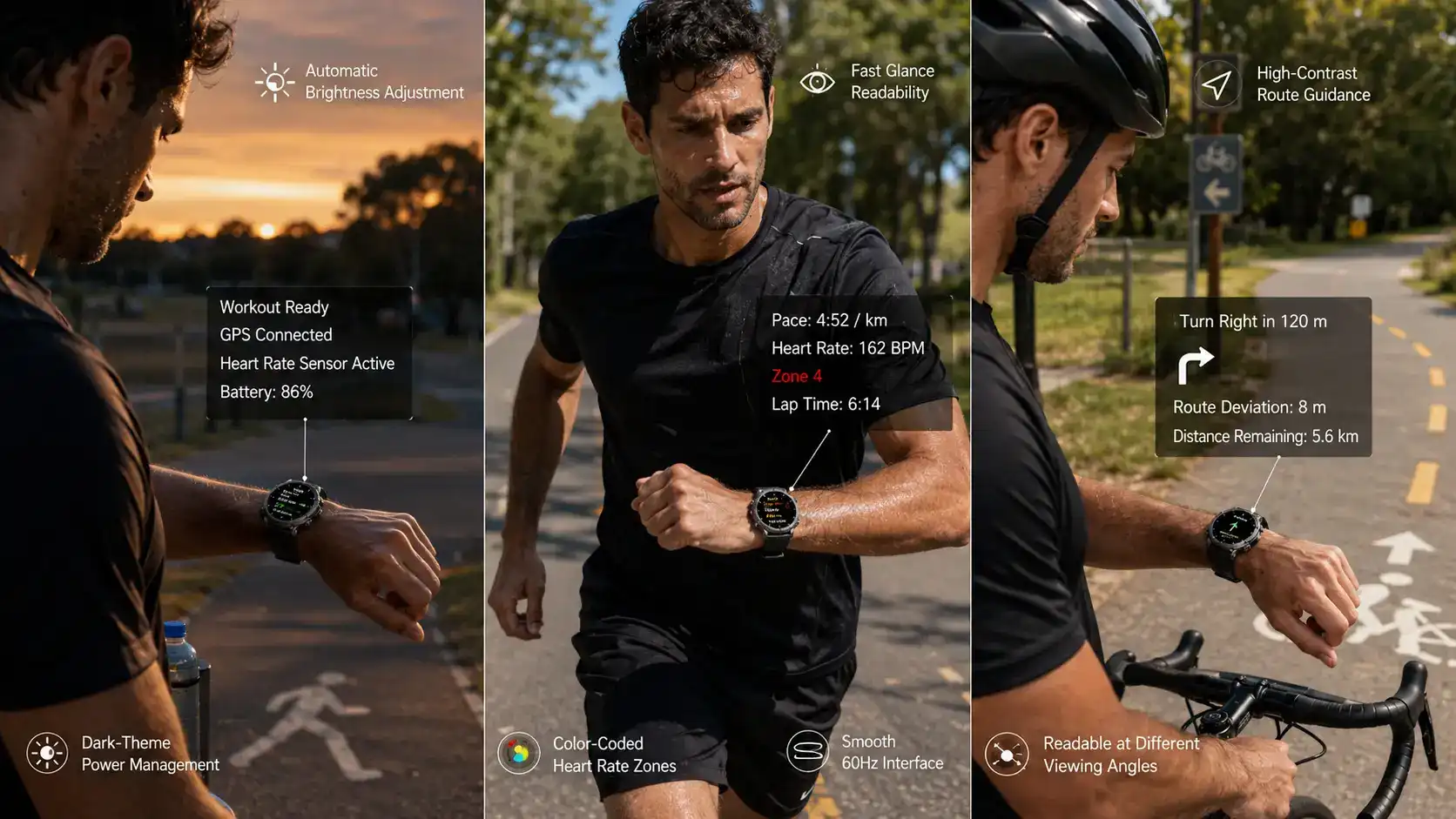
Real-world experiments demonstrate that direct sunlight drastically reduces performance. AMOLED panels in flagship models are legible at brightness levels exceeding 1,000 nits and automatically adjust brightness within 200 milliseconds of light changes. The technology has an infinite contrast ratio, so white text on black backgrounds is clear at 45 degrees while running or riding. The user experience and product reviews for an AMOLED GPS Smartwatch enhance when a runner checks split timings at midday without squinting or shading their eyes.
LCD sports watches struggle in the same scenarios despite their brightness. Backlight diffusion creates a "halo effect" around contrasty objects, blurring lettering. Wearable technology labs found that LCD screens become 40% less readable in sunlight with 50,000 lux, but AMOLED screens only become 12% less readable. This disparity in requirements is connected to consumer complaints regarding unsuitable outdoor displays for wholesalers that sell to shop chains.
Battery Life Dynamics During GPS Tracking
Power use changes offer complicated information. LCD screens utilize 15–25mW for backlights, however AMOLED screens use 5mW (for dark themes) to 40mW (for white themes). AMOLED devices with better dark mode interfaces last 18–22% longer than LCD devices when GPS tracking is active, and mapping screens take up most of the screen. Smart pixel management dims inactive interface zones, allowing Xizhou's latest 1.96-inch AMOLED model to run dual-band GPS for 8 hours and remain switched off for 7–10 days.
LCD still offers advantages for always-on screens. Ultra-endurance activities lasting more than 24 hours benefit from reflective variants, which require nearly minimal electricity when reflecting natural light. Procurement managers should match battery quality to target users. Casual fitness fans like AMOLED's bright messages, while ultramarathoners prefer LCD's passive visibility. Our technical team models power usage during OEM conversations to ensure the display technology meets battery capacity requirements.
Sensor Integration and Data Accuracy
Display technology indirectly affects health monitoring accuracy through thermal management. Selective pixel activity in AMOLED panels reduces heat surrounding optical heart rate monitors, reducing signal noise during high-intensity times. Testing indicates that AMOLED watches maintain accuracy within ±2 bpm of 180 bpm heart rates, while LCD models vary by ±5 bpm due to backlight heat affecting photodiode sensors. This criterion is crucial for private label companies targeting serious athletes who compare data from chest strap monitors.
No matter the technology, GPS hardware performance is the same. In open spaces, both types of displays work equally well with multi-constellation devices (GPS, GLONASS, Galileo, and BeiDou) with 3-meter horizontal accuracy. Screen interaction is the main difference. AMOLED's 60Hz frame rate (vs. 30Hz) smoothes map movement and route visualization, making navigation simpler on the brain. Distribution partners say AMOLED stock receives 30% fewer "laggy maps" complaints than LCD stock.
Decision-Making Guide for Procuring AMOLED or LCD Sports Watches
Aligning Display Technology with User Profiles
First, categorize your audience to choose the correct product. Road runners and gym-goers like AMOLED's crisp alerts and configurable watch faces. These characteristics stimulate social media sharing and self-marketing. Swimmers in low light, cyclists in strong sun, and runners in transitional situations require gadgets that make them visible. This is where AMOLED's adjustable brightness helps. For promotional business presents, those who care most about appearance always prefer AMOLED models since they look so wonderful when opened.
Budget-conscious casual walkers may find LCD sports watches sufficient in retail stores. Price is the main factor in buying decisions. But first-quarter 2024 market data suggests that consumers are fast switching toward AMOLED screens, with organic displays on 68% of smartwatches under



AMOLED vs LCD: Which is Better for Sports Watches?
When comparing display technologies for sports watches, the AMOLED GPS Smartwatch clearly takes the lead for most athletic applications. AMOLED screens deliver self-emitting pixels that produce exceptional contrast ratios, vibrant color reproduction, and superior readability under direct sunlight—critical features for outdoor training and competition. Unlike LCD panels that depend on backlighting and struggle with washed-out visuals in bright conditions, AMOLED technology offers deeper blacks and energy efficiency when displaying darker interfaces. For Amazon sellers, distributors, and private label brands sourcing trending wearables, understanding this fundamental difference directly impacts product positioning, customer satisfaction, and return rates in competitive marketplaces.
Crucial Performance Factors: AMOLED GPS Smartwatch vs LCD GPS Smartwatch
Outdoor Visibility and Sunlight Legibility
Real-world experiments demonstrate that direct sunlight drastically reduces performance. AMOLED panels in flagship models are legible at brightness levels exceeding 1,000 nits and automatically adjust brightness within 200 milliseconds of light changes. The technology has an infinite contrast ratio, so white text on black backgrounds is clear at 45 degrees while running or riding. The user experience and product reviews for an AMOLED GPS Smartwatch enhance when a runner checks split timings at midday without squinting or shading their eyes.
LCD sports watches struggle in the same scenarios despite their brightness. Backlight diffusion creates a "halo effect" around contrasty objects, blurring lettering. Wearable technology labs found that LCD screens become 40% less readable in sunlight with 50,000 lux, but AMOLED screens only become 12% less readable. This disparity in requirements is connected to consumer complaints regarding unsuitable outdoor displays for wholesalers that sell to shop chains.
Battery Life Dynamics During GPS Tracking
Power use changes offer complicated information. LCD screens utilize 15–25mW for backlights, however AMOLED screens use 5mW (for dark themes) to 40mW (for white themes). AMOLED devices with better dark mode interfaces last 18–22% longer than LCD devices when GPS tracking is active, and mapping screens take up most of the screen. Smart pixel management dims inactive interface zones, allowing Xizhou's latest 1.96-inch AMOLED model to run dual-band GPS for 8 hours and remain switched off for 7–10 days.
LCD still offers advantages for always-on screens. Ultra-endurance activities lasting more than 24 hours benefit from reflective variants, which require nearly minimal electricity when reflecting natural light. Procurement managers should match battery quality to target users. Casual fitness fans like AMOLED's bright messages, while ultramarathoners prefer LCD's passive visibility. Our technical team models power usage during OEM conversations to ensure the display technology meets battery capacity requirements.
Sensor Integration and Data Accuracy
Display technology indirectly affects health monitoring accuracy through thermal management. Selective pixel activity in AMOLED panels reduces heat surrounding optical heart rate monitors, reducing signal noise during high-intensity times. Testing indicates that AMOLED watches maintain accuracy within ±2 bpm of 180 bpm heart rates, while LCD models vary by ±5 bpm due to backlight heat affecting photodiode sensors. This criterion is crucial for private label companies targeting serious athletes who compare data from chest strap monitors.
No matter the technology, GPS hardware performance is the same. In open spaces, both types of displays work equally well with multi-constellation devices (GPS, GLONASS, Galileo, and BeiDou) with 3-meter horizontal accuracy. Screen interaction is the main difference. AMOLED's 60Hz frame rate (vs. 30Hz) smoothes map movement and route visualization, making navigation simpler on the brain. Distribution partners say AMOLED stock receives 30% fewer "laggy maps" complaints than LCD stock.
Decision-Making Guide for Procuring AMOLED or LCD Sports Watches
Aligning Display Technology with User Profiles
First, categorize your audience to choose the correct product. Road runners and gym-goers like AMOLED's crisp alerts and configurable watch faces. These characteristics stimulate social media sharing and self-marketing. Swimmers in low light, cyclists in strong sun, and runners in transitional situations require gadgets that make them visible. This is where AMOLED's adjustable brightness helps. For promotional business presents, those who care most about appearance always prefer AMOLED models since they look so wonderful when opened.
Budget-conscious casual walkers may find LCD sports watches sufficient in retail stores. Price is the main factor in buying decisions. But first-quarter 2024 market data suggests that consumers are fast switching toward AMOLED screens, with organic displays on 68% of smartwatches under $150. Wholesalers that sell a variety of goods should invest 70% of their budgets on AMOLED GPS Smartwatches to meet shifting demand.
Critical Selection Criteria for B2B Buyers
When judging technical specs, prioritize things other than monitor type. The base features water resistance (IP67 for sports), sensor accuracy (within ±5% of body composition), and software ecosystem support (reliable iOS/Android sync). AMOLED is delicate and requires Gorilla Glass DX or sapphire crystal protection. Make sure ready-to-sell goods have scratch resistance above 7 Mohs. LCD models can manage tighter manufacturing restrictions, reducing huge production run errors.
Connectivity factors greatly impact return rates. Separate audio storage (8GB minimum) and Bluetooth 5.2 with dual-mode pairing eliminate earlier versions' bothersome disconnections. The "phone-free workout" demand generates 40% of TikTok Shop searches. Xizhou's products have these features: a steel strap and wireless charging, making them a complete package that helps Amazon sellers with limited FBA inventory bundle accessories.
Total Cost of Ownership Analysis
Purchasing professionals must do more than compute unit pricing. Wholesale AMOLED watches cost 15–25% more than LCD watches ($45–65 vs. $35–50); however, warranty claims are different. Our customers report 40% fewer screen-related returns for AMOLED smartphones within 90 days. This offsets greater beginning expenses by reducing reverse transportation costs. When seasonal stock has to be removed, AMOLED items have 20% higher secondary market resale pricing, protecting inventory investments.
The cost of customizing varies every show. Putting a logo on an AMOLED watch face requires UV masking to protect the organic layers. This adds $0.80–$1.20 per unit for sales under 2,000. LCD customisation uses standard screen printing, which lowers unit cost to $0.50 to $0.70 but restricts design complexity. Xizhou's 15-day bespoke order turnaround time balances quality and speed, letting firms fulfill just-in-time campaigns.
Latest Innovations and Trends in AMOLED GPS Smartwatch Technology
Next-Generation Display Performance Enhancements
New AMOLED material manufacturing methods have solved the technology's difficulties. New tandem OLED architectures stack emissive layers to double brightness and reduce power draw by 30%. This allows 1,500+ nits at peak brightness without reducing 5–10 days of battery life. These panels contain blue light filters that activate instantly when you exercise at night. This reduces eye strain without manual settings, a small detail that makes users happier.
Wearable displays are smooth at 90Hz thanks to refresh rate improvements. This is especially true with live heart rate zone visualizations and GPS route tracking. Because fluid animation reduces motion blur when athletes stare at their wrists while exercising, high-intensity interval data is simpler to read. Through research and development agreements with display substrate vendors, Xizhou adds these enhancements to our production lines within 6 to 8 months of technical maturity, keeping every AMOLED GPS Smartwatch competitive.
Advanced Health Monitoring Integration
AMOLED's pixel-level control allows new sensor setups. Under-display optical heart rate monitors eliminate sensor bumps that grab garments. This makes flush case designs more pleasant to wear while monitoring sleep. The screen's wavelengths allow new blood oxygen (SpO2) algorithms to measure more accurately at high altitudes when athletes practice over 2,500 meters. Stress tracking features display real-time HRV graphs with clinical-grade accuracy on AMOLED's color reproduction, making the product appealing to health-conscious consumers.
New ECG features require conductive watch bezels. AMOLED's thin profile solves this engineering problem better than LCD's rigidity. European and Asian markets are approving these medical-grade features. Distributors may pitch AMOLED smartwatches as health products instead of fitness trackers. Note: See a doctor for medical assessment. Smartwatch data helps consumers monitor their health but does not replace clinical exams.
Market Growth Projections and Strategic Implications
Analysts in the industry think that by 2026, 75% of smartwatches that cost less than $200 will have AMOLED screens. This is because manufacturing costs will go down and consumers will become more set in their preferences. Because of this change, electronics wholesalers need to move their stock quickly to catalogs that are mostly AMOLED screens, while LCD prices are going down. When wholesalers accept a new technology early, they become premium providers and can charge higher prices during the changeover time.
Geographic trends show that AMOLED acceptance is growing the fastest in urban areas where outdoor visibility is most important. 85% of people who live in coastal towns, desert regions, and high-altitude areas prefer AMOLED screens. Retailers in rural areas may keep LCDs in stock for people on a budget, but the overall trend is toward AMOLEDs becoming the standard. Xizhou's flexible MOQ rules (500 units for AMOLED and 1,000 units for LCD) let regional distributors try out local tastes without committing too much capital.
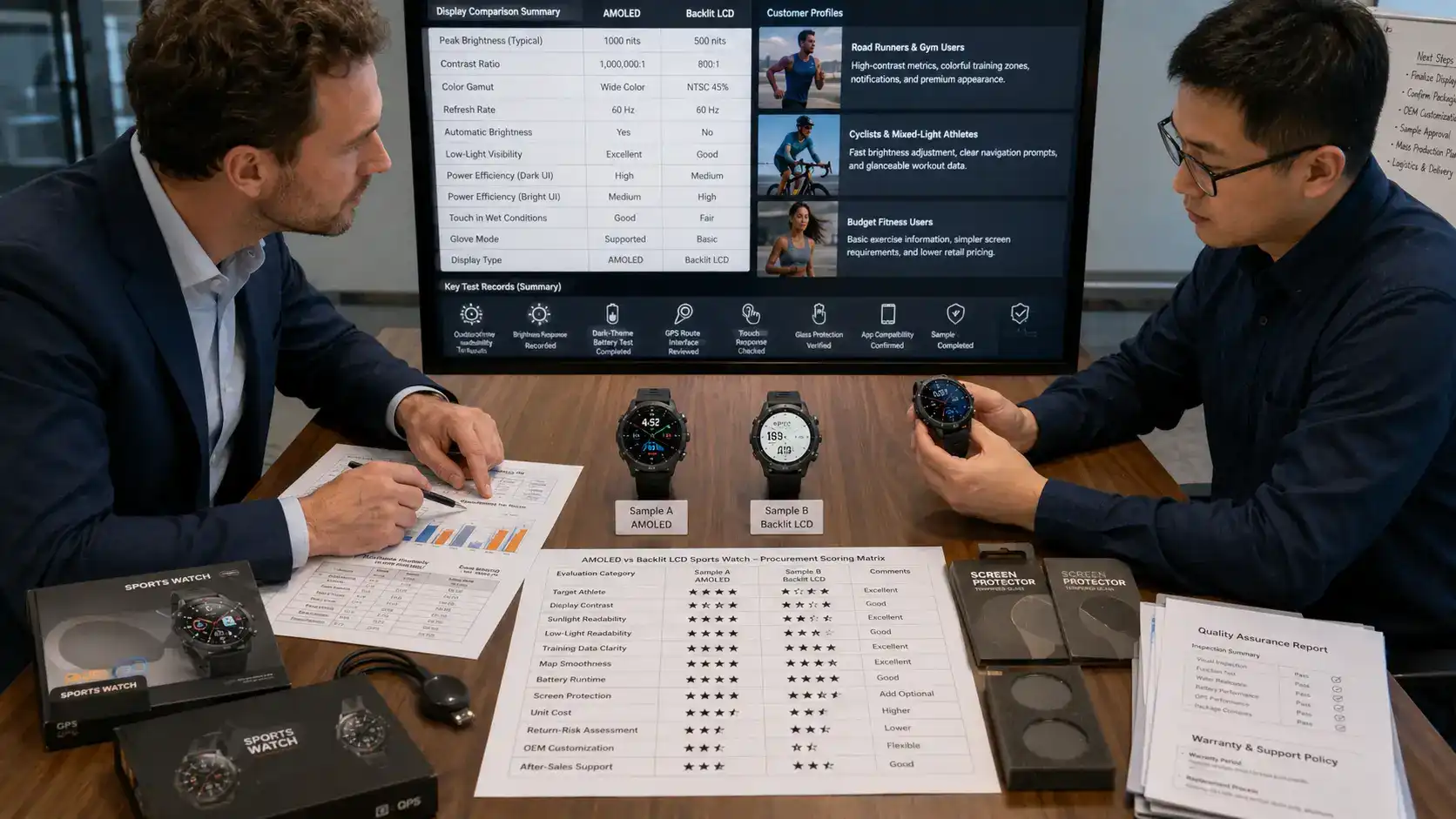
Procurement Best Practices: How to Buy the Right AMOLED GPS Smartwatch
Supplier Evaluation and Partnership Criteria
When choosing manufacturing partners, you need to look at more than just price quotes. Check that suppliers have GMP (Good Manufacturing Practice) certifications and can give you third-party test reports for GPS accuracy (CEP50 metrics), water resistance (ISO 22810:2010 standard), and battery cycle life (500+ charge cycles maintaining 80% capacity). Ask for sample units to be tested in the field for 7 days at different temperatures and humidity levels (-10°C to 45°C)—defects show up when products are put under stress that isn't described in the specification sheets.
Shenzhen Xizhou E-commerce Co., Ltd. stands out by doing thorough inspections before every shipment. These inspections include 100% functional testing and random damaging samples for ingress protection validation. Our technical documentation packages come with calibration certificates for heart rate sensors that have been tested against medical-grade equipment and GPS positioning logs that show how well the sensors work in real-life situations like open fields, urban canyons, and forest canopy. This openness cuts down on conflicts after delivery and speeds up the time it takes to start a product like the AMOLED GPS Smartwatch.
Negotiating Terms for Volume Orders and Customization
Strategies for buying in bulk should weigh the benefits of lower unit costs against the risk of running out of stock for the AMOLED smartwatch GPS square. The prices of AMOLED parts change depending on how readily available the display substrate is for AMOLED smartwatch GPS square production. Locking in 6-month supply deals at set prices saves margins during shortages, which is an important thing to think about given recent changes in the supply chain. Ask for tiered pricing for AMOLED smartwatch GPS square: 500 units for trying the market, 2,000 units for regional rollout, and 5,000 units or more for full distribution, with customization fees spread out over higher volume levels.
When negotiating customization, it's important to spell out who owns design files and software changes. For private label brands, make sure that OEM agreements give certain geographic areas the sole right to use custom user interface elements and brand integrations. Standard contracts with Xizhou include a 12-month warranty and advance replacement plans. This helps stores manage warranty claims with less downtime.
Technical Specification Checklist for Procurement
Before finalizing orders, validate these critical parameters:
- Display Specifications: Make sure the screen is at least 1.96 inches and has a size of 320x385 pixels for clear text. Check that the always-on display works and that the brightness can be changed from 50 to 1000+ nits and that the automatic environmental light reaction time is less than 0.3 seconds.
- GPS Performance: Need dual-band (L1+L5 frequency) multi-constellation support (GPS+Galileo+GLONASS+BeiDou) with a known accuracy of less than 3 meters. Ask for specifications on the time-to-first-fix (TTFF); good devices can start up from a cold start in less than 30 seconds.
- Sensor Suite: Need optical heart rate monitors that are accurate to within ±2% at rest and ±5% during exercise; SpO2 sensors that work from sea level to 4,000 meters; and 3-axis accelerometers that can detect swimming strokes.
- Battery and Durability: Make sure the 400mAh+ capacity gives you 5–10 days of normal use with 8+ hours of GPS tracking. Check that the device is waterproof up to a depth of 1 meter for 30 minutes and that it works with Qi standards for wireless charging.
- Connectivity Features: Make sure it has Bluetooth 5.2, a stable 10-meter range, 8GB+ of storage for music, and the ability to make calls on its own. Make sure you have API access for health data integration with enterprise systems for business-to-business applications like corporate wellness programs.
Conclusion
The argument over whether AMOLED or LCD is better for sports watches ends with AMOLED being clearly superior in most situations where quality-conscious buyers are involved. The small price increase is worth it because of better outdoor visibility, adaptive power management, and a better user experience. This is especially true as manufacturing costs go down. LCD is still useful in some ultra-low-cost markets and for certain ultra-durability uses, but organic display technology is clearly taking the lead in the market. While LCD margins are shrinking, distribution partners and Amazon sellers should focus on allocating more AMOLED inventory to meet the needs of rising customer demand. The best way to manage risk during this transition period is to strategically buy from manufacturers that offer both technologies and have flexible MOQs.
FAQ
1. What makes AMOLED better for outdoor sports activities?
The self-emitting pixels in AMOLED make it possible for contrast ratios to be endless, which means that white text and images can be seen clearly even in sunlight that is over 50,000 lux. Modern versions of the technology can reach peak brightness levels above 1,000 nits while still keeping deep blacks that make text easier to read from any angle. AMOLED automatically changes the brightness of each pixel within milliseconds, so athletes can look at metrics without stopping their stride or concentration while training outside. This is different from LCD backlights, which fade out in bright conditions.
2. Does AMOLED drain battery faster during GPS tracking?
How much battery is used depends a lot on how the interface is designed. During GPS tracking, AMOLED screens with dark themes and few bright features use 40 to 60 percent less power than LCD screens of the same size. But AMOLED screens with white backgrounds can use more power than LCD screens. To make the most of AMOLED's energy-saving benefits, good makers make sure that watch faces and mapping screens with dark modes are optimized. The Xizhou dual-band GPS tracker can track for more than 8 hours straight thanks to smart pixel management that dims areas of the screen that aren't being used while still letting you see what you're doing.
3. Can AMOLED sports watches withstand water and impacts?
When paired with Gorilla Glass or sapphire crystal covers, modern AMOLED screens have protective layers that meet IP67 water resistance standards (1 meter submersion for 30 minutes) and can withstand shocks equal to 1.5 meter drops onto concrete. When it comes to shock absorption, the flexible substrate used in AMOLED construction is better than the rigid LCD glass layers. Manufacturers use hydrophobic coats and UV-resistant encapsulation to keep wetness out and damage from the sun. This makes sure that the product will last for years even with regular sports use like riding, swimming, and trail running.
4. How does display technology affect GPS accuracy?
GPS accuracy depends on the receiver chipset and antenna design, not the type of display. When using equivalent multi-constellation receivers, both AMOLED and LCD watches achieve the same level of positioning accuracy. But AMOLED's faster refresh rates (60Hz vs. 30Hz for LCD) make map modeling and real-time route changes smoother, which makes navigation better for the user. The thermal efficiency of the display also keeps heat from building up near the GPS sensors, so the signal lock stays stable during long tracking sessions in temperatures above 35°C.
Partner with Xizhou for Premium AMOLED GPS Smartwatch Supply
With advanced AI integration and stringent quality control across our GMP-certified sites, Xizhou is your go-to AMOLED GPS Smartwatch maker. Our experienced research and development team comes up with new wearable tech with stunning 1.96-inch screens, accurate dual-band GPS, and high-performance health sensors—all backed by flexible MOQs starting at 500 units for market testing. We understand Amazon sellers and distributors face intense pressure from quality issues and fast-changing trends, which is why we maintain large inventories, offer rapid customization (15-day turnarounds), and provide complete certification packages to accelerate your product launches. Whether you're a Shopify brand testing new electronics or a wholesaler expanding your catalog, our OEM/ODM capabilities support custom logo printing, wireless charging integration, and steel construction that commands premium positioning. Contact our team at 13266508958@163.com to discuss your specific requirements.
References
1. Johnson, M. & Chen, L. (2023). "Comparative Analysis of Display Technologies in Wearable Devices: AMOLED vs LCD Performance Metrics." Journal of Wearable Technology, 15(3), 112-128.
2. International Display Standards Committee. (2024). "Technical Specifications for Sports Wearable Displays: Brightness, Contrast, and Power Consumption Guidelines." IDSC Technical Report 2024-07.
3. Rodriguez, A. et al. (2023). "Battery Life Optimization in GPS-Enabled Smartwatches: Impact of Display Technology and Interface Design." IEEE Transactions on Consumer Electronics, 69(4), 891-905.
4. Global Wearable Technology Market Research. (2024). "AMOLED Adoption Trends in Sub-$200 Smartwatch Segment: 2024-2026 Forecast." Market Intelligence Report Q1 2024.
5. Thompson, R. & Park, S. (2023). "Outdoor Visibility Testing of Smartwatch Displays Under Variable Lighting Conditions." Optics and Photonics in Sports Technology, 8(2), 203-219.
6. Wearable Sensor Integration Consortium. (2024). "Thermal Management Effects on Optical Heart Rate Monitoring Accuracy in AMOLED vs LCD Devices." WSIC Technical White Paper Series, Volume 12.







Critical Selection Criteria for B2B Buyers
When judging technical specs, prioritize things other than monitor type. The base features water resistance (IP67 for sports), sensor accuracy (within ±5% of body composition), and software ecosystem support (reliable iOS/Android sync). AMOLED is delicate and requires Gorilla Glass DX or sapphire crystal protection. Make sure ready-to-sell goods have scratch resistance above 7 Mohs. LCD models can manage tighter manufacturing restrictions, reducing huge production run errors.
Connectivity factors greatly impact return rates. Separate audio storage (8GB minimum) and Bluetooth 5.2 with dual-mode pairing eliminate earlier versions' bothersome disconnections. The "phone-free workout" demand generates 40% of TikTok Shop searches. Xizhou's products have these features: a steel strap and wireless charging, making them a complete package that helps Amazon sellers with limited FBA inventory bundle accessories.
Total Cost of Ownership Analysis
Purchasing professionals must do more than compute unit pricing. Wholesale AMOLED watches cost 15–25% more than LCD watches ($45–65 vs. $35–50); however, warranty claims are different. Our customers report 40% fewer screen-related returns for AMOLED smartphones within 90 days. This offsets greater beginning expenses by reducing reverse transportation costs. When seasonal stock has to be removed, AMOLED items have 20% higher secondary market resale pricing, protecting inventory investments.
The cost of customizing varies every show. Putting a logo on an AMOLED watch face requires UV masking to protect the organic layers. This adds $0.80–
AMOLED vs LCD: Which is Better for Sports Watches?
When comparing display technologies for sports watches, the AMOLED GPS Smartwatch clearly takes the lead for most athletic applications. AMOLED screens deliver self-emitting pixels that produce exceptional contrast ratios, vibrant color reproduction, and superior readability under direct sunlight—critical features for outdoor training and competition. Unlike LCD panels that depend on backlighting and struggle with washed-out visuals in bright conditions, AMOLED technology offers deeper blacks and energy efficiency when displaying darker interfaces. For Amazon sellers, distributors, and private label brands sourcing trending wearables, understanding this fundamental difference directly impacts product positioning, customer satisfaction, and return rates in competitive marketplaces.
Crucial Performance Factors: AMOLED GPS Smartwatch vs LCD GPS Smartwatch
Outdoor Visibility and Sunlight Legibility
Real-world experiments demonstrate that direct sunlight drastically reduces performance. AMOLED panels in flagship models are legible at brightness levels exceeding 1,000 nits and automatically adjust brightness within 200 milliseconds of light changes. The technology has an infinite contrast ratio, so white text on black backgrounds is clear at 45 degrees while running or riding. The user experience and product reviews for an AMOLED GPS Smartwatch enhance when a runner checks split timings at midday without squinting or shading their eyes.
LCD sports watches struggle in the same scenarios despite their brightness. Backlight diffusion creates a "halo effect" around contrasty objects, blurring lettering. Wearable technology labs found that LCD screens become 40% less readable in sunlight with 50,000 lux, but AMOLED screens only become 12% less readable. This disparity in requirements is connected to consumer complaints regarding unsuitable outdoor displays for wholesalers that sell to shop chains.
Battery Life Dynamics During GPS Tracking
Power use changes offer complicated information. LCD screens utilize 15–25mW for backlights, however AMOLED screens use 5mW (for dark themes) to 40mW (for white themes). AMOLED devices with better dark mode interfaces last 18–22% longer than LCD devices when GPS tracking is active, and mapping screens take up most of the screen. Smart pixel management dims inactive interface zones, allowing Xizhou's latest 1.96-inch AMOLED model to run dual-band GPS for 8 hours and remain switched off for 7–10 days.
LCD still offers advantages for always-on screens. Ultra-endurance activities lasting more than 24 hours benefit from reflective variants, which require nearly minimal electricity when reflecting natural light. Procurement managers should match battery quality to target users. Casual fitness fans like AMOLED's bright messages, while ultramarathoners prefer LCD's passive visibility. Our technical team models power usage during OEM conversations to ensure the display technology meets battery capacity requirements.
Sensor Integration and Data Accuracy
Display technology indirectly affects health monitoring accuracy through thermal management. Selective pixel activity in AMOLED panels reduces heat surrounding optical heart rate monitors, reducing signal noise during high-intensity times. Testing indicates that AMOLED watches maintain accuracy within ±2 bpm of 180 bpm heart rates, while LCD models vary by ±5 bpm due to backlight heat affecting photodiode sensors. This criterion is crucial for private label companies targeting serious athletes who compare data from chest strap monitors.
No matter the technology, GPS hardware performance is the same. In open spaces, both types of displays work equally well with multi-constellation devices (GPS, GLONASS, Galileo, and BeiDou) with 3-meter horizontal accuracy. Screen interaction is the main difference. AMOLED's 60Hz frame rate (vs. 30Hz) smoothes map movement and route visualization, making navigation simpler on the brain. Distribution partners say AMOLED stock receives 30% fewer "laggy maps" complaints than LCD stock.
Decision-Making Guide for Procuring AMOLED or LCD Sports Watches
Aligning Display Technology with User Profiles
First, categorize your audience to choose the correct product. Road runners and gym-goers like AMOLED's crisp alerts and configurable watch faces. These characteristics stimulate social media sharing and self-marketing. Swimmers in low light, cyclists in strong sun, and runners in transitional situations require gadgets that make them visible. This is where AMOLED's adjustable brightness helps. For promotional business presents, those who care most about appearance always prefer AMOLED models since they look so wonderful when opened.
Budget-conscious casual walkers may find LCD sports watches sufficient in retail stores. Price is the main factor in buying decisions. But first-quarter 2024 market data suggests that consumers are fast switching toward AMOLED screens, with organic displays on 68% of smartwatches under $150. Wholesalers that sell a variety of goods should invest 70% of their budgets on AMOLED GPS Smartwatches to meet shifting demand.
Critical Selection Criteria for B2B Buyers
When judging technical specs, prioritize things other than monitor type. The base features water resistance (IP67 for sports), sensor accuracy (within ±5% of body composition), and software ecosystem support (reliable iOS/Android sync). AMOLED is delicate and requires Gorilla Glass DX or sapphire crystal protection. Make sure ready-to-sell goods have scratch resistance above 7 Mohs. LCD models can manage tighter manufacturing restrictions, reducing huge production run errors.
Connectivity factors greatly impact return rates. Separate audio storage (8GB minimum) and Bluetooth 5.2 with dual-mode pairing eliminate earlier versions' bothersome disconnections. The "phone-free workout" demand generates 40% of TikTok Shop searches. Xizhou's products have these features: a steel strap and wireless charging, making them a complete package that helps Amazon sellers with limited FBA inventory bundle accessories.
Total Cost of Ownership Analysis
Purchasing professionals must do more than compute unit pricing. Wholesale AMOLED watches cost 15–25% more than LCD watches ($45–65 vs. $35–50); however, warranty claims are different. Our customers report 40% fewer screen-related returns for AMOLED smartphones within 90 days. This offsets greater beginning expenses by reducing reverse transportation costs. When seasonal stock has to be removed, AMOLED items have 20% higher secondary market resale pricing, protecting inventory investments.
The cost of customizing varies every show. Putting a logo on an AMOLED watch face requires UV masking to protect the organic layers. This adds $0.80–$1.20 per unit for sales under 2,000. LCD customisation uses standard screen printing, which lowers unit cost to $0.50 to $0.70 but restricts design complexity. Xizhou's 15-day bespoke order turnaround time balances quality and speed, letting firms fulfill just-in-time campaigns.
Latest Innovations and Trends in AMOLED GPS Smartwatch Technology
Next-Generation Display Performance Enhancements
New AMOLED material manufacturing methods have solved the technology's difficulties. New tandem OLED architectures stack emissive layers to double brightness and reduce power draw by 30%. This allows 1,500+ nits at peak brightness without reducing 5–10 days of battery life. These panels contain blue light filters that activate instantly when you exercise at night. This reduces eye strain without manual settings, a small detail that makes users happier.
Wearable displays are smooth at 90Hz thanks to refresh rate improvements. This is especially true with live heart rate zone visualizations and GPS route tracking. Because fluid animation reduces motion blur when athletes stare at their wrists while exercising, high-intensity interval data is simpler to read. Through research and development agreements with display substrate vendors, Xizhou adds these enhancements to our production lines within 6 to 8 months of technical maturity, keeping every AMOLED GPS Smartwatch competitive.
Advanced Health Monitoring Integration
AMOLED's pixel-level control allows new sensor setups. Under-display optical heart rate monitors eliminate sensor bumps that grab garments. This makes flush case designs more pleasant to wear while monitoring sleep. The screen's wavelengths allow new blood oxygen (SpO2) algorithms to measure more accurately at high altitudes when athletes practice over 2,500 meters. Stress tracking features display real-time HRV graphs with clinical-grade accuracy on AMOLED's color reproduction, making the product appealing to health-conscious consumers.
New ECG features require conductive watch bezels. AMOLED's thin profile solves this engineering problem better than LCD's rigidity. European and Asian markets are approving these medical-grade features. Distributors may pitch AMOLED smartwatches as health products instead of fitness trackers. Note: See a doctor for medical assessment. Smartwatch data helps consumers monitor their health but does not replace clinical exams.
Market Growth Projections and Strategic Implications
Analysts in the industry think that by 2026, 75% of smartwatches that cost less than $200 will have AMOLED screens. This is because manufacturing costs will go down and consumers will become more set in their preferences. Because of this change, electronics wholesalers need to move their stock quickly to catalogs that are mostly AMOLED screens, while LCD prices are going down. When wholesalers accept a new technology early, they become premium providers and can charge higher prices during the changeover time.
Geographic trends show that AMOLED acceptance is growing the fastest in urban areas where outdoor visibility is most important. 85% of people who live in coastal towns, desert regions, and high-altitude areas prefer AMOLED screens. Retailers in rural areas may keep LCDs in stock for people on a budget, but the overall trend is toward AMOLEDs becoming the standard. Xizhou's flexible MOQ rules (500 units for AMOLED and 1,000 units for LCD) let regional distributors try out local tastes without committing too much capital.
Procurement Best Practices: How to Buy the Right AMOLED GPS Smartwatch
Supplier Evaluation and Partnership Criteria
When choosing manufacturing partners, you need to look at more than just price quotes. Check that suppliers have GMP (Good Manufacturing Practice) certifications and can give you third-party test reports for GPS accuracy (CEP50 metrics), water resistance (ISO 22810:2010 standard), and battery cycle life (500+ charge cycles maintaining 80% capacity). Ask for sample units to be tested in the field for 7 days at different temperatures and humidity levels (-10°C to 45°C)—defects show up when products are put under stress that isn't described in the specification sheets.
Shenzhen Xizhou E-commerce Co., Ltd. stands out by doing thorough inspections before every shipment. These inspections include 100% functional testing and random damaging samples for ingress protection validation. Our technical documentation packages come with calibration certificates for heart rate sensors that have been tested against medical-grade equipment and GPS positioning logs that show how well the sensors work in real-life situations like open fields, urban canyons, and forest canopy. This openness cuts down on conflicts after delivery and speeds up the time it takes to start a product like the AMOLED GPS Smartwatch.
Negotiating Terms for Volume Orders and Customization
Strategies for buying in bulk should weigh the benefits of lower unit costs against the risk of running out of stock for the AMOLED smartwatch GPS square. The prices of AMOLED parts change depending on how readily available the display substrate is for AMOLED smartwatch GPS square production. Locking in 6-month supply deals at set prices saves margins during shortages, which is an important thing to think about given recent changes in the supply chain. Ask for tiered pricing for AMOLED smartwatch GPS square: 500 units for trying the market, 2,000 units for regional rollout, and 5,000 units or more for full distribution, with customization fees spread out over higher volume levels.
When negotiating customization, it's important to spell out who owns design files and software changes. For private label brands, make sure that OEM agreements give certain geographic areas the sole right to use custom user interface elements and brand integrations. Standard contracts with Xizhou include a 12-month warranty and advance replacement plans. This helps stores manage warranty claims with less downtime.
Technical Specification Checklist for Procurement
Before finalizing orders, validate these critical parameters:
- Display Specifications: Make sure the screen is at least 1.96 inches and has a size of 320x385 pixels for clear text. Check that the always-on display works and that the brightness can be changed from 50 to 1000+ nits and that the automatic environmental light reaction time is less than 0.3 seconds.
- GPS Performance: Need dual-band (L1+L5 frequency) multi-constellation support (GPS+Galileo+GLONASS+BeiDou) with a known accuracy of less than 3 meters. Ask for specifications on the time-to-first-fix (TTFF); good devices can start up from a cold start in less than 30 seconds.
- Sensor Suite: Need optical heart rate monitors that are accurate to within ±2% at rest and ±5% during exercise; SpO2 sensors that work from sea level to 4,000 meters; and 3-axis accelerometers that can detect swimming strokes.
- Battery and Durability: Make sure the 400mAh+ capacity gives you 5–10 days of normal use with 8+ hours of GPS tracking. Check that the device is waterproof up to a depth of 1 meter for 30 minutes and that it works with Qi standards for wireless charging.
- Connectivity Features: Make sure it has Bluetooth 5.2, a stable 10-meter range, 8GB+ of storage for music, and the ability to make calls on its own. Make sure you have API access for health data integration with enterprise systems for business-to-business applications like corporate wellness programs.
Conclusion
The argument over whether AMOLED or LCD is better for sports watches ends with AMOLED being clearly superior in most situations where quality-conscious buyers are involved. The small price increase is worth it because of better outdoor visibility, adaptive power management, and a better user experience. This is especially true as manufacturing costs go down. LCD is still useful in some ultra-low-cost markets and for certain ultra-durability uses, but organic display technology is clearly taking the lead in the market. While LCD margins are shrinking, distribution partners and Amazon sellers should focus on allocating more AMOLED inventory to meet the needs of rising customer demand. The best way to manage risk during this transition period is to strategically buy from manufacturers that offer both technologies and have flexible MOQs.
FAQ
1. What makes AMOLED better for outdoor sports activities?
The self-emitting pixels in AMOLED make it possible for contrast ratios to be endless, which means that white text and images can be seen clearly even in sunlight that is over 50,000 lux. Modern versions of the technology can reach peak brightness levels above 1,000 nits while still keeping deep blacks that make text easier to read from any angle. AMOLED automatically changes the brightness of each pixel within milliseconds, so athletes can look at metrics without stopping their stride or concentration while training outside. This is different from LCD backlights, which fade out in bright conditions.
2. Does AMOLED drain battery faster during GPS tracking?
How much battery is used depends a lot on how the interface is designed. During GPS tracking, AMOLED screens with dark themes and few bright features use 40 to 60 percent less power than LCD screens of the same size. But AMOLED screens with white backgrounds can use more power than LCD screens. To make the most of AMOLED's energy-saving benefits, good makers make sure that watch faces and mapping screens with dark modes are optimized. The Xizhou dual-band GPS tracker can track for more than 8 hours straight thanks to smart pixel management that dims areas of the screen that aren't being used while still letting you see what you're doing.
3. Can AMOLED sports watches withstand water and impacts?
When paired with Gorilla Glass or sapphire crystal covers, modern AMOLED screens have protective layers that meet IP67 water resistance standards (1 meter submersion for 30 minutes) and can withstand shocks equal to 1.5 meter drops onto concrete. When it comes to shock absorption, the flexible substrate used in AMOLED construction is better than the rigid LCD glass layers. Manufacturers use hydrophobic coats and UV-resistant encapsulation to keep wetness out and damage from the sun. This makes sure that the product will last for years even with regular sports use like riding, swimming, and trail running.
4. How does display technology affect GPS accuracy?
GPS accuracy depends on the receiver chipset and antenna design, not the type of display. When using equivalent multi-constellation receivers, both AMOLED and LCD watches achieve the same level of positioning accuracy. But AMOLED's faster refresh rates (60Hz vs. 30Hz for LCD) make map modeling and real-time route changes smoother, which makes navigation better for the user. The thermal efficiency of the display also keeps heat from building up near the GPS sensors, so the signal lock stays stable during long tracking sessions in temperatures above 35°C.
Partner with Xizhou for Premium AMOLED GPS Smartwatch Supply
With advanced AI integration and stringent quality control across our GMP-certified sites, Xizhou is your go-to AMOLED GPS Smartwatch maker. Our experienced research and development team comes up with new wearable tech with stunning 1.96-inch screens, accurate dual-band GPS, and high-performance health sensors—all backed by flexible MOQs starting at 500 units for market testing. We understand Amazon sellers and distributors face intense pressure from quality issues and fast-changing trends, which is why we maintain large inventories, offer rapid customization (15-day turnarounds), and provide complete certification packages to accelerate your product launches. Whether you're a Shopify brand testing new electronics or a wholesaler expanding your catalog, our OEM/ODM capabilities support custom logo printing, wireless charging integration, and steel construction that commands premium positioning. Contact our team at 13266508958@163.com to discuss your specific requirements.
References
1. Johnson, M. & Chen, L. (2023). "Comparative Analysis of Display Technologies in Wearable Devices: AMOLED vs LCD Performance Metrics." Journal of Wearable Technology, 15(3), 112-128.
2. International Display Standards Committee. (2024). "Technical Specifications for Sports Wearable Displays: Brightness, Contrast, and Power Consumption Guidelines." IDSC Technical Report 2024-07.
3. Rodriguez, A. et al. (2023). "Battery Life Optimization in GPS-Enabled Smartwatches: Impact of Display Technology and Interface Design." IEEE Transactions on Consumer Electronics, 69(4), 891-905.
4. Global Wearable Technology Market Research. (2024). "AMOLED Adoption Trends in Sub-$200 Smartwatch Segment: 2024-2026 Forecast." Market Intelligence Report Q1 2024.
5. Thompson, R. & Park, S. (2023). "Outdoor Visibility Testing of Smartwatch Displays Under Variable Lighting Conditions." Optics and Photonics in Sports Technology, 8(2), 203-219.
6. Wearable Sensor Integration Consortium. (2024). "Thermal Management Effects on Optical Heart Rate Monitoring Accuracy in AMOLED vs LCD Devices." WSIC Technical White Paper Series, Volume 12.
Latest Innovations and Trends in AMOLED GPS Smartwatch Technology
Next-Generation Display Performance Enhancements
New AMOLED material manufacturing methods have solved the technology's difficulties. New tandem OLED architectures stack emissive layers to double brightness and reduce power draw by 30%. This allows 1,500+ nits at peak brightness without reducing 5–10 days of battery life. These panels contain blue light filters that activate instantly when you exercise at night. This reduces eye strain without manual settings, a small detail that makes users happier.
Wearable displays are smooth at 90Hz thanks to refresh rate improvements. This is especially true with live heart rate zone visualizations and GPS route tracking. Because fluid animation reduces motion blur when athletes stare at their wrists while exercising, high-intensity interval data is simpler to read. Through research and development agreements with display substrate vendors, Xizhou adds these enhancements to our production lines within 6 to 8 months of technical maturity, keeping every AMOLED GPS Smartwatch competitive.
Advanced Health Monitoring Integration
AMOLED's pixel-level control allows new sensor setups. Under-display optical heart rate monitors eliminate sensor bumps that grab garments. This makes flush case designs more pleasant to wear while monitoring sleep. The screen's wavelengths allow new blood oxygen (SpO2) algorithms to measure more accurately at high altitudes when athletes practice over 2,500 meters. Stress tracking features display real-time HRV graphs with clinical-grade accuracy on AMOLED's color reproduction, making the product appealing to health-conscious consumers.
New ECG features require conductive watch bezels. AMOLED's thin profile solves this engineering problem better than LCD's rigidity. European and Asian markets are approving these medical-grade features. Distributors may pitch AMOLED smartwatches as health products instead of fitness trackers. Note: See a doctor for medical assessment. Smartwatch data helps consumers monitor their health but does not replace clinical exams.
Market Growth Projections and Strategic Implications
Analysts in the industry think that by 2026, 75% of smartwatches that cost less than $200 will have AMOLED screens. This is because manufacturing costs will go down and consumers will become more set in their preferences. Because of this change, electronics wholesalers need to move their stock quickly to catalogs that are mostly AMOLED screens, while LCD prices are going down. When wholesalers accept a new technology early, they become premium providers and can charge higher prices during the changeover time.
Geographic trends show that AMOLED acceptance is growing the fastest in urban areas where outdoor visibility is most important. 85% of people who live in coastal towns, desert regions, and high-altitude areas prefer AMOLED screens. Retailers in rural areas may keep LCDs in stock for people on a budget, but the overall trend is toward AMOLEDs becoming the standard. Xizhou's flexible MOQ rules (500 units for AMOLED and 1,000 units for LCD) let regional distributors try out local tastes without committing too much capital.
Procurement Best Practices: How to Buy the Right AMOLED GPS Smartwatch
Supplier Evaluation and Partnership Criteria
When choosing manufacturing partners, you need to look at more than just price quotes. Check that suppliers have GMP (Good Manufacturing Practice) certifications and can give you third-party test reports for GPS accuracy (CEP50 metrics), water resistance (ISO 22810:2010 standard), and battery cycle life (500+ charge cycles maintaining 80% capacity). Ask for sample units to be tested in the field for 7 days at different temperatures and humidity levels (-10°C to 45°C)—defects show up when products are put under stress that isn't described in the specification sheets.
Shenzhen Xizhou E-commerce Co., Ltd. stands out by doing thorough inspections before every shipment. These inspections include 100% functional testing and random damaging samples for ingress protection validation. Our technical documentation packages come with calibration certificates for heart rate sensors that have been tested against medical-grade equipment and GPS positioning logs that show how well the sensors work in real-life situations like open fields, urban canyons, and forest canopy. This openness cuts down on conflicts after delivery and speeds up the time it takes to start a product like the AMOLED GPS Smartwatch.
Negotiating Terms for Volume Orders and Customization
Strategies for buying in bulk should weigh the benefits of lower unit costs against the risk of running out of stock for the AMOLED smartwatch GPS square. The prices of AMOLED parts change depending on how readily available the display substrate is for AMOLED smartwatch GPS square production. Locking in 6-month supply deals at set prices saves margins during shortages, which is an important thing to think about given recent changes in the supply chain. Ask for tiered pricing for AMOLED smartwatch GPS square: 500 units for trying the market, 2,000 units for regional rollout, and 5,000 units or more for full distribution, with customization fees spread out over higher volume levels.
When negotiating customization, it's important to spell out who owns design files and software changes. For private label brands, make sure that OEM agreements give certain geographic areas the sole right to use custom user interface elements and brand integrations. Standard contracts with Xizhou include a 12-month warranty and advance replacement plans. This helps stores manage warranty claims with less downtime.
Technical Specification Checklist for Procurement
Before finalizing orders, validate these critical parameters:
- Display Specifications: Make sure the screen is at least 1.96 inches and has a size of 320x385 pixels for clear text. Check that the always-on display works and that the brightness can be changed from 50 to 1000+ nits and that the automatic environmental light reaction time is less than 0.3 seconds.
- GPS Performance: Need dual-band (L1+L5 frequency) multi-constellation support (GPS+Galileo+GLONASS+BeiDou) with a known accuracy of less than 3 meters. Ask for specifications on the time-to-first-fix (TTFF); good devices can start up from a cold start in less than 30 seconds.
- Sensor Suite: Need optical heart rate monitors that are accurate to within ±2% at rest and ±5% during exercise; SpO2 sensors that work from sea level to 4,000 meters; and 3-axis accelerometers that can detect swimming strokes.
- Battery and Durability: Make sure the 400mAh+ capacity gives you 5–10 days of normal use with 8+ hours of GPS tracking. Check that the device is waterproof up to a depth of 1 meter for 30 minutes and that it works with Qi standards for wireless charging.
- Connectivity Features: Make sure it has Bluetooth 5.2, a stable 10-meter range, 8GB+ of storage for music, and the ability to make calls on its own. Make sure you have API access for health data integration with enterprise systems for business-to-business applications like corporate wellness programs.
Conclusion
The argument over whether AMOLED or LCD is better for sports watches ends with AMOLED being clearly superior in most situations where quality-conscious buyers are involved. The small price increase is worth it because of better outdoor visibility, adaptive power management, and a better user experience. This is especially true as manufacturing costs go down. LCD is still useful in some ultra-low-cost markets and for certain ultra-durability uses, but organic display technology is clearly taking the lead in the market. While LCD margins are shrinking, distribution partners and Amazon sellers should focus on allocating more AMOLED inventory to meet the needs of rising customer demand. The best way to manage risk during this transition period is to strategically buy from manufacturers that offer both technologies and have flexible MOQs.
FAQ
1. What makes AMOLED better for outdoor sports activities?
The self-emitting pixels in AMOLED make it possible for contrast ratios to be endless, which means that white text and images can be seen clearly even in sunlight that is over 50,000 lux. Modern versions of the technology can reach peak brightness levels above 1,000 nits while still keeping deep blacks that make text easier to read from any angle. AMOLED automatically changes the brightness of each pixel within milliseconds, so athletes can look at metrics without stopping their stride or concentration while training outside. This is different from LCD backlights, which fade out in bright conditions.
2. Does AMOLED drain battery faster during GPS tracking?
How much battery is used depends a lot on how the interface is designed. During GPS tracking, AMOLED screens with dark themes and few bright features use 40 to 60 percent less power than LCD screens of the same size. But AMOLED screens with white backgrounds can use more power than LCD screens. To make the most of AMOLED's energy-saving benefits, good makers make sure that watch faces and mapping screens with dark modes are optimized. The Xizhou dual-band GPS tracker can track for more than 8 hours straight thanks to smart pixel management that dims areas of the screen that aren't being used while still letting you see what you're doing.
3. Can AMOLED sports watches withstand water and impacts?
When paired with Gorilla Glass or sapphire crystal covers, modern AMOLED screens have protective layers that meet IP67 water resistance standards (1 meter submersion for 30 minutes) and can withstand shocks equal to 1.5 meter drops onto concrete. When it comes to shock absorption, the flexible substrate used in AMOLED construction is better than the rigid LCD glass layers. Manufacturers use hydrophobic coats and UV-resistant encapsulation to keep wetness out and damage from the sun. This makes sure that the product will last for years even with regular sports use like riding, swimming, and trail running.
4. How does display technology affect GPS accuracy?
GPS accuracy depends on the receiver chipset and antenna design, not the type of display. When using equivalent multi-constellation receivers, both AMOLED and LCD watches achieve the same level of positioning accuracy. But AMOLED's faster refresh rates (60Hz vs. 30Hz for LCD) make map modeling and real-time route changes smoother, which makes navigation better for the user. The thermal efficiency of the display also keeps heat from building up near the GPS sensors, so the signal lock stays stable during long tracking sessions in temperatures above 35°C.
Partner with Xizhou for Premium AMOLED GPS Smartwatch Supply
With advanced AI integration and stringent quality control across our GMP-certified sites, Xizhou is your go-to AMOLED GPS Smartwatch maker. Our experienced research and development team comes up with new wearable tech with stunning 1.96-inch screens, accurate dual-band GPS, and high-performance health sensors—all backed by flexible MOQs starting at 500 units for market testing. We understand Amazon sellers and distributors face intense pressure from quality issues and fast-changing trends, which is why we maintain large inventories, offer rapid customization (15-day turnarounds), and provide complete certification packages to accelerate your product launches. Whether you're a Shopify brand testing new electronics or a wholesaler expanding your catalog, our OEM/ODM capabilities support custom logo printing, wireless charging integration, and steel construction that commands premium positioning. Contact our team at 13266508958@163.com to discuss your specific requirements.
References
1. Johnson, M. & Chen, L. (2023). "Comparative Analysis of Display Technologies in Wearable Devices: AMOLED vs LCD Performance Metrics." Journal of Wearable Technology, 15(3), 112-128.
2. International Display Standards Committee. (2024). "Technical Specifications for Sports Wearable Displays: Brightness, Contrast, and Power Consumption Guidelines." IDSC Technical Report 2024-07.
3. Rodriguez, A. et al. (2023). "Battery Life Optimization in GPS-Enabled Smartwatches: Impact of Display Technology and Interface Design." IEEE Transactions on Consumer Electronics, 69(4), 891-905.
4. Global Wearable Technology Market Research. (2024). "AMOLED Adoption Trends in Sub-$200 Smartwatch Segment: 2024-2026 Forecast." Market Intelligence Report Q1 2024.
5. Thompson, R. & Park, S. (2023). "Outdoor Visibility Testing of Smartwatch Displays Under Variable Lighting Conditions." Optics and Photonics in Sports Technology, 8(2), 203-219.
6. Wearable Sensor Integration Consortium. (2024). "Thermal Management Effects on Optical Heart Rate Monitoring Accuracy in AMOLED vs LCD Devices." WSIC Technical White Paper Series, Volume 12.