

AMOLED Display Technology in Modern Smartwatches
AMOLED display technology has reshaped how smartwatches deliver visual experiences to end users. Unlike conventional LCD panels, AMOLED (Active Matrix Organic Light Emitting Diode) screens illuminate each pixel independently, producing deeper blacks, richer contrast, and more vivid color saturation. When paired with multi-system GNSS positioning, an AMOLED GPS smartwatch becomes a precision instrument — one that serves fitness enthusiasts, corporate wellness programs, and B2B product lines alike. As procurement professionals evaluate wearable technology for 2024 and beyond, understanding this display technology is no longer optional; it is a competitive necessity.
Understanding AMOLED Display Technology in Smartwatches
How AMOLED Works at a Technical Level
The organic light-emitting diodes of AMOLED panels are powered by a thin-film transistor (TFT) backplane, which is a component of the screen. It is not necessary to have a separate backlight layer in an LCD system since each pixel generates its own light. This is because the backlight layer is where the majority of the energy is wasted. According to a paper that was published in 2022 by DisplayMate Technologies, AMOLED panels have the potential to achieve a brightness of more than 2,000 nits while using a much lower amount of power when displaying dark content. As a matter of fact, this capability immediately enhances the battery life, which is a significant consideration for both end users and B2B procurement teams who are required to keep track of huge inventory commitments.
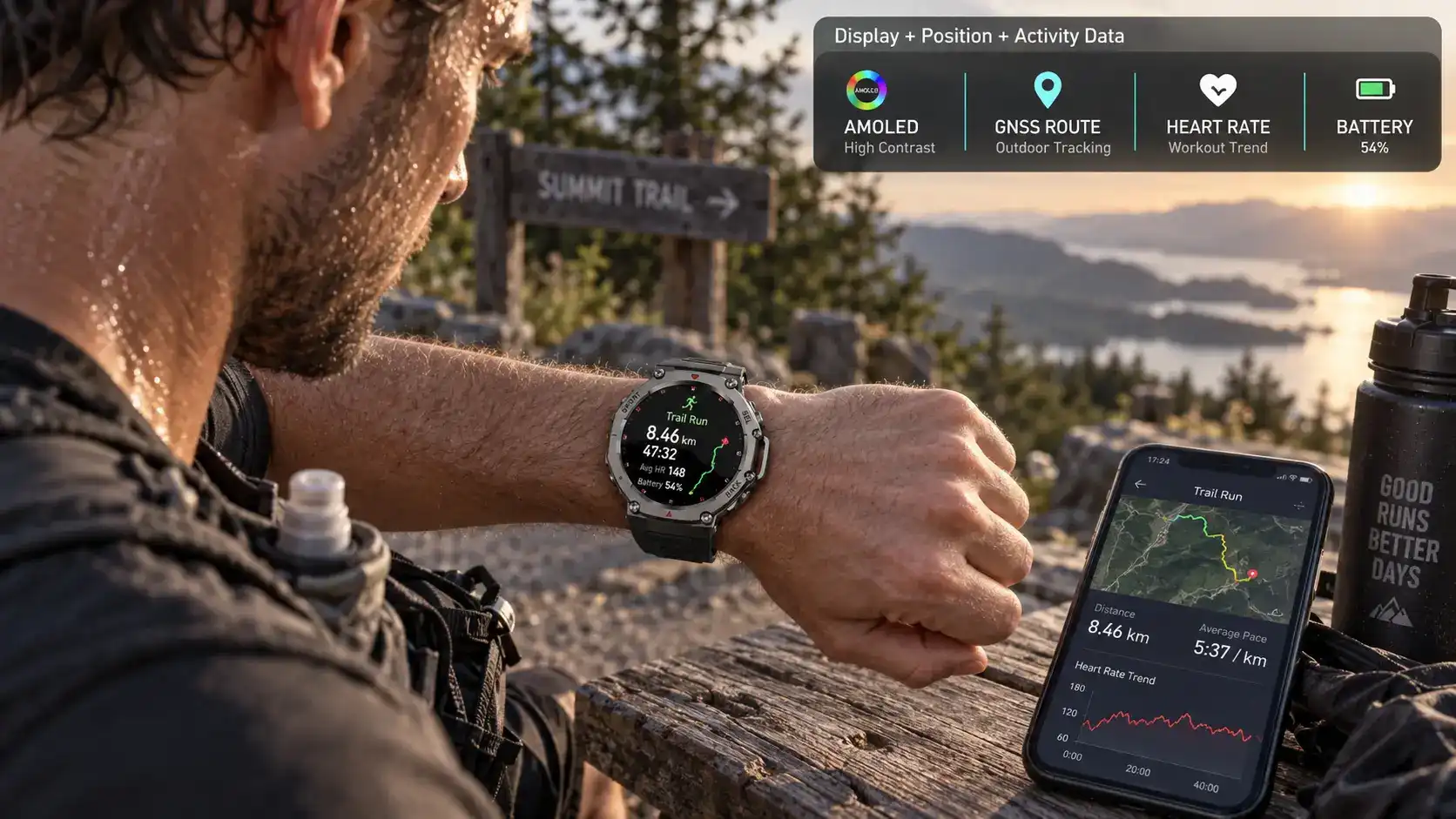
For practical purposes, this refers to a screen that can readily be adjusted to accommodate a variety of lighting situations. The illumination on the display is increased so that it can be read even when the sun is shining brightly outside. In low-light conditions, pixel-level fading makes it easier on the eyes without altering the colours or the appearance of the pictures. Due to the fact that it is so responsive, an AMOLED wristwatch that is designed to monitor one's health and activity may be used in a variety of settings, including on jogging trails, in the workplace, and almost anywhere else.
GPS Integration and Sensor Accuracy
As soon as you combine a dual-band GNSS tracking system with a high-quality AMOLED screen, the tracker transforms from a pleasant addition to a practical data tool. Signals with frequencies of L1 (1575.42 MHz) and L5 (1176.45 MHz) are used by dual-band GPS for transmission. It does this by cross-referencing a number of different satellite systems, including GPS, GLONASS, Galileo, and BeiDou, in order to reduce the positional error margins to less than three meters throughout open regions.
Considering that the gadget contains high-performance sensors integrated directly into the display environment, its value is significantly more than it already was. Heart rate monitors, machines that measure SpO2, and accelerometers are the components that make up health screens. With the help of these, corporate wellness managers and fitness businesses can demonstrate to their clients that they are trustworthy tools that are supported by data.
Disclaimer: The health monitoring capabilities of smartwatches are only intended to monitor your general health and are not intended to diagnose or treat specific conditions. They are not intended to serve as a substitute for the diagnosis or therapy provided by a trained therapist.
Comparing AMOLED GPS Smartwatches with Other Display Types
To pick the best display technology for a line of business-to-business (B2B) products like an AMOLED smartwatch, you need to be honest about the pros and cons. In the smartwatch market, AMOLED mostly goes up against LCD (IPS), transflective MIP (Memory-in-Pixel), and regular TFT screens.
Although IPS LCD screens show colors more accurately and work reliably in direct sunlight because they are reflective, they use more power because the backlight is on all the time. MIP screens in endurance-focused devices like some Garmin models put battery life ahead of visual brightness. This is great for ultra-marathon runners but less appealing to people who buy things for looks.
AMOLED sticks out when the way something looks is important to the buyer. The Samsung Galaxy Watch series always uses AMOLED panels to get top-of-the-line retail positions, and Huawei's GT4 Pro shows that AMOLED and long battery life are no longer opposite goals.
When Amazon sellers and Shopify store owners look for goods for trend-conscious customers, the type of display is often the most obvious way to tell them apart in selling photos, unboxing videos, and TikTok-style videos. A screen that looks great on camera moves units, and AMOLED screens always do that.
Selecting the Best AMOLED GPS Smartwatch for Your Business Needs
Key Criteria for Procurement and OEM Sourcing
Instead of relying only on a brand's reputation, procurement managers need a structured way to evaluate suppliers. These are the main things that should guide any choice about sourcing:
- Display size and resolution: A 1.96-inch AMOLED panel with a resolution of 320x240 provides clear, understandable images in a 44–49mm case width, which is a popular size for both men and women in the US market.
- Battery performance: Devices with 5–10 days of real-world battery life have lower return rates because customers don't have to charge them as often, which is a common reason for bad reviews on Amazon.
- Durability standards: IP67 water resistance ensures that the product can handle normal use, like sweat, rain, and splashes, without warranty claims cutting into profits.
- Connectivity features: Bluetooth music playing and hands-free calling make the device more appealing to fitness-focused users and workplace gift programs alike by reducing the need to use a phone while working out.
- Charging convenience: Support for wireless charging gets rid of complaints about proprietary cables, which are a common issue in one-star reviews for all types of wearables.
These factors take into account the problems that Amazon FBA sellers are most familiar with for an AMOLED smartwatch: returns due to poor quality, features that don't live up to customer expectations, and inventory that is vulnerable to changes in consumer tastes that happen quickly. When a product line chooses a device that meets all five criteria, it sets itself up for continued good reviews and restocking cycles.
Implementing AMOLED GPS Smartwatches in Business and OEM Solutions
Real-World B2B Applications
An AMOLED smartwatch can be used for a lot of different things, not just retail sales. As part of their health efforts, corporate wellness programs are using connected wearables more and more to keep an eye on employees' levels of exercise, signs of stress, and sleep quality. When a business gives 200 to 500 units to its employees, it gets better prices, more uniform gadget specs, and OEM branding that fits with the company's health programs.
Communities that offer health platforms are another new use. In health tracking ecosystems, people keep track of their vital signs and share that information with wellness managers. To do this, the devices need to be easy to use and technically stable. AMOLED screens make it easier to read info dashboards quickly, which increases the number of people who use these apps.
Fitness brands and private label owners can benefit from white-label customization, which includes placing the name where they want it, designing their own watch faces, packaging that looks good, and even custom UI themes that strengthen the brand identity from the moment the customer opens the box. The steel strap and case give the product a high-end look, which supports higher retail prices and bigger profit margins.
Supported extras, such as wireless charge docks, bands made of steel or silicone that can be switched out, and protective screen films, complete the product environment. Distributors and retail chains can sell these accessories as carefully put together packages.
Future Trends and Innovations in AMOLED GPS Smartwatches
The market for displays that can be worn is seeing rapid development. The technology behind microLEDs is coming closer and closer to being able to be commercialised on a commercial scale. It is anticipated that it will be even brighter than the current generation of AMOLEDs while also using less energy. Prototypes of flexible OLED displays that are able to be incorporated into bending case designs are already being manufactured by major display manufacturers.
When it comes to location, chipmakers like Airoha and Sony are working to improve GNSS receivers in order to make cold-start acquisition quicker (they are aiming for lock durations of less than twenty seconds), and all-system constellation modes are using less power. After reaching a value of around $29.3 billion in 2023, the worldwide market for smartwatches is anticipated to continue expanding at a pace of more than 8% per year until the year 2030. This is mostly due to the fact that an increasing number of individuals are becoming conscious of their health and choosing a lifestyle that is related.
In order to maintain their product lines' competitiveness in the face of evolving technological trends, procurement experts whose sourcing strategies are aligned with these trends will be able to concentrate their efforts on suppliers that possess robust research and development pipelines, flexible original equipment manufacturer capabilities, and solid inventory infrastructure.
Conclusion
AMOLED display technology is a real step forward in how easy smartwatches are to use, how nice they look, and how well they use energy. A well-designed AMOLED GPS smartwatch meets the needs of customers in the fitness, lifestyle, and workplace wellness areas thanks to its dual-band GPS, strong health sensors, independent connectivity, and long-lasting build. It's just as important for B2B buyers to understand a product's display technology as it is to understand any other feature. This is true whether they are looking for products to put on Amazon, for private label programs, or to buy in bulk for their businesses. Getting the right gadget from the right partner is the key to building a product line that makes money and can be defended.
FAQ
1. Does AMOLED technology actually extend battery life compared to LCD?
Yes, under normal conditions of use. Since AMOLED pixels only use power when they are lit up, dark watch faces and UI elements greatly reduce the overall power draw. Under mixed use, devices in this group usually have a battery life of 5–10 days, which is about the same as many IPS LCD options.
2. Is an AMOLED GPS smartwatch suitable for intensive outdoor sports tracking?
These devices are useful for trail running, cycling, and hiking because they have dual-band GPS and an AMOLED display that can be made very bright so that it can be read in direct sunlight. The IP67 rating ensures that the device is protected from sweat and rain while it is being used for a long time.
3. What should OEM buyers prioritize when customizing these devices?
Most of the time, people want to change where the logo goes, how the watch face looks, how the package looks, and how the colors in the UI look. To avoid problems after the start, it's also important to make sure that your seller keeps firmware versions uniform across production batches.
4. Can these smartwatches integrate with corporate health monitoring platforms?
A lot of products that work with Android have third-party health data APIs that let them connect to workplace wellness platforms and community health tracking systems. Before you place a large order, check with your seller to make sure the SDK is available.
Partner with Xizhou for Your AMOLED GPS Smartwatch Supply
The OEM/ODM company Xizhou is based in Shenzhen and is driven by technology. They have mature R&D engineering, GMP-certified production, and a big stock inventory to support everything from trial orders to high-volume replenishment cycles. Xizhou delivers on specification, timeline, and quality consistency whether you need a dependable amoled gps smartwatch supplier for your Amazon store, a white-label partner for your fitness brand, or bulk units for a corporate wellness rollout. Get in touch with our product team right away at 13266508958@163.com to talk about your sourcing needs.
References
1. DisplayMate Technologies. AMOLED Display Technology Performance Analysis. DisplayMate Technologies Corporation, 2022.
2. Grand View Research. Smart Watch Market Size, Share & Trends Analysis Report. Grand View Research, 2024.
3. International Organization for Standardization. ISO 22810:2010 — Horology: Water-Resistant Watches. ISO, 2010.
4. Haugen, E., & Kim, S. Wearable Sensor Technologies for Health Monitoring: A Review. Journal of Medical Devices, 2023.
5. Park, J., & Lee, H. Power Consumption Optimization in AMOLED-Based Wearable Displays. IEEE Transactions on Consumer Electronics, 2022.
6. Statista Research Department. Global Wearable Technology Market Outlook 2024–2030. Statista, 2024.