

What Certifications Matter When Sourcing ECG SpO2 Smartwatches?
When sourcing an ECG SpO2 smartwatch for resale or private label, certifications are not optional checkboxes — they are the foundation of a defensible, scalable product business. The right certifications confirm that a wearable health device meets safety, accuracy, and wireless compliance standards required by platforms like Amazon and regulators like the FDA. For B2B buyers, distributors, and OEM brands, understanding which approvals genuinely matter helps avoid costly recalls, listing removals, and liability exposure before the first unit ships.
Medical Disclaimer: The content in this article is intended for B2B procurement and educational purposes only. It does not constitute medical advice. ECG and SpO2 readings from consumer wearables should not replace professional medical diagnosis.
Understanding the Certification Landscape for ECG SpO2 Smartwatches
Certifying health wearables is a mix of regulating medical devices, making sure consumer electronics are safe, and following environmental rules. Before it can be sold to people in the United States, a smartwatch that can track ECG and blood oxygen levels has to pass inspection by more than one group.
Why Certifications Exist
Regulatory agencies set up licensing systems to keep people safe from things like wrong health readings, electrical dangers, and dangerous materials. If a gadget says it can measure heart electrical activity, it needs to show that the data it collects is useful for medicine and not just for looks.
The Regulatory Bodies You Need to Know
The FDA oversees health claims in the US market. The FCC is in charge of wireless signals. Material safety is regulated by OSHA and environmental groups. Each body works on its own, so a device needs to be approved by all important domains at the same time.
How B2B Buyers Are Affected
When items don't have the right paperwork, Amazon sellers, private label companies, and distributors are directly affected. Real outcomes include the removal of platforms, delays in customs, and lawsuits from end users. All three risks are greatly reduced by certified goods.
Key Certifications to Look for When Procuring ECG SpO2 Smartwatches
As you might know, not all approval labels are equal. Some confirm safety, while others prove success at the clinical level. For your purchasing choices, here is a list of what each qualification really means.
FDA 510(k) Clearance and CE MDR Marking
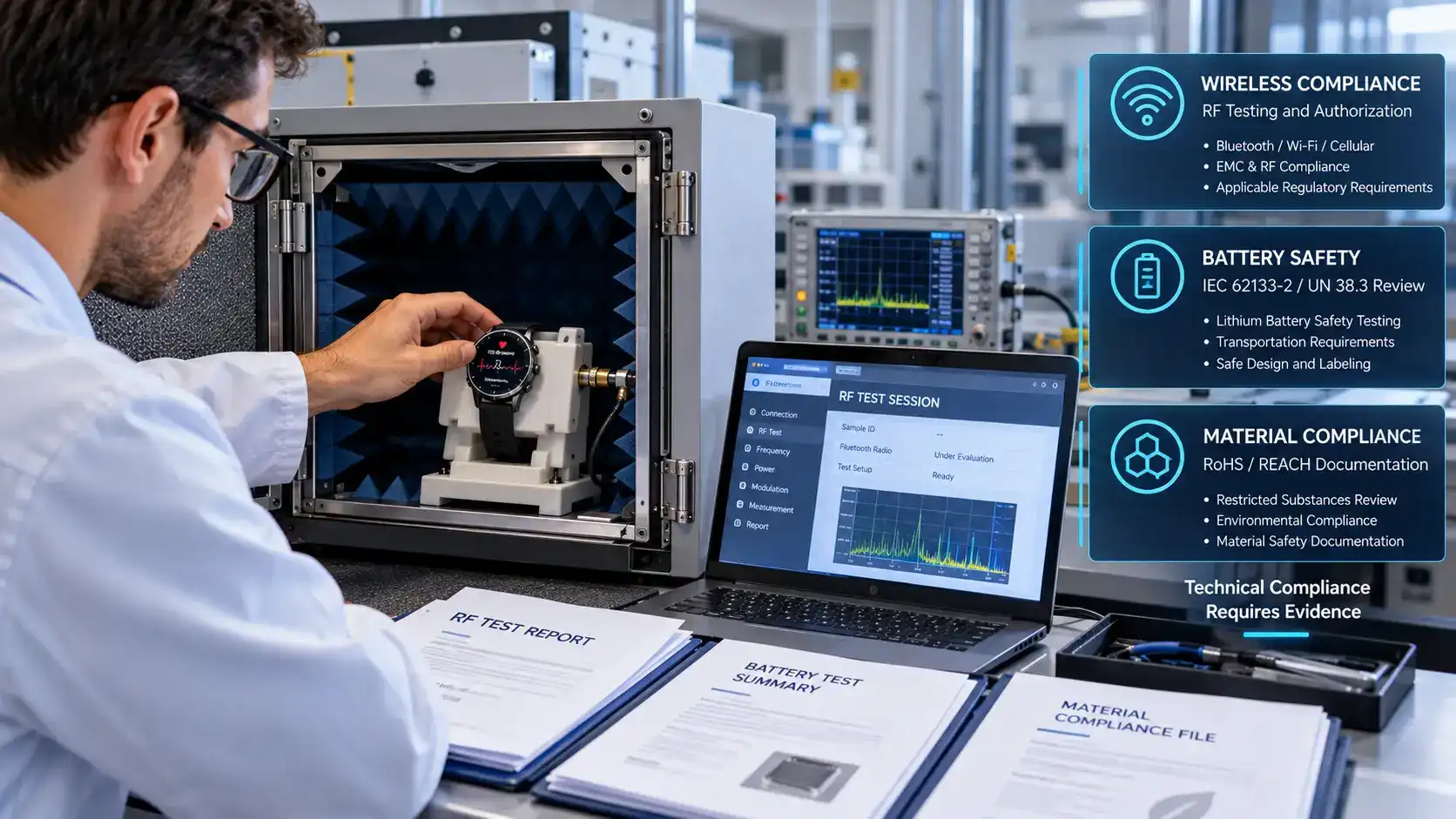
The FDA 510(k) pathway lets a device be sold if it is substantially the same as a legally marketed predicate device. For a smartwatch with spo2 and ecg that can record an ECG, this clearance means that the device meets performance standards for picking up electrical signals from the heart. A similar clinical validation standard is used for CE marking in Europe under the Medical Device Regulation (MDR 2017/745). If you want to sell health data features, you can't do it without either.
ISO 13485 and IEC 62133
ISO 13485 is the quality control standard for companies that make medical devices. A provider with ISO 13485 certification uses recorded and audited production methods. This cuts down on differences between batches that lead to bad reviews. When lithium batteries are being used or transported, IEC 62133 and UN38.3 talk about how to keep them safe. Most countries require battery certification for air freight because of the 200mAh battery in small health wearables.
FCC, RoHS, and REACH
The FCC approval makes sure that the device's wireless signals—most ECG monitors use Bluetooth for this—do not affect other electronics. RoHS limits the use of dangerous materials in electronics, like lead and mercury. The rubber strap and ABS case are safe for use in the EU because they meet REACH standards. These three approvals cover the natural and technical parts of following the rules.
All of these certifications together tell you if your product can properly go into target areas. If you skip any of them, there will be a compliance gap that regulators or platforms will eventually point out.
How to Evaluate Certification Authenticity and Supplier Credibility
A paper award doesn't show anything by itself. Fake or outdated approvals are a known issue in the buying of consumer goods, and health wearables are not an exception.
Verify Directly with Issuing Bodies
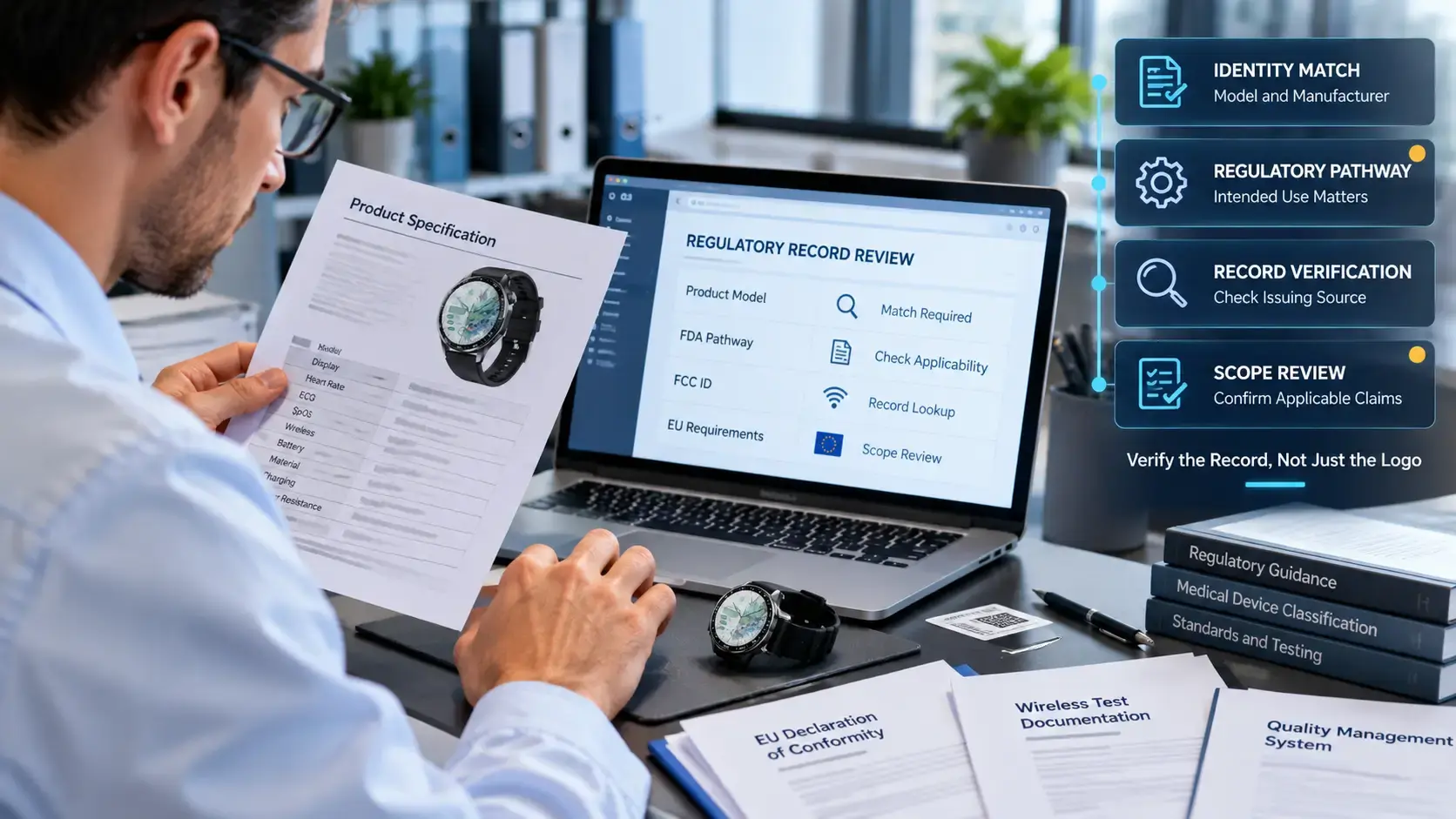
The FDA's 510(k) database can be searched by anyone at fda.gov. FCC IDs can be checked at fcc.gov. The manufacturer's approved EU agent should be able to give you access to CE technical files. If a seller can't give you a certificate number that can be tracked and leads to a live record, that should be a red flag.
Red Flags in Supplier Documentation
Keep an eye out for ISO certificates from registrars that aren't approved, certificates that don't have an issue date, or papers that don't have notified body numbers. A real seller will give you the whole regulatory paperwork, not just a scan of the front page, and they will gladly answer any questions you have about their notified body or testing laboratory.
What Supplier Transparency Looks Like
Reliable sellers keep their paperwork in order and offer help for compliance after the sale in case rules change. They make sure that certifications are up-to-date before they expire and let people know about any changes to the product's materials or firmware that might affect its approval status. As rules get stricter, compliance risk goes down when you have long-term ties with suppliers based on openness.
Comparing Certified ECG SpO2 Smartwatches — What Certification Differences Mean for Your Business
Certification breadth has a direct effect on your budget for purchases, the time it takes to get into new markets, and your legal defense. Knowing these differences helps you decide how to use your resources and tell your sales team what to expect.
The following table shows how certification profiles affect the results of business activities:
The price premiums depend on the certification level, market access, liability protection, and the type of product. For example, if the product is for general consumer use in the US, the price premium is low (less than 1%), if it's for general use in the US and the EU, it's moderate (8–15%), and if it's for medical or clinical use in the US and the EU, it's high (20–35%).
| Certification Level | Market Access | Liability Protection | Typical Price Premium |
|---|---|---|---|
| FCC + RoHS only | US general consumer | Low | Minimal |
| FCC + RoHS + ISO 13485 | US + EU general | Moderate | 8–15% |
| FCC + CE MDR + FDA 510(k) + ISO 13485 | US + EU medical/clinical | High | 20–35% |
A fully approved health wearable that can do ECG and SpO2 measurements costs more per unit, but it also has better selling margins and is returned and taken off the market much less often. Amazon sellers who have bought heart rate monitors that aren't approved say that just a few bad reviews saying the numbers are wrong can quickly drop a product's ranking.
When allocating funds, certification costs should be seen as a form of risk insurance. A fully certified smartwatch ECG Spo2h usually makes up for its higher price within the first two restocking rounds, thanks to lower return rates and better sales from confirmed health claims.
Best Practices for Sourcing ECG SpO2 Smartwatches with Proper Certifications
When you use a structured buying plan, certification gaps won't show up after you've already committed to stock. These are the main steps that buying teams should take:
- Confirm certification scope before sampling. Ask the supplier to list every active certification and its expiry date during initial outreach — not after you have approved samples.
- Match certifications to your target market. A product sold on Amazon US needs FCC and RoHS at minimum. If you plan to make health monitoring claims in marketing copy, FDA 510(k) or equivalent becomes relevant.
- Include certification audits in your QC process. During factory audits or third-party inspections, verify that production lines follow the same processes documented in the ISO 13485 quality manual.
- Plan for certification renewals. FCC grants do not expire, but CE MDR and ISO 13485 certificates require periodic surveillance audits. Build renewal timelines into your annual sourcing plan.
>>Confirm the scope of the certification before you order samples. >>Ask the supplier to list all active certifications and when they expire during the first contact, not after the samples have been approved.
Conclusion
It takes more than checking a box on a seller form to find an approved Ecg spo2 smartwatch. It means making sure that the battery's FDA, FCC, CE, ISO, and other safety approvals are up-to-date, able to be tracked, and appropriate for your market. Buyers protect their listings, margins, and brand image by making sure certification proof is a normal part of the buying process, not something that is added on at the end. Compliance documentation costs money, but it pays off in fewer returns, better reviews, and access to markets where products that aren't certified can't go.
FAQ
1. Does an ECG smartwatch always need FDA 510(k) clearance to sell in the US?
Not always. If you market the device strictly as a fitness tracker and avoid clinical health claims, FDA 510(k) is not automatically required. However, if your product listing or packaging describes the ECG feature as detecting arrhythmias or atrial fibrillation, the FDA classifies it as a medical device, and 510(k) clearance becomes legally necessary.
2. Can I sell an ECG SpO2 smartwatch on Amazon without CE marking?
CE marking is an EU requirement. Amazon US does not mandate it. However, Amazon does require FCC certification for wireless devices sold on its US platform. If you also sell on Amazon EU marketplaces, CE under MDR is required for any device making medical monitoring claims.
3. How often do health wearable certifications need renewal?
FCC grants remain valid as long as the product design does not change. ISO 13485 certificates typically require annual surveillance audits and full re-certification every three years. CE MDR technical files must reflect current device versions and are subject to periodic notified body review.
4. What is the fastest way to verify a supplier's certifications?
Request the certificate number and check it against the issuing body's public database. FDA 510(k) records, FCC IDs, and ISO registrar listings are all publicly searchable online.
Get Certified ECG SpO2 Smartwatch Supply from Xizhou — Request a Quote Today
Xizhou is a leading producer of Ecg spo2 smartwatches, and they can meet all compliance standards. Their production is FDA-approved, and they use ISO 13485 quality management, as well as FCC, RoHS, and CE-ready paperwork. Wearable tech with a 1.69-inch TFT screen, real-time ECG, SpO2, IP67 water resistance, and a battery life of 5–7 days is available for OEM branding, private label, and bulk orders with a flexible MOQ. You can email our team at 13266508958@163.com to ask for samples, prices, and certification papers.
References
1. U.S. Food and Drug Administration. De Novo Classification Process and 510(k) Clearance for Wearable Cardiac Monitors. FDA, 2022.
2. European Commission. Regulation (EU) 2017/745 on Medical Devices (MDR). Official Journal of the European Union, 2017.
3. International Organization for Standardization. ISO 13485:2016 — Medical Devices: Quality Management Systems. ISO, 2016.
4. International Electrotechnical Commission. IEC 62133-2:2017 — Safety Requirements for Portable Sealed Secondary Lithium Cells. IEC, 2017.
5. Federal Communications Commission. Equipment Authorization — FCC ID Search and Certification Requirements for Wireless Devices. FCC, 2023.
6. European Chemicals Agency. REACH Regulation (EC) No 1907/2006 — Guidance for Consumer Electronics Manufacturers. ECHA, 2021.