

Choosing Heart Rate Smartwatch for Sports Applications
Choosing the right heart rate smartwatch for sports applications means balancing precision, durability, and real-world usability. An accurate heart rate smartwatch leverages advanced photoplethysmography (PPG) sensors combined with motion compensation algorithms to deliver consistent biometric data during dynamic athletic movements. Whether you're an Amazon seller sourcing devices for resale, a distributor evaluating bulk inventory, or a private label brand seeking OEM customization, understanding sensor fidelity, device construction, and supplier reliability transforms procurement from guesswork into strategic advantage. The challenge lies not merely in selecting features but in identifying partners who guarantee quality control, flexible ordering, and responsive support throughout rapidly evolving product cycles.
Understanding Heart Rate Accuracy in Smartwatches
How Optical Sensors Capture Heart Rate Data
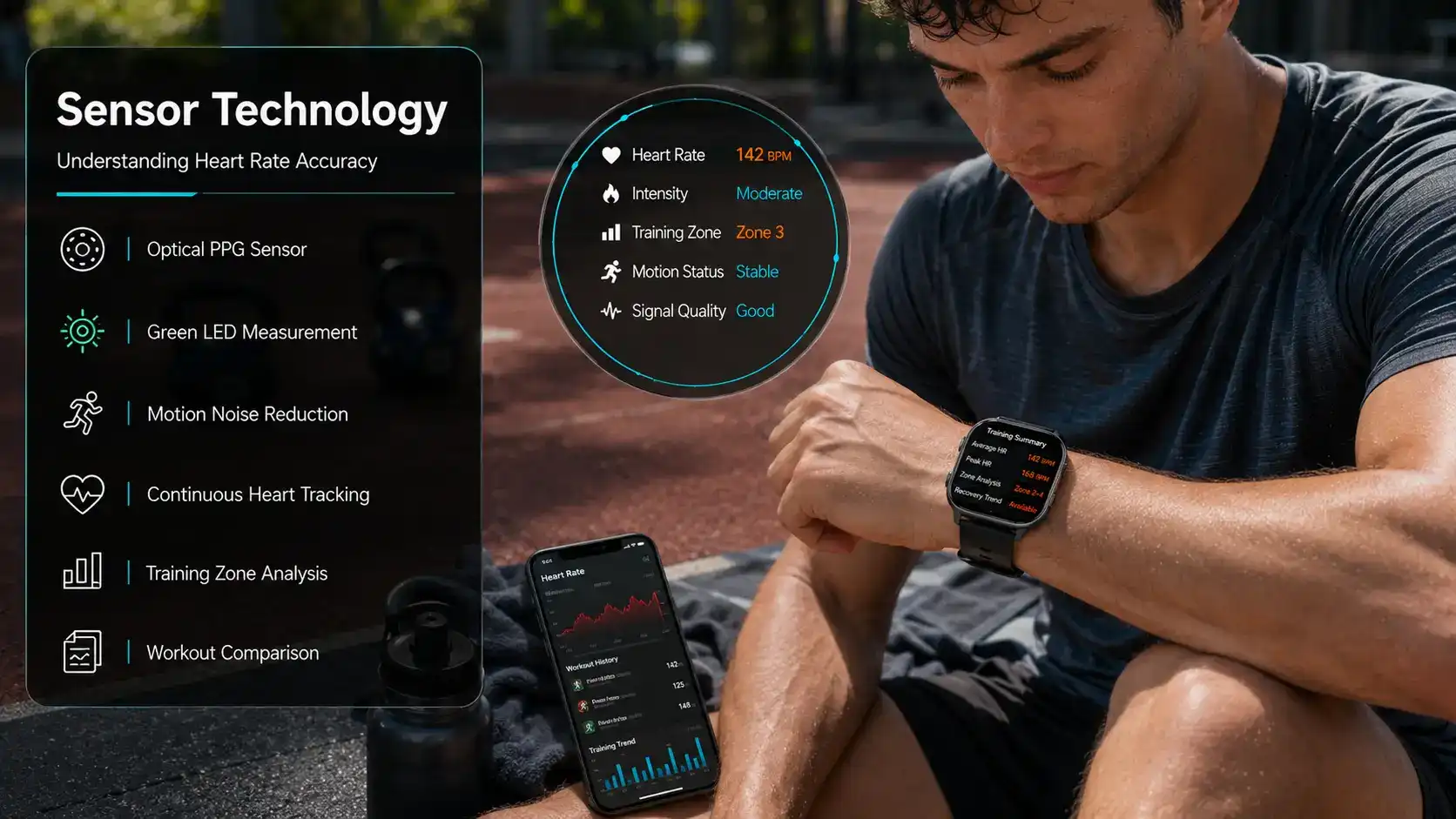
Most recent sports smartwatches feature PPG technology, which uses green LED light to look through the skin and monitor heartbeat-induced blood volume changes. The sensor converts light reflection patterns into BPM. Wrist-worn optical sensors are more handy than electrical impedance chest straps when appropriately built. They improve accuracy. Advanced variants use multi-path optical arrays and accelerometers to distinguish cardiac signals from motion noise. This is crucial for circuit training and fast running.
This technique works best when the gadget fits securely against the wrist and is one finger-width above the wrist bone. Leaky straps allow light in and decrease signal quality. Due to blood vessel narrowing, low temperatures decrease the signal. The gadget might slide if you sweat too much. Knowing these aspects helps purchasing teams establish realistic targets and provide clear product instructions.
Factors Affecting Sensor Reliability
The accuracy of heart rate measurements depends on several variables. Melanin in darker skin tones absorbs more light; hence, sensors require stronger LED brightness or several wavelengths to be accurate over a broad range of users. Motion artefacts from intensive lateral motions like boxing or tennis challenge even the most powerful algorithms. High-end devices combine dual-sensor arrays and machine learning algorithms trained on thousands of movement patterns to eliminate false positives.
Sensor positioning and touch intensity affect data consistency. Flexible silicone straps and handy cases maintain steady skin contact throughout intense workouts. LED brightness is also significant when powered by batteries. Some inexpensive versions reduce LED brightness as the battery level declines to conserve power, which reduces measuring accuracy in the final few hours before charging. Ask your vendor about these technical aspects to give them your production objectives and long-term dependability expectations.
The Role of Heart Rate Variability in Athletic Performance
Top athletes and sports scientists value HRV measures, which quantify millisecond fluctuations between heartbeats. HRV measures autonomic nervous system balance and readiness to exercise or recuperate. A timepiece that detects minor R-R interval variations allows coaches to adjust players' workloads to prevent overtraining and injury.
Special HRV algorithms capture heart rate at higher frequencies—often 1-second intervals or faster—to record fine-grained temporal variations. Professional sports watches can accomplish this, unlike fitness trackers. HRV functionality distinguishes devices for sports training, corporate wellness, and rehabilitation monitoring programs, allowing for higher pricing and demonstrable results.
Key Criteria for Choosing a Heart Rate Smartwatch for Sports
Sensor Technology and Sampling Precision
Know signal processing systems and sampling rates to assess sensor specifications. Basic heart rate monitors collect readings every 5–10 seconds when exercising, leaving data gaps when intensity varies abruptly. Professional models capture samples every second, providing thorough interval training and threshold analysis data. Look for devices with sampling frequency and motion correction information. Technical difficulties might be hidden in vague marketing talk.
Also crucial is calibration. Some modern hr monitoring watches can calibrate sensors using chest strap monitors or lab equipment. This improves accuracy for all tasks. This capability helps business-to-business customers sell equipment to physically diverse players. Procurement teams should request validation studies or independent testing demonstrating accuracy within ±5 BPM across various workout intensities. This is the industry standard for dependable sports apps.
Battery Performance Under Real-World Conditions
Battery life promises frequently assume a low-brightness screen, little GPS usage, and rudimentary heart rate monitoring. Live displays and location services may reduce endurance by 50–70% during sports tracking. GPS and continual heart rate monitoring may limit the battery life of a 10-day gadget to 8–12 hours. Ultra-marathon runners and multi-day outdoor travellers should consider this.
Find the correct mix between battery capacity, device weight, and charging infrastructure when purchasing for companies. Corporate health initiatives provide staff batteries that last 5–7 days with typical usage. Users don't have to charge them as frequently or complain. Despite their convenience, magnetic charging connections may fail if the connectors corrode from moisture. Charge cycle ratings—usually 300 to 500 complete cycles before capacity drops—estimate the total cost of ownership and battery replacement.
Durability Standards for Sports Environments
Sports devices need stronger designs than consumer gadgets. IP67 water protection is appropriate for perspiration and brief water contact, but not for swimming or open-water activities. 5Those activities benefit from ATM or IP68 ratings. For athletes whose wrists grow fatigued after lengthy exercises, aerospace-grade metal or fiber-reinforced polymer cases mix impact resistance with lightweight comfort.
A screen is durable if it can't be damaged and is visible in sunlight. IPS panels with 320x240 pixels display data effectively, while greater resolutions take more electricity. Dropped displays are protected by Corning Gorilla Glass or sapphire crystal coverings. When purchasing gadgets for team sports or outdoor training, physical resilience reduces warranty claims and enhances device longevity, which affects ROI.
Integration with Training Platforms and Ecosystems
Professional athletes and corporate purchasers benefit from devices that interact with third-party coaching platforms and health data hubs. Instructors may see players' performance data without having to manually share it when devices sync with TrainingPeaks, Strava, Apple Health, or Google Fit. Teams creating custom analytics applications or connecting wearable data to EHRs in workplace wellness or rehabilitation systems must understand API access and data export formats (TCX, FIT, and GPX).
Android support lets organisations apply their own training applications or branding overlays. OEM customers seeking white-label solutions or companies adding wearables to health management systems benefit from this versatility. Testing Bluetooth (5.0 or later) and ANT+ compatibility and reliability makes sure that data syncs reliably across a wide range of device environments, which cuts down on technical issues and support costs.
Comparison of Leading Brands and Models in 2026
Premium Segment: Precision Meets Enterprise Features
Apple Watch leads commercial deployments with its dual-wavelength PPG sensors and optional ECG functionality. Companies that seek to standardise employee health programs value their iOS and corporate mobility management compatibility. It's expensive and confined to one environment, but the user experience is amazing. This is something purchasing teams with several hardware configurations should consider.
Garmin bridges professional sports and rugged outdoor performance. The Forerunner series has heart rate zones optimised for lactate threshold training and sophisticated running characteristics, including cadence, vertical oscillation, and ground contact time. Garmin's open data and big third-party app ecosystem appeal to coaches and training sites who require detailed performance statistics. Since the GPS battery lasts over 30 hours, ultra-distance activities may be done without charging.
Mid-Tier Innovation: Balancing Features and Value
Fitbit is simple to use and effectively tracks your health, making it a suitable option for company wellness programs that emphasise participation over performance. New versions monitor SpO2 and analyse sleep stages, making them useful outside of sports. You pay annually for Fitbit Premium to get personalised training routines and information. Distributors that sell gadgets with service bundles may profit repeatedly.
Polar makes precise heart rate monitors using decades of sports science research. Their Precision Prime sensor fusion reduces motion artefacts during high-intensity periods by combining optical and skin contact data. Semi-professional athletes, college sports teams, and rehabilitation clinics where biometric monitoring influences medical decisions need this concentration on reliable data. When considering multi-year installations, institutional customers are less concerned about obsolescence since Polar products have longer firmware support cycles.
Emerging Competitors: Regional Strengths and Cost Efficiency
By combining decent sensor accuracy with aggressive pricing strategies, Xiaomi and Huawei offer great value in emerging markets. These brands are great at adding new features quickly and integrating them into specific ecosystems, especially in Asian countries. However, corporate buyers who have to deal with regulatory compliance requirements like GDPR or HIPAA when health data crosses borders need to carefully look at data privacy policies and where cloud infrastructure is located.
Suunto devices that focus on navigation, altitude tracking, and extreme power-saving modes have a niche market among serious mountain climbers and triathletes. While Suunto's heart rate monitors are just as accurate as those made by other companies, what sets them apart is their special environmental sensors, such as barometric altimeters, compasses, and storm alarms. These make them perfect for outdoor education programs, military training, or adventure tourism companies that outfit guided expeditions.
Procurement Guide: How and Where to Buy Accurate Heart Rate Smartwatches
Identifying Reliable Sourcing Channels
Big purchasers receive the greatest rates from manufacturers and recognised OEM partners. Shenzhen Xizhou E-commerce Co., Ltd. makes bespoke smartwear. They produce popular SKUs at scale with minimal trial order minimums. Their skilled research and development teams help private label products stand out in congested marketplaces with distinctive brand positioning, packaging, and firmware.
Established electronics wholesalers provide a large assortment and logistical expertise, helping customers who require frequent refills without significant delays. Middlemen increase margins, lowering resale profits. Direct procurement optimises cash flow and inventory risk for main product lines and distributor agreements for seasonal or unique SKUs.
Online B2B platforms find suppliers but need authentication. Read the company's licenses, plant audit reports, ISO 9001, CE, FCC, and RoHS certificates before purchasing samples. Get examples from comparable customers and check production capacity via video factory visits or third-party inspections. Balanced deposits, output objectives, and quality assessment keep everyone safe and production running.
Cost Structures and Pricing Negotiations
Order size, customisation, and part required affect unit cost. IPS displays, optical sensors, and off-the-shelf software cost $8–15 for 1,000 or more devices. Premium $25–$45 versions include medical-grade sensors, AMOLED screens, and bespoke Android builds. Knowing what impacts sensor module, battery, and case material prices helps negotiate and anticipate profits.
Bulk pricing comes when 500, 1,000, 5,000, or 10,000 units are sold. For first purchases (500–1,000 units), suppliers with flexible MOQ frameworks and specified volume levels are more likely to provide tiered pricing that approaches large-order prices. Higher order values for straps, charging cables, and protective cases may lower delivery costs.
Warranty arrangement affects total ownership cost. A 12-month manufacturer warranty is fine, but 18–24 months or advance replacement plans may save downtime and customer support costs. Explain the warranty's exclusions for incorrect use-caused water damage, cosmetic deterioration, and battery capacity loss to avoid disagreements. Some merchants share warranty risk, providing money back or credit for future purchases for batches with fewer defects.
Maximizing Device Performance Post-Procurement
For accurate heart rate monitoring, both good hardware and good user education are needed. By giving out fitting guides that stress snug wrist placement and cleaning instructions, you can stop common accuracy complaints that are caused by user error instead of device problems. By encouraging firmware changes through partner apps, algorithm improvements and bug fixes are made that improve sensor performance over the lifetime of the device.
Users will have more faith in the accuracy of the device if you suggest suitable extras like chest strap monitors for cross-validation during important training phases. Some athletes like dual-monitoring systems, where hr monitoring watches make daily training easier, and chest straps provide the highest level of accuracy during races or lactate threshold tests. Supporting this mixed approach shows that your brand cares more about performance results than product promotion, which builds trust in sports groups that take performance seriously.
Future Trends and Innovations in Heart Rate Smartwatches for Sports
Medical-Grade Sensors and Regulatory Evolution
Consumer wearables and medical gadgets merge faster when sensor technologies become precise enough for hospitals. New gadgets feature electrocardiogram (ECG) sensors that may detect life-threatening atrial fibrillation, which requires sophisticated medical equipment. Smartwatches are now health monitoring instruments with FDA and CE certifications. This expands clinical rehabilitation, chronic illness management, and elder care monitoring market opportunities.
Continuous glucose monitoring integration, albeit early, might change how diabetic athletes train with blood sugar. New noninvasive optical spectroscopy approaches might eliminate fingerstick testing, revolutionising diabetes management. Businesses that cooperate with the first businesses to produce these technologies have an advantage in future health-tech marketplaces. They require particular legal support with government and liability concerns.
Artificial Intelligence and Personalized Training
Machine learning algorithms trained on millions of workouts may now provide each individual with personalised coaching ideas depending on how they react to various exercises. AI-powered smartwatches analyse training load, recovery parameters, and performance patterns to determine training, rest, and taper. This shift from passively gathering data to actively directing users makes the gadget seem more valuable, which justifies charging more and providing premium services.
The bleeding edge of sports science and other domains is predictive analytics that identify injury risk from modest walking variances or unusual heart rate healing patterns. Teams and training centers save injury-related missed time and healthcare expenditures with these capabilities, which offer institutional sales ROI. OEM partners differentiate their goods from general hardware specs by creating their own algorithms or adding sports science IP.
Sustainability and Corporate Responsibility
Environmental issues are becoming important in purchasing decisions, particularly for company purchasers with ESG commitments. Manufacturers that recycle, reduce packaging, and gather old gadgets achieve these aims. To achieve due diligence criteria, public companies and ethical brands must have supply chain evidence on conflict minerals and labour abuses.
Improvements in battery technology that extend gadget life and simplify recycling reduce environmental impact and overall cost of ownership. Solar charging and kinetic energy harvesting may become popular, reducing the need for charging. Long-term purchase strategies with environmentally friendly enterprises defend against new legislation and shifting client attitudes toward responsible technology use.

Conclusion
To choose an accurate heart rate smartwatch for sports use, you have to weigh the benefits of accurate sensors, long-lasting batteries, and ecosystem connectivity against the costs and difficulties of getting the watch. Realistic performance expectations for the Accurate Heart Rate Smartwatch can be set by knowing the limits of PPG technology and how to work around them. By looking at the best brands, like Apple's business integration, Garmin's athletic depth, or Polar's focus on precision, we can see how their strengths can help organizations match the powers of their devices with their needs. Direct relationships with manufacturers give you more options for customization and better prices, while long-term partnerships with distributors make sure you always have stock on hand. New trends in medical-grade sensors, AI teaching, and sustainability give buyers who are willing to think ahead a chance to make money. Clear guarantee terms, careful seller screening, and user education programs all help to improve device performance and customer happiness in retail, wholesale, and educational settings.
FAQ
1. What is the typical accuracy range for optical heart rate sensors during running?
Optical scanners of good quality are more accurate than chest strap monitors by about 5 beats per minute during steady-state running. Motion artifacts make accuracy worse during high-intensity intervals or activities that require a lot of arm movement. Devices that have advanced motion compensation algorithms and safe wrist placement stay more consistent. Cross-validating device readings against chest straps during initial training sessions helps athletes learn how their specific device works with different types of workouts.
2. How does IP67 water resistance differ from 5ATM ratings?
IP67 certification means that the product can be submerged in up to one meter of water for 30 minutes. This is enough to protect against sweat and rain, but not enough for swimming. 5ATM (50 meters) ratings show pressure resistance equal to 50 meters deep, which is good for swimming and water sports. When you shower or swim, the water pressure changes, making the pressure in certain areas higher than when you are just immersed. For sports that involve contact with water, ratings of at least 3ATM are needed, and ratings of 5ATM are best for daily aquatic training.
3. Can heart rate smartwatches detect serious cardiac conditions?
Some high-end models with ECG features can find atrial fibrillation, an irregular heart rate that raises the chance of stroke. But these gadgets aren't diagnostic tools, so they can't find all types of arrhythmia or heart attacks. Instead of replacing a professional heart evaluation, they act as early warning systems that make people want to see a doctor. Users who are having chest pain, dizziness, or other worrying symptoms should see a doctor right away, no matter what the device says.
Medical Disclaimer: The information on this page about heart rate monitors and other health measures is only meant to teach and is not meant to be medical advice. Always get help from experienced medical workers to figure out what's wrong and how to treat it. The information from a smartwatch should not be used instead of a skilled medical exam.
4. What battery life should I expect with continuous GPS and heart rate tracking?
With GPS and constant heart rate tracking on most sports smartwatches, you can expect them to last between 8 and 15 hours. Ultra-endurance types, like some Garmin devices, can go for 30 hours or more thanks to bigger batteries and chipsets that use less power. Over time, the number of charge cycles hurts the battery's performance. Athletes who are planning events that will use up a device's battery quickly should look into portable charging options or devices that have "ultra-endurance" modes that lower the GPS sampling frequency to make the device last longer.
Partner with a Trusted, Accurate Heart Rate Smartwatch Supplier
Xizhou is an expert at making an Accurate Heart Rate Smartwatch for serious athletes and sports applications that need a lot of power. Our gadgets have advanced optical sensors with motion compensation algorithms, a long-lasting fiber-reinforced polymer build, and a lot of training metrics, such as VO2 Max estimation and zone-based tracking. Our flexible MOQ starts at 500 units; we offer fast customization services, and our GMP-certified facility has strict quality control. These are just a few of the ways we help Amazon sellers, distributors, and private label brands get reliable inventory and stand out from the competition. Our experienced research and development team can add OEM logos, make custom packages, and change software on standard devices to make them branded performance tools.
We keep a lot of inventory on hand so that we can quickly restock, which is important for the success of e-commerce. Full certifications (CE, FCC, RoHS) and quick customer service after the sale take away all the risks of buying. Xizhou gives your business the production freedom and technical know-how it needs, whether it's to test new product lines or make more of the ones that are already selling well. Email our team at 13266508958@163.com to talk about your unique needs and ask for sample units.
References
1. Gillinov, S., et al. (2017). "Variable Accuracy of Wearable Heart Rate Monitors during Aerobic Exercise." Medicine & Science in Sports & Exercise, 49(8), 1697-1703.
2. Seshadri, D. R., et al. (2019). "Wearable Sensors for Monitoring the Physiological and Biochemical Profile of the Athlete." NPJ Digital Medicine, 2(1), 72.
3. Bent, B., Goldstein, B. A., Kibbe, W. A., & Dunn, J. P. (2020). "Investigating Sources of Inaccuracy in Wearable Optical Heart Rate Sensors." NPJ Digital Medicine, 3(1), 18.
4. Düking, P., et al. (2021). "Recommendations for Assessment of the Reliability, Sensitivity, and Validity of Data Provided by Wearable Sensors Designed for Monitoring Physical Activity." JMIR mHealth and uHealth, 9(4), e26860.
5. Nelson, B. W., & Allen, N. B. (2019). "Accuracy of Consumer Wearable Heart Rate Measurement During an Ecologically Valid 24-Hour Period: Intraindividual Validation Study." JMIR mHealth and uHealth, 7(3), e10828.
6. Shaffer, F., & Ginsberg, J. P. (2017). "An Overview of Heart Rate Variability Metrics and Norms." Frontiers in Public Health, 5, 258.