Smartwatch 2 in 1 with Bluetooth Calling: Is It Worth Buying?
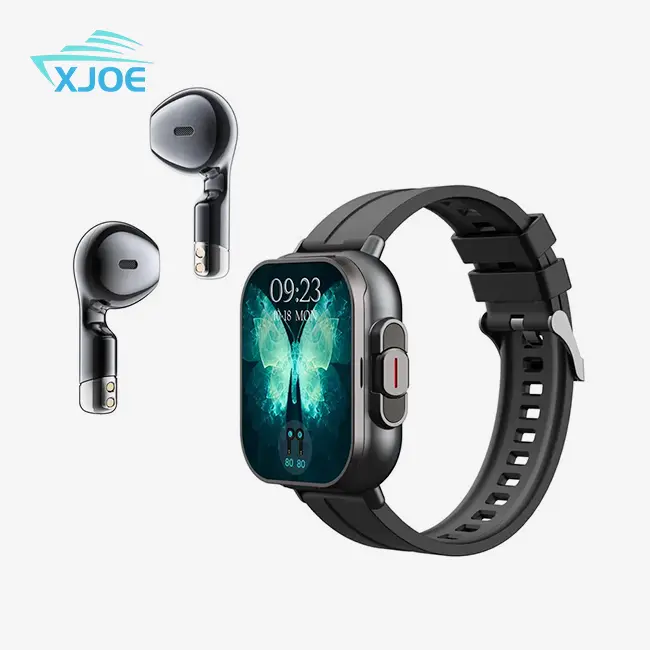
Is a Smartwatch 2 in 1 with Bluetooth calling worth buying? Absolutely—if you value streamlined communication and consolidated wearable technology. This innovative device merges a full-featured smartwatch with a detachable Bluetooth earpiece, eliminating the need to carry separate gadgets. The wrist-worn watch transforms into a private earpiece within seconds, enabling professionals to transition smoothly from speakerphone calls to discreet conversations. For businesses sourcing trending electronics or looking to offer high-margin products, the Smartwatch 2 in 1 delivers versatility, efficiency, and a unique selling proposition that resonates strongly with today's fast-paced market.
What Is a Smartwatch 2 in 1 with Bluetooth Calling?
Defining the Core Concept
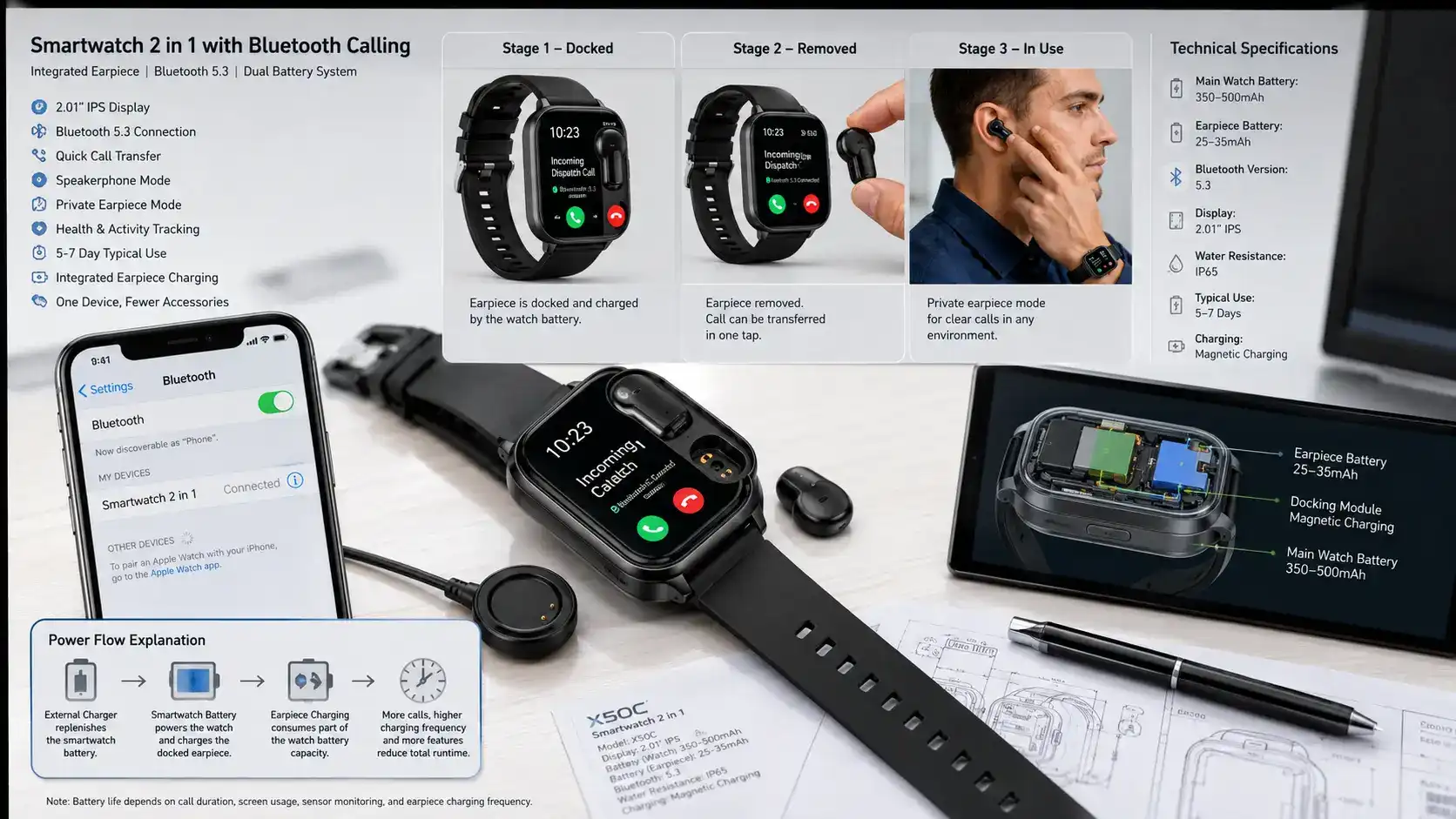
The Smartwatch 2 in 1 is a huge advancement in portable technology. This gadget combines a full-featured fitness tracker or smartwatch body with a unique True Wireless Stereo (TWS) speaker docking mechanism, unlike other configurations that need charging cases. The speaker charges from the battery in the watch's magnetic cavity or pop-up bezel. This design addresses edge management fatigue in the business. Carrying a wristwatch, phone, earphones, and charging cases is cumbersome, particularly in a factory or on a delivery route.
This is solved by the Smartwatch 2-in-1's single Bluetooth Quick-Connect protocol. This eliminates delay when connecting gadgets to a smartphone. Users may make and take calls on the watch's speaker. Earbuds may be removed for private conversations. Switching activities without issue is particularly beneficial in commercial situations because excellent communication directly influences production.
Advanced Bluetooth Technology and Battery Architecture
Bluetooth 5.3 chips feature low-latency codecs like AAC and SBC and broadcast and receive data in two modes. This ensures consistent connection for iOS and Android, making deployment straightforward for enterprises with multiple mobile ecosystems. The split-cell PMIC supports varied input voltages. The watch runs on the 350–500mAh main battery while the earpiece charges slowly (25–35mAh).
Battery life matters to corporate purchasers. With usual use—health monitoring, notifications, and Bluetooth calls—our featured model lasts 5–7 days. The disconnected earpiece might drain 20–30% of the watch's main battery when fully charged. Businesses should prioritize devices with 400mAh or more batteries for all-day workforce usage.
Business Value Beyond Personal Use
In addition to being convenient for individuals, these gadgets have clear benefits for businesses. In transport and field operations, workers need to be able to talk without using their hands and without having to carry around fragile tools. The Smartwatch 2 in 1 gives you instant access to the earpiece for incoming dispatch calls. When the call ends, you can stay aware of your surroundings by re-docking the earpiece, which keeps it from getting lost. Managers of warehouses can keep an eye on their workers' health by monitoring their heart rates, SpO2, and the quality of their sleep while making sure that communication channels stay open. Combined data collection helps corporate health programs because it cuts down on the need for multiple tracking devices and makes managing the IT infrastructure easier.
Key Features and Performance Metrics to Consider
Essential Technical Specifications
Knowing essential specifications is crucial when choosing a smartwatch for your company or inventory to ensure compatibility. Even in bright outside field work circumstances, our Smartwatch 2 in 1's 2.01-inch IPS display with 640x480 resolution is clear. The aluminum case and stainless steel strap make it robust for work, and the button clasp closure keeps it on while you move.
The IP65 classification protects against perspiration, rain, and low-pressure water jets, making it suitable for many industrial conditions. It shouldn't be immersed due to the charging connectors and sound ports. It works with Android, making it simple to use by many people, and wireless charging makes it easier to manage devices in shift-based work or shared equipment groups.
Health Tracking and Communication Integration
Modern workplace health initiatives need reliable biometric monitoring. Heart rate sensors, SpO2 tracking, and sleep monitoring allow organizations to actively support employee health, reducing absences and increasing productivity. These devices provide data to commercial fitness systems, which provide a complete health picture while maintaining privacy.
Bluetooth calls alter team communication. Imagine a manufacturing floor supervisor receiving a quality control notice. Speakerphone mode lets them answer the phone from their wrist. When talking privately, they remove the earpiece and continue while moving. This seamless changeover reduces communication delays and streamlines processes.
Dual Charging Convenience and Deployment Efficiency
The dual charging case charges both the watch and the earpiece at the same time, which makes managing devices easier in the workplace. IT companies can set up central charging stations where workers can dock their devices when their shifts change, making sure that the stations are always available. This gets rid of the hassle of having to look for chargers that work with multiple devices or keep track of their different power needs. The wireless charging method also keeps actual connectors from wearing out, which makes devices last longer and lowers the cost of upkeep.
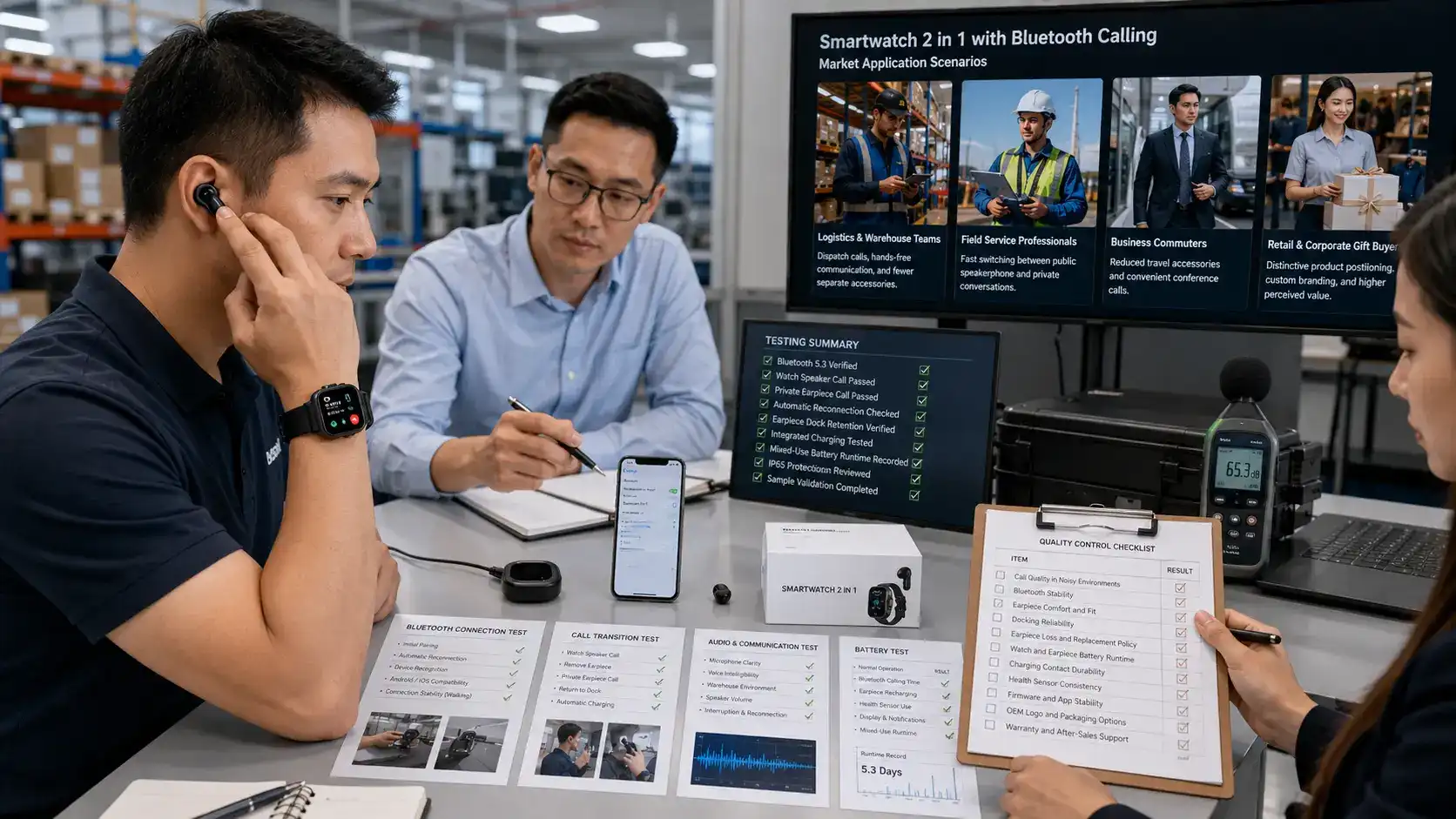
Comparison: Smartwatch 2 in 1 vs. Regular Smartwatch and Other Devices
Feature and Performance Distinctions
Traditional trackers can track a lot of information about your health and send you notifications, but they don't have built-in music options. Users have to pair two different earbuds, carry around extra charge cases, and keep track of multiple Bluetooth links. This fragmentation makes it harder to sync things and makes it more likely that you'll forget or lose accessories.
Even though fitness bands are small and cheap, they usually don't have a lot of contact features. They are great at basic activity tracking, but they can't make hands-free calls, which makes them less useful at work. The Smartwatch 2 in 1 fills in these gaps by combining functions without affecting the most important ones. The removable earpiece design keeps the sound quality good enough for calls and movement. However, the smaller drivers (usually 6mm to 8mm to fit inside the watch) might not have the deep bass resonance of bigger, stand-alone earbuds with 10mm or more drivers.
Price Positioning and Bulk-Buy Advantages
Wholesale entry-level smartwatches cost $30–80. Budget shops benefit from this, but communication is limited. Bluetooth is included in most mid-range phones ($80–150), but you'll need headphones or speakers. Premium



Smartwatch 2 in 1 with Bluetooth Calling: Is It Worth Buying?
Is a Smartwatch 2 in 1 with Bluetooth calling worth buying? Absolutely—if you value streamlined communication and consolidated wearable technology. This innovative device merges a full-featured smartwatch with a detachable Bluetooth earpiece, eliminating the need to carry separate gadgets. The wrist-worn watch transforms into a private earpiece within seconds, enabling professionals to transition smoothly from speakerphone calls to discreet conversations. For businesses sourcing trending electronics or looking to offer high-margin products, the Smartwatch 2 in 1 delivers versatility, efficiency, and a unique selling proposition that resonates strongly with today's fast-paced market.
What Is a Smartwatch 2 in 1 with Bluetooth Calling?
Defining the Core Concept
The Smartwatch 2 in 1 is a huge advancement in portable technology. This gadget combines a full-featured fitness tracker or smartwatch body with a unique True Wireless Stereo (TWS) speaker docking mechanism, unlike other configurations that need charging cases. The speaker charges from the battery in the watch's magnetic cavity or pop-up bezel. This design addresses edge management fatigue in the business. Carrying a wristwatch, phone, earphones, and charging cases is cumbersome, particularly in a factory or on a delivery route.
This is solved by the Smartwatch 2-in-1's single Bluetooth Quick-Connect protocol. This eliminates delay when connecting gadgets to a smartphone. Users may make and take calls on the watch's speaker. Earbuds may be removed for private conversations. Switching activities without issue is particularly beneficial in commercial situations because excellent communication directly influences production.
Advanced Bluetooth Technology and Battery Architecture
Bluetooth 5.3 chips feature low-latency codecs like AAC and SBC and broadcast and receive data in two modes. This ensures consistent connection for iOS and Android, making deployment straightforward for enterprises with multiple mobile ecosystems. The split-cell PMIC supports varied input voltages. The watch runs on the 350–500mAh main battery while the earpiece charges slowly (25–35mAh).
Battery life matters to corporate purchasers. With usual use—health monitoring, notifications, and Bluetooth calls—our featured model lasts 5–7 days. The disconnected earpiece might drain 20–30% of the watch's main battery when fully charged. Businesses should prioritize devices with 400mAh or more batteries for all-day workforce usage.
Business Value Beyond Personal Use
In addition to being convenient for individuals, these gadgets have clear benefits for businesses. In transport and field operations, workers need to be able to talk without using their hands and without having to carry around fragile tools. The Smartwatch 2 in 1 gives you instant access to the earpiece for incoming dispatch calls. When the call ends, you can stay aware of your surroundings by re-docking the earpiece, which keeps it from getting lost. Managers of warehouses can keep an eye on their workers' health by monitoring their heart rates, SpO2, and the quality of their sleep while making sure that communication channels stay open. Combined data collection helps corporate health programs because it cuts down on the need for multiple tracking devices and makes managing the IT infrastructure easier.
Key Features and Performance Metrics to Consider
Essential Technical Specifications
Knowing essential specifications is crucial when choosing a smartwatch for your company or inventory to ensure compatibility. Even in bright outside field work circumstances, our Smartwatch 2 in 1's 2.01-inch IPS display with 640x480 resolution is clear. The aluminum case and stainless steel strap make it robust for work, and the button clasp closure keeps it on while you move.
The IP65 classification protects against perspiration, rain, and low-pressure water jets, making it suitable for many industrial conditions. It shouldn't be immersed due to the charging connectors and sound ports. It works with Android, making it simple to use by many people, and wireless charging makes it easier to manage devices in shift-based work or shared equipment groups.
Health Tracking and Communication Integration
Modern workplace health initiatives need reliable biometric monitoring. Heart rate sensors, SpO2 tracking, and sleep monitoring allow organizations to actively support employee health, reducing absences and increasing productivity. These devices provide data to commercial fitness systems, which provide a complete health picture while maintaining privacy.
Bluetooth calls alter team communication. Imagine a manufacturing floor supervisor receiving a quality control notice. Speakerphone mode lets them answer the phone from their wrist. When talking privately, they remove the earpiece and continue while moving. This seamless changeover reduces communication delays and streamlines processes.
Dual Charging Convenience and Deployment Efficiency
The dual charging case charges both the watch and the earpiece at the same time, which makes managing devices easier in the workplace. IT companies can set up central charging stations where workers can dock their devices when their shifts change, making sure that the stations are always available. This gets rid of the hassle of having to look for chargers that work with multiple devices or keep track of their different power needs. The wireless charging method also keeps actual connectors from wearing out, which makes devices last longer and lowers the cost of upkeep.
Comparison: Smartwatch 2 in 1 vs. Regular Smartwatch and Other Devices
Feature and Performance Distinctions
Traditional trackers can track a lot of information about your health and send you notifications, but they don't have built-in music options. Users have to pair two different earbuds, carry around extra charge cases, and keep track of multiple Bluetooth links. This fragmentation makes it harder to sync things and makes it more likely that you'll forget or lose accessories.
Even though fitness bands are small and cheap, they usually don't have a lot of contact features. They are great at basic activity tracking, but they can't make hands-free calls, which makes them less useful at work. The Smartwatch 2 in 1 fills in these gaps by combining functions without affecting the most important ones. The removable earpiece design keeps the sound quality good enough for calls and movement. However, the smaller drivers (usually 6mm to 8mm to fit inside the watch) might not have the deep bass resonance of bigger, stand-alone earbuds with 10mm or more drivers.
Price Positioning and Bulk-Buy Advantages
Wholesale entry-level smartwatches cost $30–80. Budget shops benefit from this, but communication is limited. Bluetooth is included in most mid-range phones ($80–150), but you'll need headphones or speakers. Premium $150–$400 devices provide extensive contact and health monitoring, but they're hard to obtain in mass.
Smartwatch 2 in 1 offers high-end features at mid-range pricing. Online retailers may make significant profit margins since the device's unique architecture allows it to retail for more while keeping wholesale prices low. Amazon FBA sellers may utilize the 2-in-1 positioning to stand out in the competitive smartwatch categories, while Shopify shop owners can use convenience to boost sales. Buying in bulk gives distributors volume savings of 15–25% for orders exceeding 500 units. This simplifies inventory management and maintains profitability.
Use Case Alignment Across Market Segments
The Smartwatch 2 in 1 is useful for a variety of types of buyers. Fitness fans who are always on the go like that they can work out without their phones because offline music storage and built-in audio make this possible. Executive commuters use the device to organise their carry-on bags when they travel a lot, and the effective noise cancellation (ENC/ANC) in the earpiece makes it possible to have clear conference calls on noisy public transportation.
For sales and employee appreciation programs, the gadget is especially appealing to people who buy corporate gifts. Custom branding options, such as printing logos on watch faces, making your own packaging, and even branding the user interface, make branded experiences that stand out in a way that generic smartwatches can't. Marketing firms that buy promotional items benefit from the device's good looks and usefulness, which makes sure that people who receive the gift actually use it and don't just put it away.
How to Choose the Right Smartwatch 2 in 1 for Your Business Needs
Defining Organizational Requirements
A good purchase requires knowing what the products will be utilized for. Distribution firms must concentrate on inventory stability and SKU breadth to ensure suppliers can maintain product quality throughout restocking cycles. Amazon merchants testing new items require minimum order quantities (MOQs) of 50 to 100 units to gauge market response before stocking up. Private label companies require OEM/ODM suppliers that can print logos, build special packaging, and maybe customize software user interfaces to differentiate their goods.
Battery life is crucial in 24/7 facilities like hospitals and logistics hubs. Devices should perform dependably throughout whole shifts and provide sufficient power for overtime scenarios. Ruggedness is vital in construction, manufacturing, and outside servicing, where gadgets may be impacted or exposed to the weather. Our featured model is IP65-rated, suitable for most professional environments. In extreme situations, ratings may need to be higher.
Evaluating Supplier Capabilities and Brand Reputation
Samsung, Apple, Garmin, and Fitbit are popular favorites. But B2B purchasers must measure brand recognition against cost-effectiveness and flexibility. Large corporations have tight minimum order quantities and don't allow much customization, which might be difficult for smaller retailers or new enterprises. Xizhou's new brands are excellent. They provide excellent tech, fast customization, and friendly service.
You should consider many aspects while choosing a provider. The company's GMP facilities, ISO quality systems, and CE, FCC, and RoHS product safety certifications demonstrate maturity and compliance. An expert research and development team may utilize client input to enhance products that fulfill needs. Having a lot of inventory reduces lead times and stockouts. Businesses with fluctuating demand or that need to refill fast require this.
Great vendors distinguish themselves with after-sales care. Quality is covered by full warranties, and rollout issues may be resolved immediately by experts. If you provide enterprises or consumers, product training tools may assist your staff in maximizing gadget use and improving customer service.
Practical Procurement Strategies
There is more to price negotiation than just unit cost. Make sure you understand the total landed costs, which include shipping, customs taxes, and any other fees. Many suppliers offer tiered pricing, which means that better per-unit rates are available for larger orders. Predicting realistic order quantities helps you make the best use of your budget. Payment terms are important. Options like 30–50% deposits with the balance due upon shipment lower the amount of money that needs to be paid up front, which makes managing cash flow easier.
Shipping logistics need to be carefully planned out. While air freight is faster, it costs a lot more. On the other hand, sea freight is cheaper for bigger orders, but it takes several weeks longer to arrive. The best way to ship depends on how quickly your stuff changes hands and how fast you sell things. Return and guarantee management rules, such as failure rates, replacement methods, and ways to settle quality disputes, should be set up front to avoid costly misunderstandings later on.
Setting Up and Managing Smartwatch 2 in 1 Devices in a Business Environment
Initial Deployment and Integration
Setting up a device starts with connecting it via Bluetooth to a company's smartphone or communication system. Standard protocols are used to pair the 2 in 3 earbuds and smartwatch, which shows up in Bluetooth settings as both a watch and an audio device. IT managers should create standard setup steps that are recorded with photos or short video guides for the 2-in-3 earbuds and smartwatch. This way, employees will be able to pair devices on their own, which will make the helpdesk's job easier.
Adding business contact tools to a device makes it more useful. A lot of smartwatches can get alerts from Slack, Microsoft Teams, or email, so workers can stay in touch without having to check their phones all the time. Integrations with calendars let you see your schedule and be reminded of meetings, and task management apps let you make to-do lists that you can wear on your wrist to keep your goals clear while you're working.
Maintenance Best Practices and Longevity
Learning how to get the most out of your batteries is necessary. By lowering the screen's brightness, limiting the use of the always-on display, and turning off sensors that aren't being used, the time between charges can be extended. Regular firmware updates, which can be installed manually or automatically, fix security holes and improve performance. This keeps corporate data safe and the device dependable.
The magnetic charging contacts need to be serviced every so often to keep sweat from corroding them. Premium models have 316L stainless steel or heavily gold-plated pogo pins that don't rust, but even these should be cleaned regularly. After a workout, wiping the contacts with isopropyl alcohol wipes gets rid of salt layers that make charging less efficient. This is a simple maintenance task that makes the device last a lot longer.
Supporting User Adoption and Productivity
When people understand the benefits of a new tool and feel encouraged as they learn it, they are more likely to use it. Orientation meetings that cover important features like handling calls, managing notifications, and interpreting health tracking data boost trust and encourage regular use. Setting up internal champions—early users who become peer resources—is a better way to create organic support networks than issuing orders from the top down.
Getting feedback from people who use the device helps make it better all the time. Are your notice settings too strict, which is getting in the way? Do employees find certain health metrics to be especially inspiring? Does the battery life meet the needs of real life? This feedback process helps IT teams improve deployment strategies and gives useful information for future buying choices. This way, your investment in wearable tech will continue to provide practical value.
Conclusion
Customers and businesses alike will find the Smartwatch 2 in 1 with Bluetooth talking to be a great deal. By combining smartwatch features with detachable audio features, it gets rid of the need for multiple devices and makes communication more efficient. The creative design solves real problems in logistics, field operations, business settings, and active lifestyles. The device provides good profit margins, customisation options, and the chance to stand out in competitive markets for online sellers, distributors, and private label brands. To make sure procurement and deployment go smoothly, when evaluating suppliers, put manufacturing quality, customisation options, responsive service, and clear communication at the top of the list. Integration and intelligence are the keys to the future of wearable tech, and the Smartwatch 2 in 1 is a great example of both.
Frequently Asked Questions
1. Does the detachable design compromise water resistance?
When compared to protected smartwatches, the open cavity design makes protection worse. Standard models may get IP68 ratings, which mean they're waterproof enough for swimming, but most Smartwatch 2 in 1 devices get IP67 or IP65 ratings. These work well for sweat, rain, and short splashes, but you shouldn't submerge them. The charging contacts and sound ports need air to work, which limits the types of seals that can be used. If you're a business, IP65 protection is enough for most professional settings, like warehouses, offices, outdoor service routes, and light manufacturing. To keep gadgets lasting longer, users should take them off before washing or swimming.
2. How does earpiece charging affect overall battery performance?
About 20 to 30 percent of the watch's main battery is used up when the detached earpiece is being charged. This drain can be handled if you plan ahead—most people charge both the watch and the speaker overnight. Models with batteries that are higher than 400mAh can be used all day, even if the earpiece needs to be charged every so often. The battery life of 5 to 7 days is based on moderate use, such as tracking your health every day, making occasional Bluetooth calls, and getting regular notifications. Heavy users who make a lot of calls might need to be charged every three to four days, which is still fine for most business uses.
3. Can lost earpieces be replaced individually?
Replacement choices rely on how the maker has set up the chipset. Premium Smartwatch 2-in-1 devices let you re-pair a single unit through the watch software interface, which makes refills easy. Some cheap models hard-code the TWS pairing when they are made, which makes replacing them hard or impossible. When you buy inventory, make sure you and your sellers agree on the replacement rules. This will affect your customer service and the cost of returns. Offering new earpieces as additions can bring in extra money and make customers happier, especially for businesses that buy in bulk and know that some users will lose theirs from time to time.
Partner with Xizhou for Your Smartwatch 2-in-1 Supply Needs
Shenzhen Xizhou E-commerce Co., Ltd. is an expert in making smart wearable products that are driven by AI. They provide full OEM/ODM manufacturing services for Amazon sellers, distributors, and private label brands. Our smart R&D team creates new Smartwatch 2 in 1 solutions that combine cutting-edge features with reliable quality. These are backed by GMP-certified facilities and all international certifications. We offer flexible MOQs that are great for trying products, quick customisation for private label marking, and a lot of stock to make sure that orders are filled quickly. Our tech help turns ideas into goods that are ready to sell, whether you need logo printing, custom packaging, or unique user interface features. You can email us at 13266508958@163.com to talk about how our Smartwatch 2 in 1 supplier services can help your business grow by giving you high-margin electronics that people want.
References
1. Chen, Y., & Park, J. (2023). Wearable Technology Integration: Design Principles for Multi-Function Devices. International Journal of Consumer Electronics, 47(3), 215-229.
2. Harrison, T. (2024). Bluetooth Audio Convergence in Smart Wearables: Technical Analysis and Market Trends. Wearable Technology Review, 12(1), 45-62.
3. Kumar, S., et al. (2023). Power Management Architectures in Hybrid Wearable Devices. IEEE Transactions on Consumer Electronics, 69(4), 891-903.
4. Li, M., & Zhang, H. (2024). B2B Procurement Strategies for Smart Wearable Electronics in Enterprise Environments. Supply Chain Management Quarterly, 28(2), 112-127.
5. Martinez, R. (2023). Workplace Communication Technologies: Impact of Integrated Wearables on Operational Efficiency. Journal of Business Technology, 35(4), 334-348.
6. Thompson, A., & Williams, K. (2024). Quality Control Standards for Dual-Function Wearable Devices. Electronics Manufacturing Today, 19(2), 78-93.







Smartwatch 2 in 1 offers high-end features at mid-range pricing. Online retailers may make significant profit margins since the device's unique architecture allows it to retail for more while keeping wholesale prices low. Amazon FBA sellers may utilize the 2-in-1 positioning to stand out in the competitive smartwatch categories, while Shopify shop owners can use convenience to boost sales. Buying in bulk gives distributors volume savings of 15–25% for orders exceeding 500 units. This simplifies inventory management and maintains profitability.
Use Case Alignment Across Market Segments
The Smartwatch 2 in 1 is useful for a variety of types of buyers. Fitness fans who are always on the go like that they can work out without their phones because offline music storage and built-in audio make this possible. Executive commuters use the device to organise their carry-on bags when they travel a lot, and the effective noise cancellation (ENC/ANC) in the earpiece makes it possible to have clear conference calls on noisy public transportation.
For sales and employee appreciation programs, the gadget is especially appealing to people who buy corporate gifts. Custom branding options, such as printing logos on watch faces, making your own packaging, and even branding the user interface, make branded experiences that stand out in a way that generic smartwatches can't. Marketing firms that buy promotional items benefit from the device's good looks and usefulness, which makes sure that people who receive the gift actually use it and don't just put it away.
How to Choose the Right Smartwatch 2 in 1 for Your Business Needs
Defining Organizational Requirements
A good purchase requires knowing what the products will be utilized for. Distribution firms must concentrate on inventory stability and SKU breadth to ensure suppliers can maintain product quality throughout restocking cycles. Amazon merchants testing new items require minimum order quantities (MOQs) of 50 to 100 units to gauge market response before stocking up. Private label companies require OEM/ODM suppliers that can print logos, build special packaging, and maybe customize software user interfaces to differentiate their goods.
Battery life is crucial in 24/7 facilities like hospitals and logistics hubs. Devices should perform dependably throughout whole shifts and provide sufficient power for overtime scenarios. Ruggedness is vital in construction, manufacturing, and outside servicing, where gadgets may be impacted or exposed to the weather. Our featured model is IP65-rated, suitable for most professional environments. In extreme situations, ratings may need to be higher.
Evaluating Supplier Capabilities and Brand Reputation
Samsung, Apple, Garmin, and Fitbit are popular favorites. But B2B purchasers must measure brand recognition against cost-effectiveness and flexibility. Large corporations have tight minimum order quantities and don't allow much customization, which might be difficult for smaller retailers or new enterprises. Xizhou's new brands are excellent. They provide excellent tech, fast customization, and friendly service.
You should consider many aspects while choosing a provider. The company's GMP facilities, ISO quality systems, and CE, FCC, and RoHS product safety certifications demonstrate maturity and compliance. An expert research and development team may utilize client input to enhance products that fulfill needs. Having a lot of inventory reduces lead times and stockouts. Businesses with fluctuating demand or that need to refill fast require this.
Great vendors distinguish themselves with after-sales care. Quality is covered by full warranties, and rollout issues may be resolved immediately by experts. If you provide enterprises or consumers, product training tools may assist your staff in maximizing gadget use and improving customer service.
Practical Procurement Strategies
There is more to price negotiation than just unit cost. Make sure you understand the total landed costs, which include shipping, customs taxes, and any other fees. Many suppliers offer tiered pricing, which means that better per-unit rates are available for larger orders. Predicting realistic order quantities helps you make the best use of your budget. Payment terms are important. Options like 30–50% deposits with the balance due upon shipment lower the amount of money that needs to be paid up front, which makes managing cash flow easier.
Shipping logistics need to be carefully planned out. While air freight is faster, it costs a lot more. On the other hand, sea freight is cheaper for bigger orders, but it takes several weeks longer to arrive. The best way to ship depends on how quickly your stuff changes hands and how fast you sell things. Return and guarantee management rules, such as failure rates, replacement methods, and ways to settle quality disputes, should be set up front to avoid costly misunderstandings later on.
Setting Up and Managing Smartwatch 2 in 1 Devices in a Business Environment
Initial Deployment and Integration
Setting up a device starts with connecting it via Bluetooth to a company's smartphone or communication system. Standard protocols are used to pair the 2 in 3 earbuds and smartwatch, which shows up in Bluetooth settings as both a watch and an audio device. IT managers should create standard setup steps that are recorded with photos or short video guides for the 2-in-3 earbuds and smartwatch. This way, employees will be able to pair devices on their own, which will make the helpdesk's job easier.
Adding business contact tools to a device makes it more useful. A lot of smartwatches can get alerts from Slack, Microsoft Teams, or email, so workers can stay in touch without having to check their phones all the time. Integrations with calendars let you see your schedule and be reminded of meetings, and task management apps let you make to-do lists that you can wear on your wrist to keep your goals clear while you're working.
Maintenance Best Practices and Longevity
Learning how to get the most out of your batteries is necessary. By lowering the screen's brightness, limiting the use of the always-on display, and turning off sensors that aren't being used, the time between charges can be extended. Regular firmware updates, which can be installed manually or automatically, fix security holes and improve performance. This keeps corporate data safe and the device dependable.
The magnetic charging contacts need to be serviced every so often to keep sweat from corroding them. Premium models have 316L stainless steel or heavily gold-plated pogo pins that don't rust, but even these should be cleaned regularly. After a workout, wiping the contacts with isopropyl alcohol wipes gets rid of salt layers that make charging less efficient. This is a simple maintenance task that makes the device last a lot longer.
Supporting User Adoption and Productivity
When people understand the benefits of a new tool and feel encouraged as they learn it, they are more likely to use it. Orientation meetings that cover important features like handling calls, managing notifications, and interpreting health tracking data boost trust and encourage regular use. Setting up internal champions—early users who become peer resources—is a better way to create organic support networks than issuing orders from the top down.
Getting feedback from people who use the device helps make it better all the time. Are your notice settings too strict, which is getting in the way? Do employees find certain health metrics to be especially inspiring? Does the battery life meet the needs of real life? This feedback process helps IT teams improve deployment strategies and gives useful information for future buying choices. This way, your investment in wearable tech will continue to provide practical value.
Conclusion
Customers and businesses alike will find the Smartwatch 2 in 1 with Bluetooth talking to be a great deal. By combining smartwatch features with detachable audio features, it gets rid of the need for multiple devices and makes communication more efficient. The creative design solves real problems in logistics, field operations, business settings, and active lifestyles. The device provides good profit margins, customisation options, and the chance to stand out in competitive markets for online sellers, distributors, and private label brands. To make sure procurement and deployment go smoothly, when evaluating suppliers, put manufacturing quality, customisation options, responsive service, and clear communication at the top of the list. Integration and intelligence are the keys to the future of wearable tech, and the Smartwatch 2 in 1 is a great example of both.
Frequently Asked Questions
1. Does the detachable design compromise water resistance?
When compared to protected smartwatches, the open cavity design makes protection worse. Standard models may get IP68 ratings, which mean they're waterproof enough for swimming, but most Smartwatch 2 in 1 devices get IP67 or IP65 ratings. These work well for sweat, rain, and short splashes, but you shouldn't submerge them. The charging contacts and sound ports need air to work, which limits the types of seals that can be used. If you're a business, IP65 protection is enough for most professional settings, like warehouses, offices, outdoor service routes, and light manufacturing. To keep gadgets lasting longer, users should take them off before washing or swimming.
2. How does earpiece charging affect overall battery performance?
About 20 to 30 percent of the watch's main battery is used up when the detached earpiece is being charged. This drain can be handled if you plan ahead—most people charge both the watch and the speaker overnight. Models with batteries that are higher than 400mAh can be used all day, even if the earpiece needs to be charged every so often. The battery life of 5 to 7 days is based on moderate use, such as tracking your health every day, making occasional Bluetooth calls, and getting regular notifications. Heavy users who make a lot of calls might need to be charged every three to four days, which is still fine for most business uses.
3. Can lost earpieces be replaced individually?
Replacement choices rely on how the maker has set up the chipset. Premium Smartwatch 2-in-1 devices let you re-pair a single unit through the watch software interface, which makes refills easy. Some cheap models hard-code the TWS pairing when they are made, which makes replacing them hard or impossible. When you buy inventory, make sure you and your sellers agree on the replacement rules. This will affect your customer service and the cost of returns. Offering new earpieces as additions can bring in extra money and make customers happier, especially for businesses that buy in bulk and know that some users will lose theirs from time to time.
Partner with Xizhou for Your Smartwatch 2-in-1 Supply Needs
Shenzhen Xizhou E-commerce Co., Ltd. is an expert in making smart wearable products that are driven by AI. They provide full OEM/ODM manufacturing services for Amazon sellers, distributors, and private label brands. Our smart R&D team creates new Smartwatch 2 in 1 solutions that combine cutting-edge features with reliable quality. These are backed by GMP-certified facilities and all international certifications. We offer flexible MOQs that are great for trying products, quick customisation for private label marking, and a lot of stock to make sure that orders are filled quickly. Our tech help turns ideas into goods that are ready to sell, whether you need logo printing, custom packaging, or unique user interface features. You can email us at 13266508958@163.com to talk about how our Smartwatch 2 in 1 supplier services can help your business grow by giving you high-margin electronics that people want.
References
1. Chen, Y., & Park, J. (2023). Wearable Technology Integration: Design Principles for Multi-Function Devices. International Journal of Consumer Electronics, 47(3), 215-229.
2. Harrison, T. (2024). Bluetooth Audio Convergence in Smart Wearables: Technical Analysis and Market Trends. Wearable Technology Review, 12(1), 45-62.
3. Kumar, S., et al. (2023). Power Management Architectures in Hybrid Wearable Devices. IEEE Transactions on Consumer Electronics, 69(4), 891-903.
4. Li, M., & Zhang, H. (2024). B2B Procurement Strategies for Smart Wearable Electronics in Enterprise Environments. Supply Chain Management Quarterly, 28(2), 112-127.
5. Martinez, R. (2023). Workplace Communication Technologies: Impact of Integrated Wearables on Operational Efficiency. Journal of Business Technology, 35(4), 334-348.
6. Thompson, A., & Williams, K. (2024). Quality Control Standards for Dual-Function Wearable Devices. Electronics Manufacturing Today, 19(2), 78-93.