

Selecting Reliable AMOLED Smartwatch Manufacturers
Choosing the right AMOLED smartwatch manufacturer is one of the most consequential decisions a procurement professional can make. Whether you run an Amazon FBA store, distribute consumer electronics regionally, or manage a private label wearable brand, the supplier you select directly shapes your product reviews, margins, and long-term competitiveness. In this guide, I walk through every critical checkpoint — from evaluating display quality and GPS precision to negotiating OEM contracts — so your next sourcing decision is grounded in evidence, not guesswork. If you are sourcing an amoled gps smartwatch at scale, this is exactly where to start.
Why AMOLED GPS Smartwatches Are Dominating the Wearables Market
As of 2023, the global market for smartwatches was worth $32.6 billion. Grand View Research says it will continue to grow at a rate of 8.1% per year until 2030. AMOLED screens are a big reason for this rise. AMOLED technology allows for pixel-level light control, which means that blacks are darker, colors are more saturated, and the panel uses a lot less power when showing dark UI elements.
A high-nit AMOLED screen is easier to read for fitness fans walking along a mountain trail at noon, while an LCD panel gets too bright. For a corporate wellness program that gives branded wearables to 5,000 employees, the visual premium makes the brand seem stronger. From these real-life examples, we can see why B2B buyers, like TikTok Shop gadget brands and local electronics sellers, are strongly moving their SKU mix toward AMOLED wearables.
Market Demand Across B2B Segments
Need is not always the same. The fitness and outdoor markets value GPS precision across multiple constellations and a tough design. Corporate wellness buyers care about how clear the display is and how well it fits with their brand. Amazon FBA buyers have to keep up with quickly changing customer trends, so they need suppliers who can restock their shelves in weeks, not months. Figuring out which customer group you're trying to reach will help you decide which maker features are most important.
Key Criteria for Selecting Reliable AMOLED Smartwatch Manufacturers
The worst mistakes in buying can be avoided by carefully evaluating each vendor: getting a package with displays that don't work, GPS signals that don't work, or parts that don't comply with regulations, which lead to customs holds. I think your review should be built around four bases.
The following criteria represent the core benchmarks every serious B2B buyer should verify before committing to a supplier:
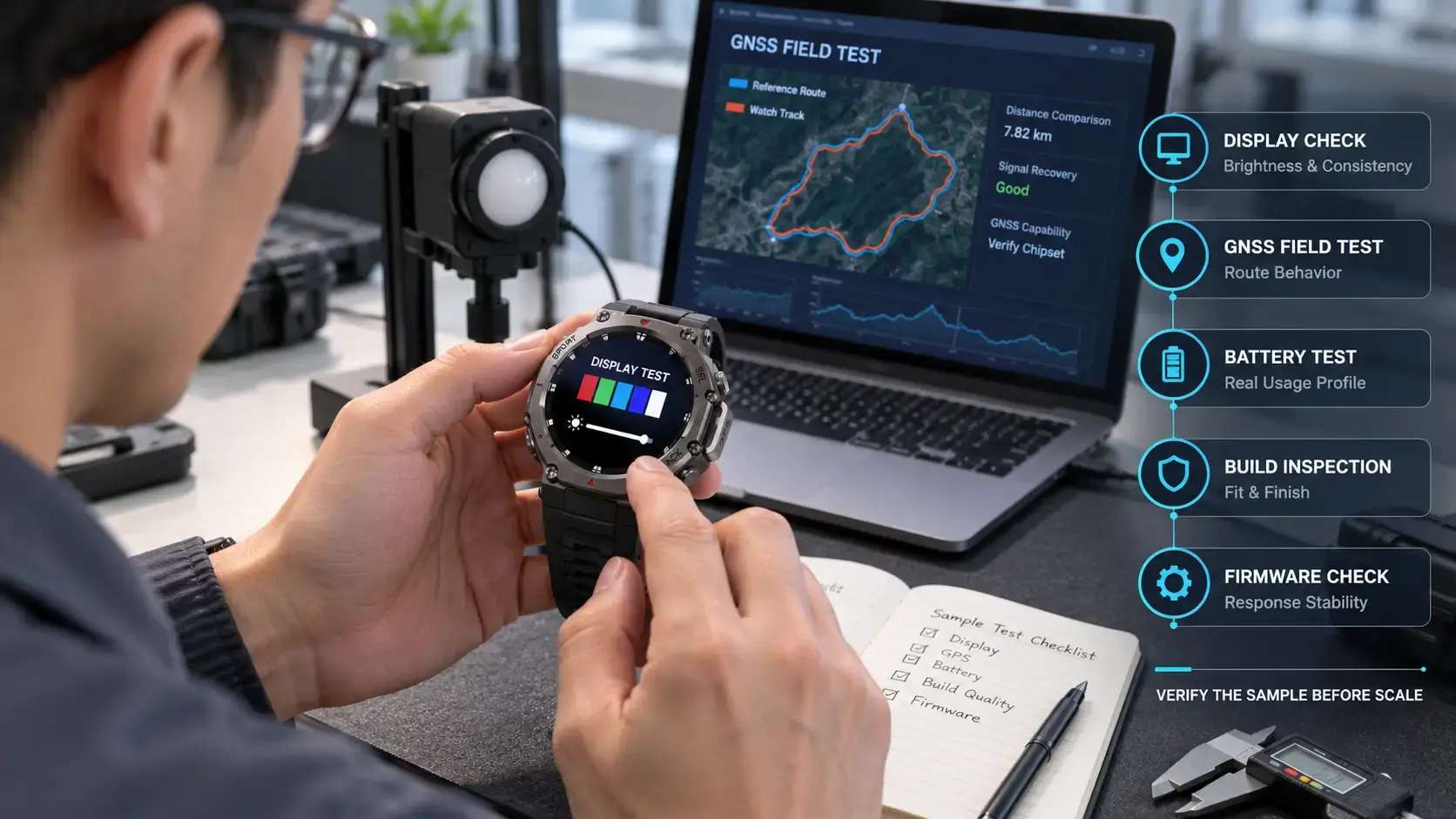
- Display quality verification: Ask for physical samples and test the AMOLED panel in direct sunlight. A reputable maker should always be able to keep brightness levels above 500 nits and color accuracy with a Delta-E number below 2.
- GPS accuracy and satellite support: Dual-band GNSS (L1 and L5 bands) cuts positional error to less than 2 meters in open areas. Check to see if the chipset works with multiple constellations, like GPS, GLONASS, Galileo, and BeiDou, so it works well in a variety of places.
- Compliance certifications: You must have CE, RoHS, and FCC certifications in order to enter the US market. Ask to see the original certificates and check the dates of their validity.
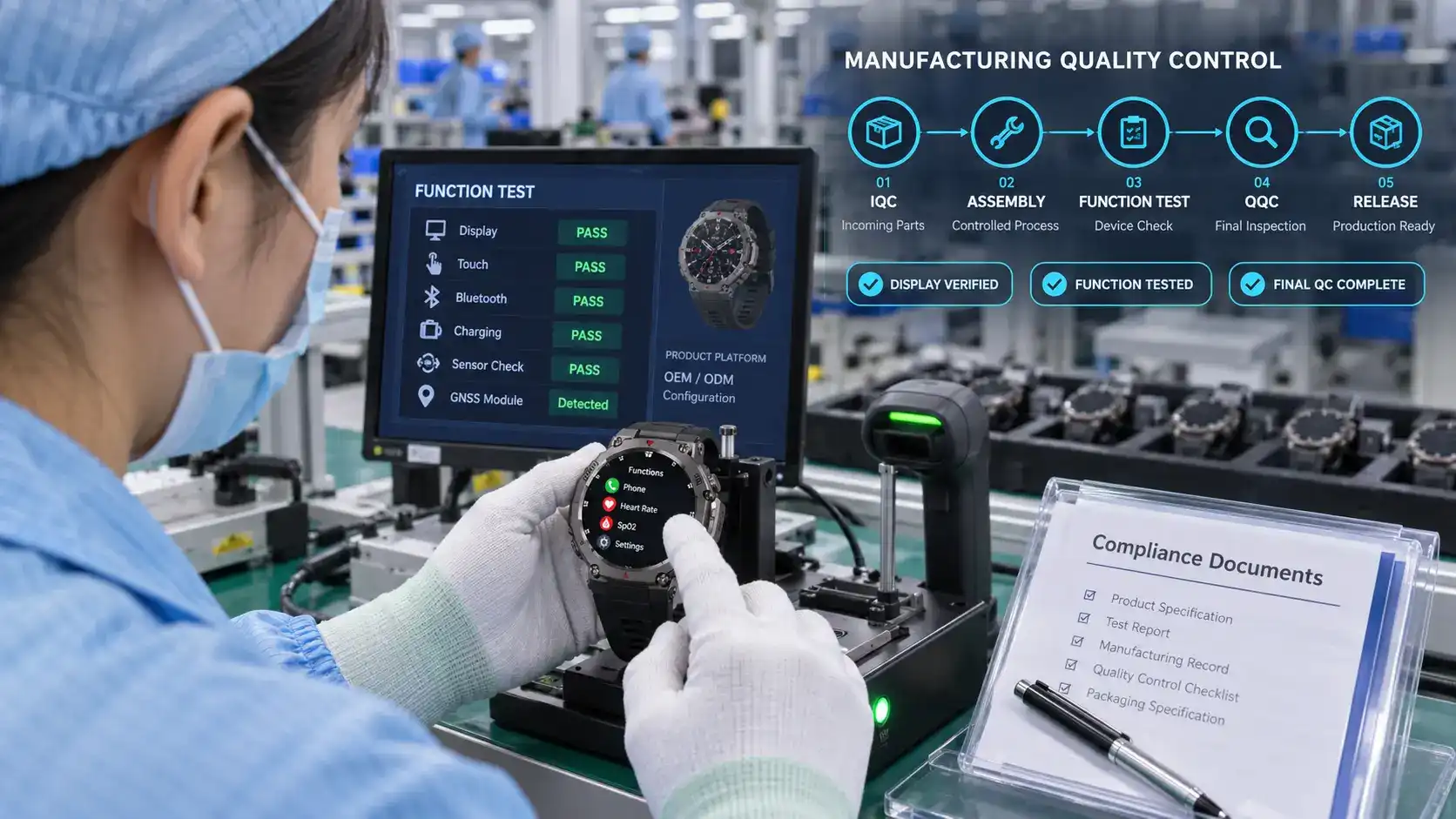
- Production model alignment: Find out if the supplier is an OEM (you provide the design) or an ODM (they provide a base design that you customize) business, or a direct brand. ODM works best for startups and medium-sized sellers who need to get their products to market quickly without spending a lot of money on tech.
- Quality control infrastructure: A GMP-certified plant with recorded incoming quality control (IQC) and outgoing quality control (OQC) systems cuts down on defect rates and costs caused by returns by a large amount.
By using these standards in a planned way, an intuitive choice can be turned into a sound purchasing choice for an amoled gps smartwatch. When buying things for distribution networks that care about price, purchasing managers should put more weight on price and MOQ flexibility. When looking for health monitoring platforms, technical engineers should put more weight on sensor accuracy and software support.
Certifications and Compliance Checklist
Before you sign any purchase deal, make sure that the item has the CE marking for EU compatibility, the FCC ID for US radio compliance, the RoHS marking for limits on dangerous substances, and the IP67 or higher water resistance certification. If you miss even one of these, it could take weeks longer to clear customs, and you could be fined.
Comparing AMOLED Smartwatch Manufacturers: What the Market Looks Like
High-end consumer brands like Garmin, Samsung, Apple, and Fitbit set the standard for advanced features and trust in the brand. When it comes to multi-band GPS accuracy, Garmin's Forerunner and Fenix lines are the best. The Galaxy Watch series from Samsung is the best at making AMOLED displays. This means that these brands aren't good production partners for most B2B buyers because they don't offer OEM or ODM services.
One level below is where the important competitors are: specialized OEM/ODM companies that work in the Shenzhen ecosystem. A big chunk of the global smartwatch market is run by these companies under dozens of different brand names. What sets them apart is how much they invest in research and development, how clear their component sourcing is, how strong their warranty policies are, and how quickly they respond to disputes after the sale.
OEM vs. ODM: Choosing the Right Manufacturing Model
You have full power over the design when you work with an OEM, but it costs more and takes longer to get the parts. With an ODM agreement, you can get your product on the market faster by making changes to a tried-and-true hardware platform. For example, you can change the dial design, strap material, UI style, and packaging without having to start from scratch. ODM is usually the best option for Amazon sellers who change their SKUs often based on trends.
Procurement Strategies That Protect Your Margins and Quality
When it comes to unit cost, customization options, and open communication, buying directly from a manufacturer for an amoled smartwatch gps square almost always beats buying through a middleman distributor. Still, doing your research is important for reliable sources. Here's how I go about it:
Talk about trial orders before you commit to buying a lot. In 7–14 days, a reliable provider will send working samples. Use those examples to test the accuracy of the GPS in real life, see how fast the battery drains, and see how good the display is. Before you sign the buy order, write down everything.
When it comes to prices, bulk order tiering is normal. When you buy a certain amount, suppliers usually lower the price by 8–15%. In the deal, make sure that there are clear defect rate limits (usually less than 1.5%) and guaranteed lead times. Ask for detailed warranty terms. At least a 12-month guarantee with a clear replacement or refund process will keep your Amazon seller numbers from going up when there are a lot of returns.
Logistics and Inventory Management
Lead time is just as important as unit price for Amazon FBA sellers. Check with your supplier to see if they keep a ready-stock buffer for SKUs that sell quickly. If your supplier stores finished goods, you can get more within 7–10 days instead of having to wait 30–45 days for a production run.
Future Trends Shaping AMOLED Smartwatch Procurement
The sourcing strategy of procurement teams should take into account three changes that will happen in the next 24 to 36 months. LTPO (Low Temperature Polycrystalline Oxide) backplanes are becoming more popular for AMOLED panels. These backplanes allow adaptive refresh rates from 1Hz to 60Hz and increase battery life by up to 40%. By 2026, suppliers who buy LTPO tools now will have an advantage in the manufacturing world.
Health sensors are being used for more than just counting steps and heart rate. Prototypes for non-invasive glucose monitoring, skin temperature tracking, and continuous blood oxygen monitoring are getting closer to being ready for sale. When looking for manufacturers of sensor suites for community health systems, corporate wellness platforms, or clinical monitoring apps, procurement teams should talk to companies that are testing these suites right now. Note that any health information gathered by consumer-grade gadgets is only meant to help you stay healthy and is not meant to be used as medical advice or a diagnosis.
Sustainability is also becoming a way for suppliers to stand out. Importers in the US and EU are being forced to report more and more on ESG issues. Manufacturers who keep track of their carbon footprint, use reusable packaging, and follow the rules about conflict minerals make it easier for you to follow the rules and build your brand's story.
Conclusion
It's not a one-step process to find a trusted amoled gps smartwatch manufacturer. Instead, there is a structured evaluation process that includes display engineering, GPS precision, compliance certification, production model fit, and responsibility after the sale. Manufacturers that are both technically sound and reliable in their operations are more likely to have long-term B2B partnerships. Finding the right supplier for your business plan is what makes the difference between long-term growth and expensive mistakes in sourcing, no matter if you run a fast-paced Amazon FBA business or a private-label clothing brand.
FAQ
1. What makes an AMOLED display better than an LCD for smartwatches?
There is no need for a backlight because AMOLED screens make light at the pixel level. This makes the contrast stronger, the colors more accurate, and the power use lower when dark interfaces are shown. These are all measurable benefits for customer satisfaction and battery life standards.
2. Which certifications are mandatory for selling smartwatches in the US?
Any gadget that sends radio waves needs to be certified by the FCC. RoHS compliance limits materials that are dangerous. IP67 certification for water resistance is a strong business requirement. For EU sales, the product must have the CE mark. Check the originals, not the copies.
3. How do I assess GPS accuracy before placing a bulk order?
Ask for examples and test them in the field in both open land and light urban cover. In normal situations, a dual-band GNSS device should be able to keep its position within 2–3 meters. Write down a known route and then check the distance you wrote down against a standard.
4. What is a reasonable MOQ for testing a new AMOLED smartwatch SKU?
OEM/ODM suppliers you can trust usually take trial orders of 50 to 200 units. A low MOQ is especially helpful for Amazon buyers who want to see how the market responds before committing to bigger inventory positions.
Partner With Xizhou for Your Next AMOLED GPS Smartwatch Sourcing Project
Xizhou is an OEM/ODM company that focuses on technology and makes smart wearable electronics powered by AI. Our flagship amoled gps smartwatch features a stunning 1.96-inch AMOLED screen, dual-band GPS, independent music playback, Bluetooth calling, and high-performance health sensors — all in a steel-cased, IP67-rated design with wireless charging and 5–10 days of battery life. As a trusted AMOLED GPS smartwatch supplier, we support flexible MOQs, rapid customization, and fast delivery times for Amazon sellers, distributors, and private label brands. Contact us at 13266508958@163.com to request samples and a unique price today.
References
1. Grand View Research. Smartwatch Market Size, Share & Trends Analysis Report. 2023.
2. IDC. Worldwide Wearables Market Quarterly Tracker. 2023.
3. IEEE Consumer Electronics Magazine. AMOLED vs. LCD Display Technologies in Wearable Devices: A Comparative Analysis. 2022.
4. Gartner. Procurement Best Practices for Consumer Electronics Sourcing. 2023.
5. Journal of Electronic Commerce Research. Supply Chain Risk Management in Cross-Border Electronics Procurement. 2022.
6. Counterpoint Research. Global Smartwatch Market Outlook: Technology Shifts and OEM Dynamics. 2023.